
Introduction
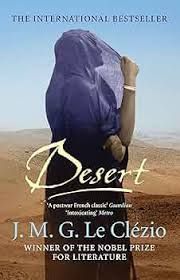
Book (Migration) Review: Desert by J. M. G. Le Clézio, J. M.G. Le Clézio’s Desert is a lyrical, haunting novel that moves between history and myth, exile and belonging, silence and survival. First published in 1980, the novel remains strikingly relevant today for its exploration of colonial violence, cultural erasure, displacement, and the human relationship with land. Written in Le Clézio’s signature poetic prose, Desert resists conventional narrative structure, offering instead a meditation on memory, identity, and endurance.
At once epic and intimate, Desert tells two interwoven stories separated by time but united by spirit: the historical journey of the Saharan nomads led by Ma al-‘Aynayn in their resistance to French colonial forces, and the contemporary story of Lalla, a young girl descended from those same nomads, struggling to survive in a modern world that has no place for her traditions. Through these parallel narratives, Le Clézio constructs a powerful critique of colonial modernity and a profound elegy for cultures pushed to the margins.
Overview of the Novel
Desert unfolds in two alternating narrative strands. The first recounts the forced migration of Saharan nomads in the early twentieth century as they flee French colonial expansion. This section follows Nour, a young boy who witnesses the suffering, starvation, and spiritual resilience of his people. Their journey across the desert is brutal, marked by loss, hunger, and violence, yet sustained by faith, communal bonds, and a deep connection to the land.
The second strand follows Lalla, a young girl living in a shantytown near a North African coastal city many decades later. Orphaned and marginalized, Lalla grows up in poverty, caught between the remnants of nomadic tradition and the alienation of modern urban life. Her eventual journey to Europe exposes her to exploitation, objectification, and cultural dislocation before she ultimately returns to the desert, reclaiming her identity.
Rather than following a linear plot, Desert moves like memory itself—cyclical, fragmented, and rhythmic. Le Clézio prioritizes atmosphere, sensation, and interior experience over action, making the novel as much a poetic meditation as a narrative work.
The Desert as Symbol and Living Presence
The desert in Le Clézio’s novel is not a backdrop; it is a living entity, almost a character in its own right. It represents freedom, continuity, and spiritual depth, standing in stark contrast to the oppressive structures of colonial and modern society.
For the nomads, the desert is home, identity, and sustenance. It is harsh, unforgiving, and dangerous, yet it is also honest and unpossessive. The land does not exploit or deceive; it demands endurance and respect. In contrast, cities—both in North Africa and Europe—are portrayed as spaces of alienation, surveillance, and commodification.
Le Clézio’s desert is also a site of memory. It holds the voices of ancestors, the traces of lost civilizations, and the endurance of a people whose history has been written out of official records. By centering the desert, the novel resists Western narratives that frame such spaces as empty, barren, or backward.
Colonialism and Historical Violence
One of Desert’s most powerful achievements is its portrayal of colonial violence without sensationalism. Le Clézio does not dwell on battles or political rhetoric; instead, he shows colonialism through its consequences—displacement, hunger, illness, and cultural erasure.
The march of the nomads is not heroic in a conventional sense. It is tragic, exhausting, and relentless. The French army appears distant and impersonal, representing a system rather than individual villains. This narrative choice emphasizes how colonial power operates through structures rather than isolated acts of cruelty.
Importantly, Le Clézio restores dignity to the colonized subjects. The nomads are not passive victims; they are portrayed as spiritually resilient, deeply connected to one another and their land. Their resistance may fail militarily, but it endures culturally and symbolically, carried forward through memory and lineage—most notably through Lalla.
Lalla: Identity, Exile, and Resistance
Lalla’s story forms the emotional core of the novel. As a young girl living on the margins of society, she embodies the tension between tradition and modernity. She is poor, uneducated by institutional standards, and largely invisible to the dominant culture. Yet she possesses a powerful inner life shaped by oral stories, intuition, and an unspoken connection to her ancestral past.
When Lalla travels to Europe, her alienation intensifies. She becomes a model, her image consumed and commodified by the fashion industry. This section of the novel delivers a sharp critique of Western capitalism and the objectification of non-Western bodies. Lalla is valued not as a person but as an aesthetic object—exotic, silent, and disposable.
Despite this exploitation, Lalla retains her inner autonomy. Her refusal to fully assimilate becomes an act of resistance. Ultimately, her return to the desert represents not failure but reclamation—a rejection of imposed identities in favor of self-definition.
Language and Narrative Style
Le Clézio’s prose in Desert is spare, rhythmic, and deeply sensory. He favors long, flowing sentences punctuated by moments of stark simplicity. The language mirrors the landscape it describes: expansive, repetitive, and hypnotic.
Dialogue is minimal, reinforcing the novel’s emphasis on silence and interiority. Much of the communication occurs through gesture, memory, and sensation rather than speech. This stylistic choice aligns with the novel’s themes of marginalization and voicelessness while also challenging readers accustomed to dialogue-driven narratives.
Le Clézio’s style may feel demanding to some readers, but it is integral to the novel’s impact. The slow pacing forces readers to inhabit time differently, mirroring the rhythms of nomadic life and resisting the urgency of modern storytelling.
Memory, Orality, and Storytelling
A recurring theme in Desert is the power of oral tradition. Stories passed down through generations preserve identity in the absence of written history. For Lalla, these stories are not entertainment but survival tools, grounding her in a lineage that predates colonial disruption.
Le Clézio positions storytelling as an act of resistance. In a world that seeks to erase or redefine marginalized cultures, remembering becomes political. The novel itself functions as an act of remembrance, reclaiming histories excluded from dominant narratives.
Gender and Power
While Desert is not overtly feminist, its portrayal of Lalla highlights the intersections of gender, colonialism, and economic exploitation. As a young woman, Lalla’s body becomes a site of control—by employers, photographers, and social systems. Yet Le Clézio avoids portraying her as powerless. Her silence is not submission; it is autonomy.
Lalla’s resistance lies in her refusal to internalize the values imposed upon her. She does not aspire to Western success or validation. Her return to the desert, pregnant and alone, signifies continuity rather than defeat—a reclamation of agency through choice.
Modern Relevance of Desert
Despite being written over four decades ago, Desert feels urgently contemporary. Its themes resonate in discussions about:
- Refugees and forced migration
- Cultural displacement and identity loss
- Environmental respect versus exploitation
- Postcolonial memory and historical justice
In an era marked by globalization and ecological crisis, Le Clézio’s reverence for land and critique of materialism feel prophetic. Desert challenges readers to reconsider progress, asking what is lost when speed, profit, and dominance replace balance and belonging.
Strengths of the Novel
One of Desert’s greatest strengths is its moral clarity without didacticism. Le Clézio does not lecture; he invites readers to witness. His empathy for marginalized lives is evident but never sentimental.
The novel’s dual structure is also highly effective. By linking past and present, Le Clézio illustrates how historical trauma reverberates across generations. The past is not concluded; it lives on through memory, land, and bloodlines.
Potential Challenges for Readers
Some readers may find Desert challenging due to its slow pacing, minimal plot, and poetic style. Those seeking conventional narrative tension or resolution may struggle. However, these qualities are intentional and essential to the novel’s thematic depth.
Rather than offering answers, Desert asks readers to sit with ambiguity, loss, and endurance. Its rewards are subtle but lasting.
Conclusion
Desert by J. M. G. Le Clézio is a profound meditation on exile, memory, and the enduring bond between people and land. Through its poetic language and dual narratives, the novel restores dignity to voices often erased by history and challenges modern assumptions about progress and civilization.
It is not a novel to be rushed. It asks for patience, attention, and openness. In return, it offers a deeply moving exploration of what it means to belong—to a place, a culture, and a lineage that refuses to disappear.
Ultimately, Desert reminds readers that survival is not only physical but cultural, and that memory itself can be a form of resistance. It stands as one of Le Clézio’s most powerful works and a landmark novel in postcolonial literature.
**aqua sculpt**
aquasculpt is a premium metabolism-support supplement thoughtfully developed to help promote efficient fat utilization and steadier daily energy.
**prostafense reviews**
ProstAfense is a premium, doctor-crafted supplement formulated to maintain optimal prostate function, enhance urinary performance, and support overall male wellness.
**neuro sharp**
Neuro Sharp is an advanced cognitive support formula designed to help you stay mentally sharp, focused, and confident throughout your day.
You are my inspiration , I possess few web logs and infrequently run out from to post .
Thanks for a marvelous posting! I certainly enjoyed reading it, you happen to be a great author.I will ensure that I bookmark your blog and may come back from now on. I want to encourage continue your great posts, have a nice morning!
Hey, I’ve been checking out 9nbetcom.info. Seems like a solid option for a bit of online entertainment. Maybe good luck will find you if you try out 9nbetcom!