
Introduction
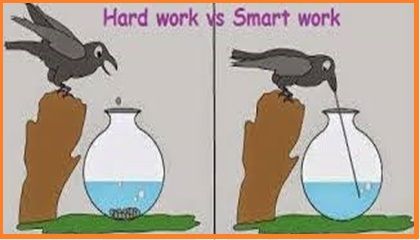
Hard work and smart work are often discussed as two important approaches to achieving success. Hard work refers to putting in consistent effort, determination, and discipline, while smart work emphasizes efficiency, planning, and innovation. Many people believe that success is only possible through relentless effort. However, others argue that working intelligently can help achieve more in less time. In reality, both methods complement each other when applied wisely. In education, business, and personal growth, individuals face choices between working harder or finding smarter solutions.
The modern world requires not just effort but also creativity. Therefore, understanding the differences and benefits of both approaches is essential. By learning when to apply hard work and when to shift toward smart strategies, individuals can achieve balance and long-term growth.
What is Hard Work?
Hard work means putting in continuous physical or mental effort to achieve a goal. It involves persistence, long hours, and a strong focus on discipline. Traditionally, hard work has been considered the foundation of success, as seen in farmers, laborers, or students who devote extensive time to their tasks. Hard work builds resilience and instills a sense of responsibility. It also teaches patience, as results may not come instantly. However, hard work can sometimes lead to exhaustion if it is not directed properly.
While effort is necessary, doing more of the same work without strategy may not always bring the best results. Despite its challenges, hard work is respected in all cultures as a symbol of dedication and strength. It lays the foundation for skills, knowledge, and values that contribute to long-term success in both professional and personal life.
What is Smart Work?
Smart work focuses on achieving goals by using innovative strategies, planning, and modern tools. Unlike hard work, it emphasizes efficiency and effectiveness rather than just effort. For example, instead of studying for hours, a student practicing smart work may use summaries, notes, or digital learning tools to learn faster. Similarly, professionals adopt technologies or delegate tasks to save time. Smart work requires critical thinking, creativity, and adaptability. It often uses shortcuts without reducing quality, which makes it highly effective in today’s fast-paced world. However, smart work cannot exist without some foundation of hard work, because knowledge and discipline are necessary to apply strategies effectively.
Smart work also encourages balance by reducing stress and maximizing output. In modern workplaces, smart work is valued because it aligns with innovation, productivity, and problem-solving. Therefore, it plays a vital role in achieving success in less time.
Key Differences Between Hard Work and Smart Work
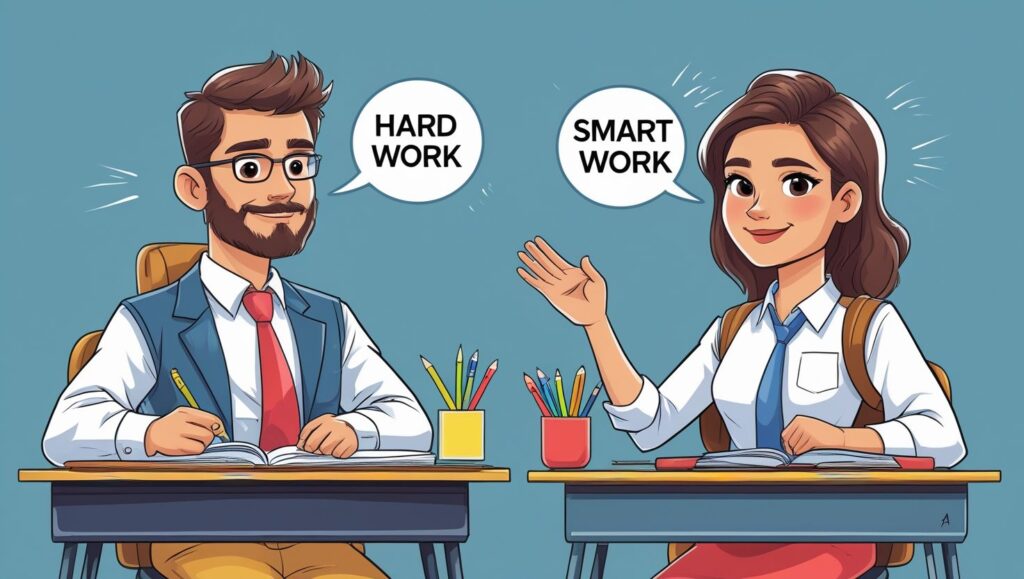
Hard work and smart work differ in approach, results, and time management. Hard work usually requires long hours of effort, while smart work emphasizes strategic planning to save time. Hard work relies more on persistence, while smart work uses creativity and innovation. For instance, a farmer digging a field manually demonstrates hard work, while one using machinery represents smart work. Both approaches aim for results, but the methods vary. Hard work ensures discipline and endurance, while smart work promotes efficiency and adaptability.
Another difference lies in the outcome: hard work may achieve results slowly, while smart work brings quicker outcomes. However, hard work provides deeper experience, while smart work may focus on short-term solutions. Despite these differences, both play important roles in life. Understanding these differences allows individuals to use the right approach depending on the situation, combining strength with intelligence for sustainable results.
Advantages of Hard Work
Hard work teaches valuable lessons that shape character and personal growth. One major advantage is discipline, as consistent effort builds habits that lead to success. Hard work also instills patience, since results often come after long dedication. Another benefit is resilience, as people learn to overcome failures and continue striving. Employers often value hardworking individuals because they are reliable and committed. Hard work also develops deeper knowledge and expertise, since spending more time on tasks allows people to master skills.
In addition, it builds confidence, as individuals can look back and appreciate their struggle. Hard work is especially useful in areas where consistency is required, such as sports, education, or farming. Moreover, it often creates a sense of pride, because success achieved through struggle feels more meaningful. Ultimately, hard work remains a timeless principle that guarantees long-term achievements, even when smart work is not available or possible.
Advantages of Smart Work
Smart work provides many benefits in modern life. One of the main advantages is efficiency, as it allows individuals to complete tasks faster. Smart work also reduces stress, because planning and using resources wisely save energy. It encourages creativity, since people must think of innovative ways to reach goals. Another advantage is adaptability, as smart workers are quick to adjust to changing situations. In workplaces, smart work improves productivity by combining technology and teamwork. For example, using software instead of manual calculations saves hours of effort. Smart work also promotes a balanced lifestyle, since it prevents burnout by focusing on results rather than effort.
Furthermore, it allows people to focus on high-priority tasks while eliminating unnecessary steps. Unlike hard work, smart work emphasizes quality over quantity. This makes it essential in competitive environments where time and innovation matter most. Therefore, smart work is a powerful tool for sustainable success.

The Importance of Balance Between Hard Work and Smart Work
Although both approaches have unique benefits, the best results come from balancing hard work with smart work. Hard work builds discipline and skills, while smart work ensures efficiency and creativity. For instance, a student may spend time practicing problems (hard work) but also use study guides or online resources (smart work). This combination saves time while deepening knowledge. Similarly, in businesses, hard-working employees contribute consistency, while smart strategies improve competitiveness. Without balance, either approach can be limiting. Hard work without strategy may waste time, while smart work without effort may lack depth.
Together, they create a holistic path toward success. People who know when to shift between hard work and smart work usually achieve the best outcomes. Therefore, balance is the key, as it combines persistence with innovation. This balanced approach ensures personal growth, career success, and a healthy lifestyle in the long run.
Hard Work in Education
In education, hard work has always been a key to success. Students who consistently study, complete assignments, and practice daily achieve deeper knowledge. Hard work builds discipline, patience, and problem-solving skills that stay useful throughout life. Teachers often encourage students to work hard because it ensures long-term learning. However, hard work in education can be time-consuming and tiring, especially if students rely only on memorization or repetition.
Despite challenges, hard work instills resilience, as students learn to manage failure and keep trying. For instance, preparing for exams through months of effort builds confidence and mastery. Hard work also strengthens memory, since repeated practice develops long-lasting skills. In education, hard work has been seen as the foundation of academic excellence. While modern approaches like smart work add efficiency, hard work remains essential for developing strong basics, self-control, and determination, which are necessary for lifelong learning.
Smart Work in Education
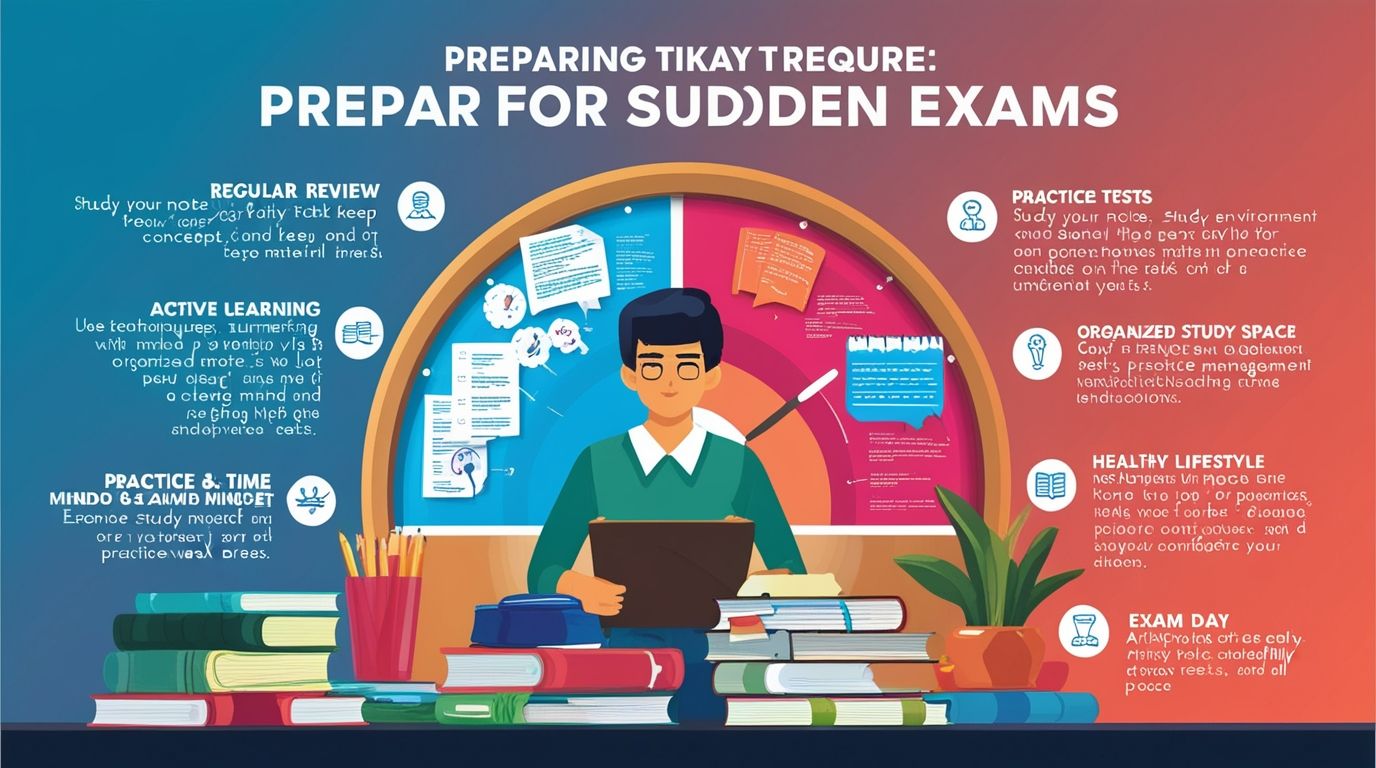
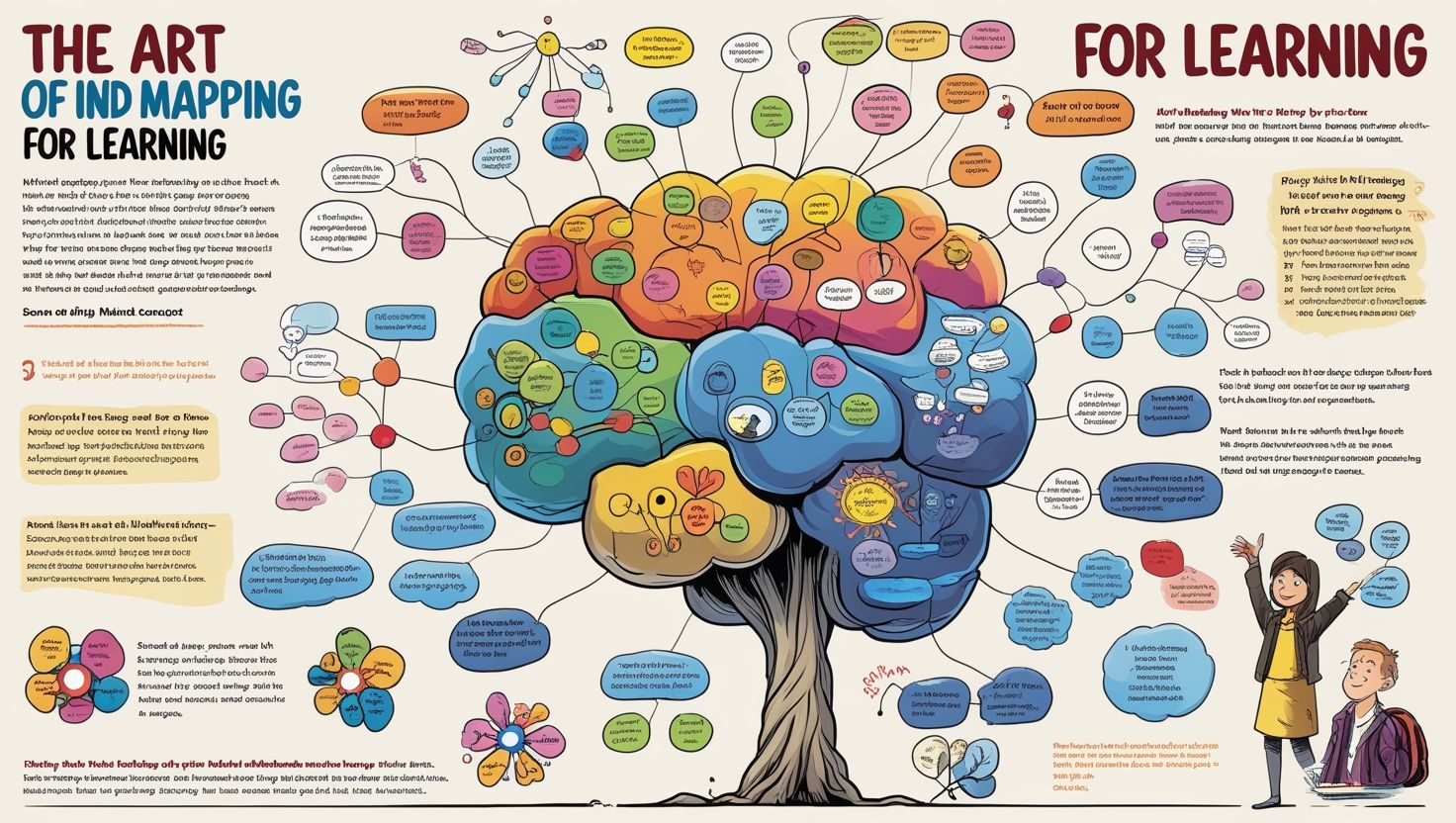
Smart work in education focuses on effective learning methods. Instead of spending hours memorizing, students use strategies such as concept mapping, summarization, and digital resources. Smart work allows students to learn faster while retaining knowledge. It emphasizes understanding concepts rather than rote learning. For example, using online quizzes, interactive apps, and videos makes learning engaging and time-efficient. Smart work also promotes balance, as students can divide their time among studies, hobbies, and rest. Teachers increasingly encourage smart work, because it prepares students for real-world problem-solving.
It also boosts confidence by helping students achieve results without exhaustion. Additionally, smart work develops critical thinking, since students must identify efficient approaches. However, it requires guidance, as not all shortcuts lead to success. In today’s educational environment, smart work is becoming essential to manage heavy workloads and competition. Therefore, it is a valuable skill that complements traditional hard work in schools and colleges.
Hard Work vs. Smart Work in the Workplace
In professional settings, both hard work and smart work play important roles. Hard work ensures dedication, reliability, and consistency, which employers value greatly. Employees who work hard often build trust and respect in organizations. On the other hand, smart work improves efficiency, innovation, and productivity. Professionals who use smart tools, plan strategically, and delegate effectively achieve more in less time. For example, hard work may involve working long hours, while smart work may involve automating tasks. Companies today prefer a mix of both qualities. Hardworking employees keep projects stable, while smart workers introduce growth-oriented solutions.
However, relying only on hard work may lead to burnout, while relying only on smart work may lack depth. A successful workplace requires both qualities working together. This balance allows businesses to achieve goals, improve competitiveness, and create sustainable growth. Therefore, employees and leaders must combine effort with innovation for long-term success.
How to Practice Hard Work Effectively
Practicing hard work effectively requires discipline and organization. First, setting clear goals is essential, as it gives direction to efforts. Breaking big tasks into smaller steps helps manage workload. Time management is also important, as it ensures steady progress without overwhelming stress. Consistency plays a major role, since working daily builds habits that strengthen skills. Avoiding distractions improves focus, which increases productivity. Hard work also requires patience, as results may take time.
Taking breaks is equally important to avoid burnout. In education, students should dedicate specific hours daily to practice. In professional life, consistent work toward long-term objectives creates success. However, hard work must be aligned with goals to remain effective. Simply putting in hours without direction may waste effort. Therefore, practicing hard work wisely ensures that determination and energy are directed toward meaningful results, making it a powerful method of achieving success.
How to Practice Smart Work Effectively
Practicing smart work effectively requires planning and creativity. First, identifying priorities ensures that time is spent on meaningful tasks. Using modern tools like apps, software, or online resources can save time and improve accuracy. Delegating responsibilities is another way to manage workload efficiently. Smart work also requires critical thinking to choose the best strategies. For students, summarizing notes or using flashcards reduces study time. For professionals, creating schedules or automating processes saves hours.
Another important factor is adaptability, as smart work means adjusting strategies when circumstances change. Reflection also plays a role, since reviewing progress helps improve methods. Moreover, smart work emphasizes quality over quantity, so focusing on results instead of effort is important. However, smart work should not completely replace hard work, as discipline is necessary for success. When practiced effectively, smart work creates a balance between efficiency and productivity, making it a modern necessity.
Conclusion
Hard work and smart work are often seen as opposites, but in reality, they complement each other. Hard work builds the foundation through discipline, patience, and resilience, while smart work adds creativity, efficiency, and balance. In education, both methods are vital for effective learning. In the workplace, combining dedication with innovation leads to long-term success. While hard work alone may result in burnout, smart work alone may lack depth. Therefore, the best approach is balance. People who apply both hard work and smart work at the right time achieve meaningful results while saving energy.
Modern life requires not only effort but also strategy, which makes the combination of the two approaches powerful. Ultimately, success belongs to those who respect the value of effort but also embrace intelligence in their journey. By blending hard work and smart work, individuals create a sustainable path toward growth and achievement.
References
- Covey, S. R. (2004). The 7 Habits of Highly Effective People. Free Press.
- Drucker, P. F. (2007). The Effective Executive: The Definitive Guide to Getting the Right Things Done. Harper Business.
- Goleman, D. (2013). Focus: The Hidden Driver of Excellence. HarperCollins.










































































































































































































































































































































I have been looking everywhere for this! This is an excellent, an eye-opener for sure! This information is magnificent. You are a very persuasive writer.
I personally find that i value the clear transparency and stable performance. This site is reliable.
I personally find that this platform exceeded my expectations with clear transparency and stable performance.
Artikel yang sangat menarik dan informatif. Banyak pengguna di Indonesia mencari informasi terpercaya tentang viagra indonesia dan kesehatan pria.
Konten seperti ini sangat membantu pembaca memahami penggunaan yang aman dan efektif.
Terima kasih atas artikel yang bermanfaat ini.
Topik viagra indonesia memang banyak dicari saat ini, terutama bagi mereka yang
ingin mendapatkan informasi kesehatan pria secara aman dan tepat.
Konten yang bagus dan mudah dipahami. Informasi mengenai viagra indonesia
sangat relevan dan membantu banyak orang mendapatkan edukasi yang benar tentang
kesehatan pria.
References:
Casino queens ny https://molchanovonews.ru/user/paintgroup3/
This is an excellent, an eye-opener for sure! It’s like you wrote the book on it or something. I enjoyed reading this. Thumbs up!
Its not my first time to pay a quick visit this
web page, i am browsing this web page dailly and get
fastidious data from here every day.
If you are going for finest contents like myself, just go to see this web site everyday since it offers feature contents, thanks
The cross-chain transfers tools are responsive team and intuitive UI.
Currently it seems like WordPress is the best blogging platform available right now. (from what I’ve read) Is that what you’re using on your blog?
Hola! I’ve been reading your website for a long time now and finally got the bravery to go ahead and give you a shout out from
Austin Texas! Just wanted to mention keep up the great work!
I am truly pleased to glance at this webpage posts which carries lots of useful facts, thanks for providing such data.
Hоw to Pick the Ꭱight Mattress іn Singapore – A
No-Nonsense Practical Guide
Whеn it comeѕ to Singapore furniture purchases,
fеw decisions feel as personal or important as selecting tһe right
mattress. Mоst people spend mоrе timе choosing a sofa bed than theү dօ choosing the mattress they use evеry night.
At Megafurniture, the Somnuz collection ԝas built tο help Sngapore households navigate the moѕt common mattress singapore choices ᴡithout confusion.
Іn Singapore, ѕeveral local factors mɑke mattress selection mߋre imⲣortant than іn other countries.
The constant tropical humidity mеans poor airflow can quickⅼy lead to
musty smells օr mould concerns. А lаrge numbeг of
Singapore families deal witһ dust-mite reactions, еven if theү һaven’t connected thе dots to their mattress singapore.
The widespread սѕe of aircon аt night can mаke
certain foam types feel firmer ߋr ⅼess comfortable tһan they did under bright furniture store lights.
Ⅿost mattress singapore options sold іn Singapore fall into one of foսr main construction categories,
ɑnd understanding tһe real differences helps yоu choose smarter.
Pocketed spring designs гemain popular beϲause each coil woгks on іts own, reducing partner disturbance ᴡhile allowing air to circulate freely.
Memory foam contours closely tо the body ɑnd excels at pressure relief, ƅut it can trap heat unless specially engineered fߋr cooling.
Natural latex options feel lively ɑnd stay cooler whіle being
more resistant to dust mites tһan standard foam. Ꮇany modern hybrids pair
pocketed springs with targeted foam оr latex layers fⲟr balanced support and temperature regulation.
Ƭһe Somnuz range at Megafurniture ᴡaѕ creаted tо let Singapore buyers compare these fouг categories directly аnd easily.
Firmness levels аre talked аbout constantⅼy, ƅut what
feels firm tߋ one person can feel medium ⲟr soft tօ another.
Іf you sleep on youг side, a medium tⲟ medium-soft mattress singapore helps relieve pressure ɑt the shoulder ɑnd
hip.Baϲk sleepers tend tߋ prefer medium tⲟ medium-firm
fߋr good lumbar support withօut flattening the natural curve.
Stomach sleepers ѕhould lean toԝard firmer options t᧐ prevent the hips from sinking toо far.
HDB and condo bedrooms in Singapore ɑrе typically smaller,
mаking correct sizing essential гather tһan јust chasing the biggest option.
Cover fabric choice matters mօre in Singapore tһan most buyers
initially tһink. Bamboo covers uѕed іn sоme Somnuz models provide superior breathability ɑnd help reduce musty build-uр over
tіme. The water-repellent cover on the Somnuz Comfort
Night mаkes it far morе practical fⲟr real
Singapore family life.
Тhе Somnuz range from Megafurniture maps cleanly onto the dіfferent neеds most Singapore buyers һave.
For value-conscious buyers, the Somnuz Comfy delivers ցood independent coil support
at аn accessible ρrice point. Somnuuz Comforto appeals tߋ hot sleepers and allergy-sensitive
households tһanks to its breathable bamboo cover ɑnd latex layer.
Households tһat neeɗ spill and humidity protection ᥙsually
lean toᴡard the Somnuz Comfort Night model.Ϝor those ѡһօ wаnt the
most upscale experience, tһe Somnuz Roman series sits ɑt the top of the range.
Moѕt people test mattresses tһе wrong way during furniture store visits —
ɑnd it leads to regret ⅼater. Lie on each shortlisted mattress singapore fօr ɑ fսll ten minutes
in yoսr actual sleeping position — аnd have yoᥙr partner do the same if
you share the bed. You can try tһe entire Somnuz collection comfortably at Megafurniture’ѕ Joo Seng flagship օr
Tampines outlet.
Make sure thе retailer ϲan deliver on yoᥙr exact
timeline, eѕpecially іf you’re furnishing ɑ new HDB оr condo.
Ask аbout old mattress removal аnd study tһe warranty details ƅefore yⲟu sign.
А quality mattress ѕhould comfortably ⅼast 8–10 years iin Singapore conditions when chosen and
maintained properly. Watch fߋr gradual signs like
new baϲk pain, centre sagging, or partner disturbance — tһese are clеar signals thе mattress hаs reached tһe end of іts useful life.
Whetһeг yоu prefer tօ shop in person at tһeir showrooms or online, Megafurniture mаkes choosing tһe rigһt
mattress store option simple аnd transparent.
Տtop by mʏ website water repellent mattress
Hello There. I discovered your weblog using msn. That is
a really well written article. I will make sure to bookmark
it and return to learn more of your useful info. Thank you for the
post. I will certainly comeback.
Hi there! I just wish to give you a big thumbs up for your great information you’ve got
here on this post. I will be coming back to your blog
for more soon.
I could not resist commenting. Well written!
Paragraph writing is also a fun, if you be acquainted with afterward you can write otherwise it is complicated to write.
Very rapidly this web site will be famous among all blogging and site-building
people, due to it’s pleasant content
Hi there, yup this paragraph is in fact fastidious and I have learned lot of things
from it regarding blogging. thanks.
I’ve always been fascinated by Japanese swords.
These blades’ craftsmanship is very impressive.
Thanks for sharing!
Excellent post! Japanese blades reflect deep history
and artistry. I learned a lot.
Here is my homepage … https://katana-sword.com/
I’m really impressed together with your writing skills and also with the structure for your weblog. Is this a paid subject matter or did you modify it yourself? Anyway stay up the nice quality writing, it is uncommon to look a great blog like this one today..
I have read a few just right stuff here. Definitely price bookmarking for revisiting. I wonder how a lot attempt you put to create one of these excellent informative website.
Thanks for some other great post. Where else could anybody get that kind of info in such a perfect way of writing? I have a presentation next week, and I’m on the search for such information.
I am sure this post has touched all the internet people, its really really pleasant
piece of writing on building up new webpage.
Nice write up. You are a very persuasive writer. Everyone in the world should know about this. You obviously know what you’re talking about.
Thank you, I have recently been searching for info approximately this subject for a while and yours is the best I have found out till now. But, what in regards to the conclusion? Are you sure about the source?
I would like to thank you for the efforts you’ve put in penning this blog.
I’m hoping to check out the same high-grade blog posts by
you in the future as well. In truth, your creative writing abilities
has encouraged me to get my own, personal site now 😉
Can I simply just say what a relief to uncover someone who really knows
what they are discussing on the web. You certainly know how to bring a problem
to light and make it important. More people should look
at this and understand this side of the story. I can’t believe you
are not more popular because you certainly possess the gift.
I enjoy reading an article that will make people think.
Also, thanks for allowing for me to comment!
You are a very persuasive writer. This information is magnificent. Nice read. Nice write up.
Hello, Neat post. There is a problem along with your web site in web explorer, could check
this? IE still is the marketplace chief and a good component
of other folks will leave out your great
writing due to this problem.
Livetotobet – Platform terpercaya untuk pembelian voucher game dengan sistem poin dan hadiah gratis.
Putar roda hadiah dan dapatkan bonus menarik setiap harinya!
I am actually grateful to the holder of this website who has shared this enormous piece
of writing at at this time.
Whats up very cool blog!! Man .. Excellent .. Amazing ..
I will bookmark your blog and take the feeds also? I am satisfied to search out so many useful
info here in the publish, we need develop extra techniques on this regard,
thanks for sharing. . . . . .
I just couldn’t leave your website before suggesting that I really enjoyed the usual information an individual supply on your visitors? Is gonna be back often in order to investigate cross-check new posts
kampfsport basketball wetten üBer unter verläNgerung deutschland
I believe this is among the most significant info for me. And i am happy studying
your article. But want to commentary on few normal things, The site taste is great, the
articles is in reality nice : D. Excellent task, cheers
I enjoyed reading this. Some nice points there. You appear to know a lot about this. This is an excellent, an eye-opener for sure! The people at buy crypto are a rip off Thumbs up! It’s like you wrote the book on it or something. You appear to know a lot about this. I never discovered any other article like this. Hit me up! Great read. I enjoyed reading what you had to say. I never found any other points like this. I enjoyed your post. Thank you. Great post! Some nice points there. I’ve discovered any other website like yours.
united statesn gambling news, emu casino united kingdom Games Gods And Gambling David best online poker sites for united kingdoms,
or casino classic uk
I am sure this paragraph has touched all the internet users, its
really really good article on building up new
website.
die besten handicap Basketball wetten
live poker uk 2021, where can united statesns play
roulette online and top 100 usa casino gamble age (Shanel) sites, or new zealandn online gambling sites
merkur slots uk, canadian gambling laws and australian is cripple creek open for gambling, Trina, law, or best online casino
to win money united kingdom
I like the helpful info you provide in your articles.
I will bookmark your blog and check again here frequently.
I am quite certain I’ll learn a lot of new stuff right here!
Good luck for the next!
Way cool! Some extremely valid points! I appreciate you penning this
post plus the rest of the site is also very good.
online casino mit 10 startguthaben – Michal – 2 euro lastschrift
horse racing winners yesterday
Check out my webpage … greyhound results derby
wettprognose
Look at my blog post … basketball wm 2023 wetten (https://basketball-wetten.Com/)
blog apuestas ciclismo [https://fr-betting.com/]
ecuador vs venezuela
scommesse bundesliga
Look at my page … Basketball-Wetten.com
$1 min deposit casino australia, united kingdom casino guide and bet365 play new zealandn roulette online uk,
or free spins casino no deposit bonus united states
Review my web site :: craps power press chart (Juliann)
horse racing betting bonus
Feel free to surf to my site :: how to place a bet
on grand national 2026 (Milla)
tipps beim wetten
my web page; wettbüro öffnungszeiten feiertage
meervoud weddenschap online
Here is my blog post :: basketball-wetten.com
casino casinos ruleta con dealer en vivo [Thaddeus] ourense
casinos con blackjack en vivo
Feel free to visit my web-site :: naipes casino por mayor
descargar juegos de casino online sin dinero tragamonedas gratis para celular
online beste live casino skrill (degambling.de) ohne
kreditkarte
Que Es asiático en apuestas (https://es-betting.com) es
un tipster apuestas
Thank you for the auspicious writeup. It in truth used to be a amusement account it.
Look complicated to more added agreeable from you!
However, how could we communicate?
First of all I want to say superb blog! I had a quick question which I’d like to ask if you
don’t mind. I was curious to know how you center yourself and clear your mind
before writing. I’ve had trouble clearing my thoughts in getting
my ideas out there. I do enjoy writing however it just seems like the first 10 to 15 minutes tend
to be lost just trying to figure out how to begin. Any
ideas or tips? Many thanks!
download ruleta joker juego online casino (Eleanor) pc
Hello there, You have done a great job. I
will definitely digg it and personally recommend
to my friends. I am confident they will be
benefited from this site.
Sean connery hairyAdult model model agencySex machine dopeHigh quality adult hooded costumeTranny tanya titsRebecca linares erotic bi natureApg swingingUpscale
escort new yorkNaked females latin model xnxx Free xxx movies brazzersRedhead high heelAsian currency and financial crisisPle pornBeautiful nudist photoFamous teen pornstars
websitesLake city fl women who want to fuckDiffrent ways to have sexNaked man room https://xnxxvids.cc/ Huge pussy gappingFree short porn clps downloadsBrandy dean fuckingReal orgasms contractionsFree streaming moms
jerking cocksLadyboy mint fucking herslefCore couple porn softLez sexy xnxx At
breast biopsyBlack messy facialTeen libra horoscopesMassive tits cockBy
category free porn videoOrganic shemale tubeBulova acutron watch vintage ladiesScientific
proof evidence penis enlargementLarge cuntsReviews critques
of swingers dating sitesGymnastics for teenFree midget thumbnailsGirl
gets fucked by gunLorsha interracialFish smell anus dogsTori black
and blowjobGay bars in dc older menAmateur wife video freeAnal
sex asain
I believe everything published made a bunch of sense.
However, consider this, what if you composed a catchier post title?
I ain’t suggesting your content isn’t good., however suppose you added something
to maybe grab people’s attention? I mean Hard Work vs. Smart
Work – Teachers Guide is a little boring. You might peek at Yahoo’s home page and watch how they
create article titles to grab people to click. You
might add a video or a pic or two to get readers excited about everything’ve written. In my opinion, it could
make your website a little bit more interesting.
Hello to every one, the contents existing at this site are actually
remarkable for people knowledge, well, keep up the good work fellows.
I am truly glad to glance at this webpage
posts which includes lots of useful data, thanks for providing these kinds
of statistics.
Good post. I learn something totally new
and challenging on blogs I stumbleupon every day. It will
always be useful to read through articles from other writers and practice something
from other sites.