
Abstract
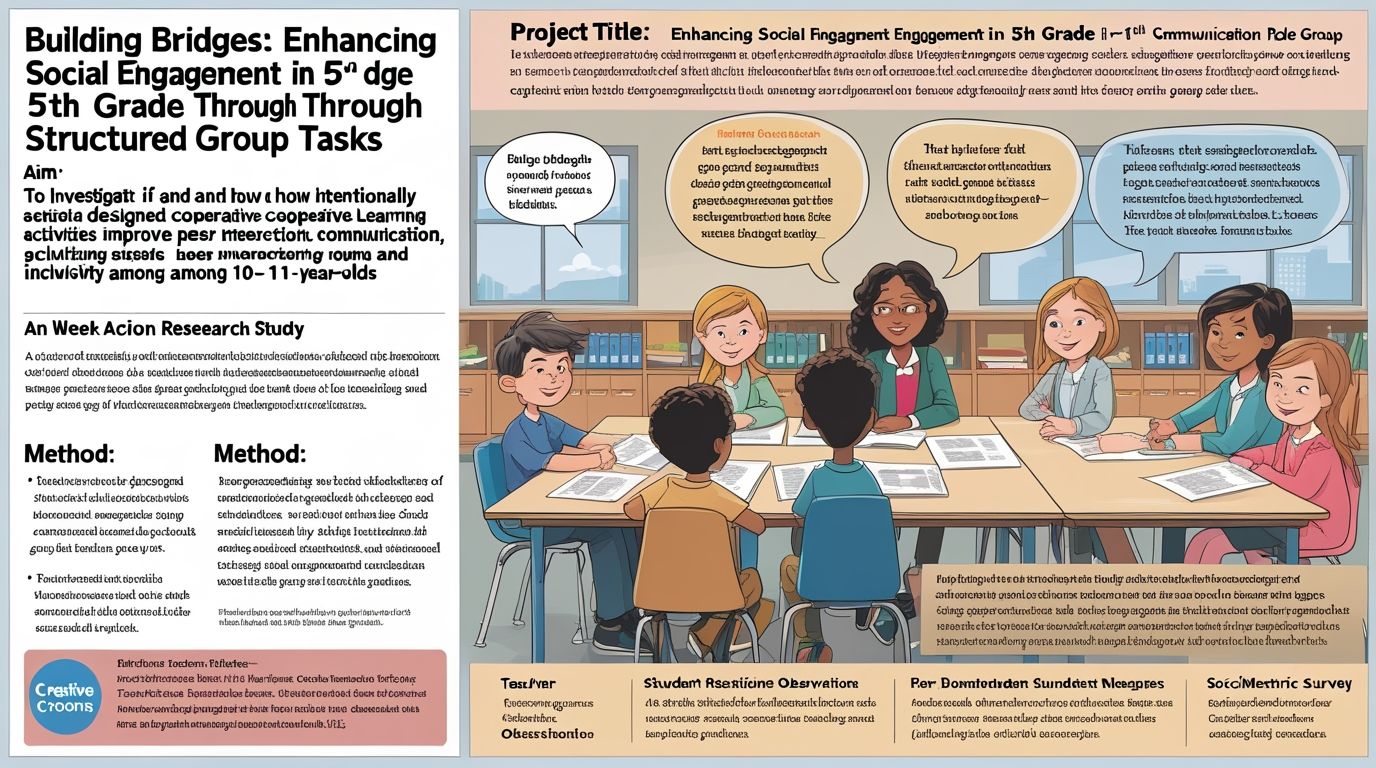
Enhancing Social Engagement a Research Project, This research project investigates the effectiveness of structured group tasks in enhancing social engagement among fifth-grade students (aged 10-11). Recognising the critical role of social-emotional development in middle childhood, the study aims to design, implement, and evaluate a series of collaborative classroom activities. Through a mixed-methods approach combining teacher observation, student surveys, and sociometric analysis, the project will assess changes in prosocial behaviours, communication skills, and inclusive peer interactions. The findings are expected to contribute practical strategies for educators to foster cooperative learning environments that support both academic and social development.
1. Introduction: The Context and Significance
The fifth-grade year represents a pivotal transition in childhood development. Students are navigating increasing academic demands while simultaneously deepening their social awareness and peer relationships. Social engagement—the meaningful participation and interaction with peers—is not merely a “soft skill” but a foundational component of cognitive development, emotional well-being, and academic success. However, modern classrooms often face challenges like social fragmentation, cliques, digital distraction, and varying levels of social confidence among students.
Group tasks, when strategically designed, move beyond simple seat clustering. They can be powerful pedagogical tools to cultivate essential 21st-century skills: collaboration, communication, critical thinking, and empathy. This research project posits that intentionally structured group tasks, underpinned by cooperative learning principles, can significantly enhance the quality and depth of social engagement in a fifth-grade classroom. The goal is to create an inclusive environment where every student feels valued, heard, and motivated to contribute to a shared goal.
Research Question: How do structured, interdependent group tasks impact the level and quality of social engagement among fifth-grade students?
Primary Objective: To design and implement a series of group-based learning modules and measure their effect on students’ prosocial behaviours, peer relationships, and perceptions of teamwork.
2. Literature Review
2.1 The Importance of Social Engagement in Middle Childhood
Developmental psychologists (e.g., Erikson, Selman) identify ages 10-12 as a stage where peer approval and friendship become central. Positive social engagement at this stage is linked to higher self-esteem, better academic performance, and lower levels of anxiety and loneliness. It fosters a sense of belonging, which is a key protective factor for mental health.
2.2 Theoretical Frameworks for Collaborative Learning
- Vygotsky’s Sociocultural Theory: Learning is a social process; knowledge is constructed through interaction with more capable peers within the Zone of Proximal Development.
- Johnson & Johnson’s Cooperative Learning Model: Emphasises positive interdependence, individual accountability, face-to-face promotive interaction, social skills, and group processing. This model moves beyond “group work” to “cooperative learning,” where success is impossible without the contribution of each member.
- Slavin’s Student Team Learning: Highlights team goals and team success, which are achieved only when all members have learned the material.
2.3 Key Elements of Effective Group Tasks
Research indicates that successful group tasks for this age group should be:
- Interdependent: The task requires pooling resources, ideas, and efforts.
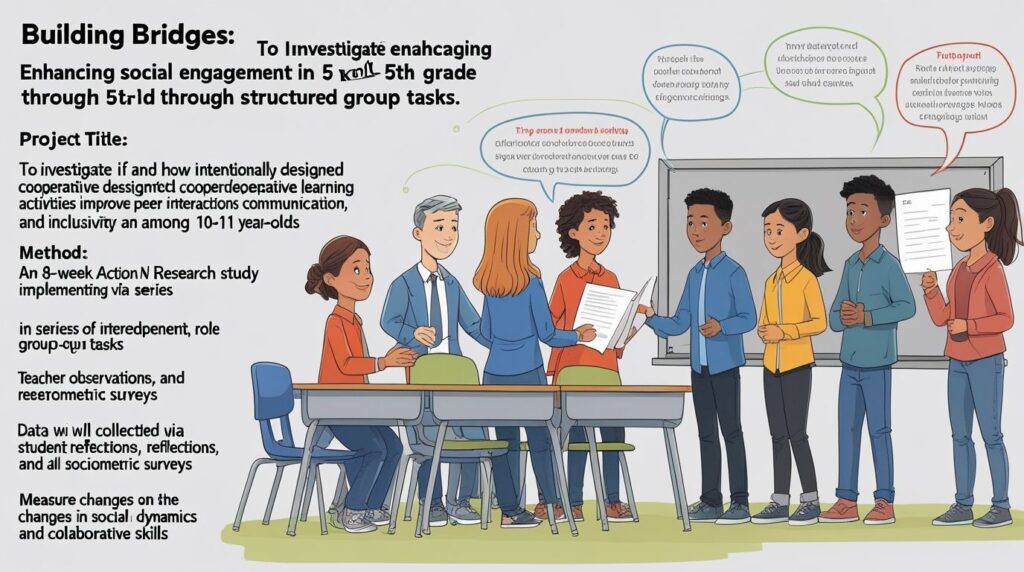
- Structured with Clear Roles: Roles (e.g., facilitator, recorder, materials manager, reporter) ensure active participation and prevent dominance by a few.
- Open-Ended and Challenging: Tasks should be complex enough to necessitate discussion and multiple perspectives, not just divisible into separate parts.
- Reflective: Includes time for “group processing” where students discuss how well they worked together.
2.4 Gaps in Existing Practice
Common pitfalls include poorly defined tasks, “free-riding” by some members, and a lack of explicit instruction in social skills. This project seeks to address these by embedding social skill instruction directly into the task design.
3. Methodology
3.1 Participants
A single class of approximately 25-30 fifth-grade students (aged 10-11) and their teacher. Parental consent and student assent will be obtained.
3.2 Research Design
A mixed-methods, action research model will be employed, conducted over one academic term (8-10 weeks). The design includes:
- Pre-Intervention Phase (Weeks 1-2): Baseline data collection.
- Intervention Phase (Weeks 3-7): Implementation of six structured group tasks.
- Post-Intervention Phase (Week 8): Data collection and analysis.
3.3 The Intervention: Design of Group Tasks
Six 90-minute group tasks will be developed, integrated into the standard curriculum (Science, Social Studies, Language Arts). Each task will follow a consistent structure:
- Social Skill Mini-Lesson (10 mins): Explicit teaching of one skill (e.g., active listening, constructive disagreement, encouraging others, managing time).
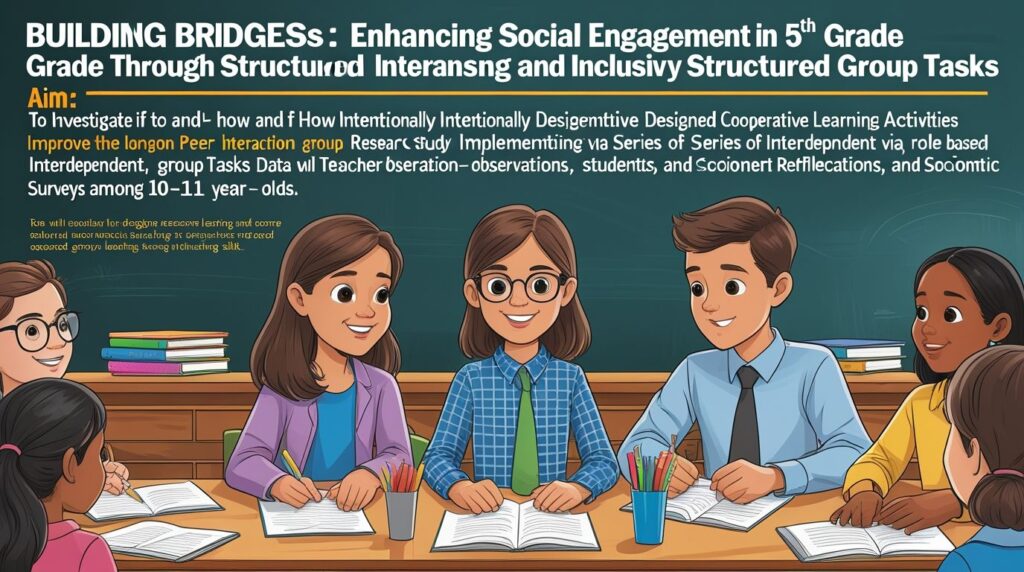
- Task Introduction & Role Assignment (10 mins): Clear explanation of the goal, materials, and individual roles. Groups of 4-5 will be strategically formed by the teacher to ensure diversity (mixed ability, gender, social circles).
- Collaborative Work Time (45 mins): Students work on the interdependent task.
- Creation of Group Product (15 mins): Teams prepare their output (poster, presentation, model, report).
- Group Processing & Reflection (10 mins): Guided discussion using prompts: “What did our group do well?” “What was challenging?” “How can we improve next time?”
Sample Tasks:
- Science: “Design a Sustainable City” – Groups create a model city balancing ecological and human needs (interdependence: zoning, transportation, energy).
- Social Studies: “Historical News Broadcast” – Groups research and present a key event as a news team (roles: anchor, researcher, on-scene reporter).
- Language Arts: “Mystery Story Circle” – Each group writes a story where each member contributes a section following a plot structure, building on the previous author’s work.
3.4 Data Collection Tools
- Sociometric Surveys: A pre- and post-intervention “Peer Nominations” survey to map changes in friendship patterns, perceived helpfulness, and inclusivity.
- Structured Teacher Observation Checklist: The teacher will use a rubric during each task to rate group dynamics on criteria like turn-taking, equitable participation, use of encouraging language, and conflict resolution.
- Student Self-Reflection Journals: Simple, age-appropriate prompts after each task (e.g., “I contributed by…”, “I felt proud when my group…”, “Next time, I will try to…”).
- Focus Group Interviews (Post-Intervention): Small, mixed-group discussions to gather qualitative insights on their experiences, challenges, and perceived changes.
- Analysis of Group Products: Assessing not just academic content but evidence of collaboration in the work (e.g., integrated ideas, cohesive style).
3.5 Ethical Considerations
- Confidentiality will be maintained; students will be assigned codes for data.
- The focus is on observing group dynamics, not evaluating individual deficits.
- The teacher/researcher will be vigilant to mediate any significant conflict and ensure a psychologically safe environment.
- Participation in data collection is voluntary.
4. Implementation Plan for Weeks
1-2: Preparation & Baseline
- Obtain permissions, explain the project to students as “becoming better teammates.”
- Administer pre-intervention sociometric survey.
- Teacher observes normal classroom social interactions for baseline.
3-7: Intervention Cycle
- Session 1: Task 1 – Focus skill: Active Listening.
- Session 2: Task 2 – Focus skill: Giving Encouragement.
- Session 3: Task 3 – Focus skill: Managing Disagreements.
- Session 4: Task 4 – Focus skill: Ensuring Everyone Contributes.
- Session 5: Task 5 – Focus skill: Time Management.
- Session 6: Task 6 – Focus skill: Integrated Application (no new skill, using all previously learned).
8: Post-Intervention & Analysis
- Administer post-intervention sociometric survey.
- Conduct focus group interviews.
- Collect and analyse all journals, observation checklists, and products.
- Hold a class celebration to acknowledge growth and share general findings.
5. Expected Outcomes and Analysis
5.1 Quantitative Analysis
- Compare pre- and post-sociometric data to identify shifts in peer networks (e.g., increased cross-group nominations).
- Aggregate teacher observation scores to plot a trend line of improved group process skills.
- Use descriptive statistics (means, frequencies) to present findings.
5.2 Qualitative Analysis
- Thematic analysis of student journals and focus group transcripts to identify common themes: increased confidence, enjoyment of collaboration, strategies for inclusion, and frustrations overcome.
- Triangulate data from all sources to build a rich, coherent picture of change.
5.3 Anticipated Results
It is hypothesised that the intervention will lead to:
- A measurable increase in positive peer interactions and a more inclusive classroom social landscape.
- Improved student self-reported comfort and efficacy in group settings.
- Enhanced quality of group products, demonstrating deeper integrative thinking.
- Teacher-reported reduction in social management issues and increased student initiative in helping peers.
6. Discussion and Implications
6.1 Interpreting the Results
Success will not be measured by the absence of conflict, but by the development of constructive strategies to manage it. The research expects to demonstrate that social skills, like academic skills, can be taught, practised, and refined through deliberate design.
6.2 Practical Implications for Educators
- A Blueprint for Task Design: The project will yield a replicable template for creating interdependent group tasks across subjects.
- The Role of Explicit Social Instruction: Highlights the necessity of dedicating time to teach collaboration explicitly, not assuming it is innate.
- Strategic Group Formation: Reinforces the value of teacher-formed, heterogeneous groups to break down social barriers.
6.3 Limitations
- The small sample size limits generalisability.
- The Hawthorne Effect may be present, as students know they are part of a project.
- The short duration may not indicate long-term behavioural change.
6.4 Recommendations for Future Research
- A longitudinal study tracking the same students into sixth grade.
- A comparative study between classes using structured vs. unstructured group work.
- Investigating the specific impact on shy or socially withdrawn students.
7. Conclusion
Fostering social engagement is not a diversion from the academic curriculum but a vital pathway through which deeper learning occurs. This research project underscores the potential of carefully crafted group tasks to transform a fifth-grade classroom into a dynamic community of learners. By building positive interdependence and explicitly teaching the arts of collaboration, educators can equip students with the relational competencies essential for success in school and beyond. The ultimate goal is to nurture not only more knowledgeable students, but also more empathetic, communicative, and engaged citizens.
Appendices (Proposed)
- Appendix A: Sample Lesson Plan for a Group Task
- Appendix B: Teacher Observation Checklist Rubric
- Appendix C: Student Self-Reflection Journal Template
- Appendix D: Pre/Post Sociometric Survey Sample
References
(Key references would include works by Vygotsky, Johnson & Johnson, Slavin, as well as recent studies from journals like Child Development, Journal of Educational Psychology, and The Elementary School Journal.)
Insgesamt hat Scorsese mehr als 60 Filme gedreht und seine Arbeit wird
auch in Zukunft die Filmindustrie beeinflussen. Nach seinem Studium
an der New York University begann er seine Karriere als Regieassistent und drehte seinen ersten Spielfilm
„Who’s That Knocking at My Door“ im Jahr
1967. Der Film zeigt auch die dunklen Seiten des Glücksspiels, wie
Korruption, Geldwäsche und Betrug.
Die Verquickung unterschiedlicher Neurosen und Abhängigkeiten, die dieses Trio unaufhaltsam in den Abgrund ziehen, ist von beinahe Shakespearschen Dimensionen. Die
Wiederaufnahme der Gangsterthematik und Variation auf GoodFellas basiert wie der Vorgängerfilm auf einem Tatsachenbericht des
Mafia-Rechercheurs Nicholas Pileggi, setzt dessen intime Milieubeschreibung aber noch
rasanter und den Figuren gegenüber distanzierter um. Aufstieg und Fall eines
Casino-Managers und seines Jugendfreundes im mafiabeherrschten Las Vegas der siebziger Jahre.
Stone überzeugt als geldgieriges Miststück, das im Grunde
nur glücklich sein will, sich dabei aber größtenteils selbst im Weg steht und mit
Vollgas auf den Abgrund zurast. Sein Zusammenspiel mit dem erneut außergewöhnlichen Joe Pesci („JFK“, „Lethal
Weapon“) ist perfekt.
References:
https://online-spielhallen.de/888-casino-erfahrungen-ein-umfassender-uberblick/