

Introduction
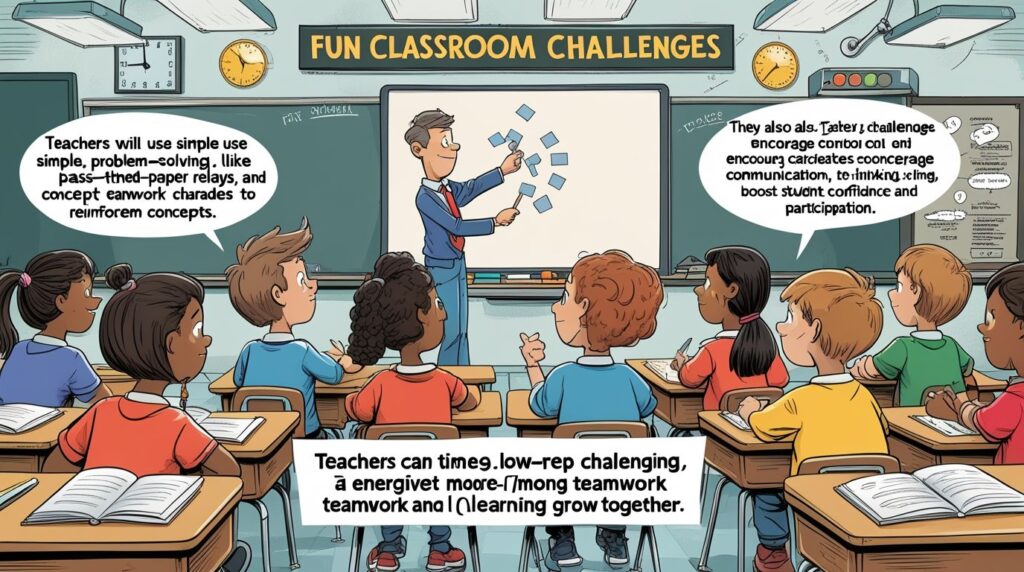
Fun Classroom Challenges of Lesson Concepts, Teachers often search for quick activities that build teamwork and reinforce learning at the same time. Interestingly, students learn better when they work together. They communicate more. They think more. They help each other. Therefore, fun and low-prep classroom challenges play an important role in making lessons engaging. These activities bring energy into the classroom and strengthen concepts without long preparation. Moreover, they help students solve problems creatively. They also develop confidence. This article explores a wide range of low-prep challenges teachers can use anytime. It also explains how these challenges encourage teamwork and support lesson goals.
1. The 60-Second Solve Challenge
The 60-Second Solve Challenge is a fast and exciting task. Teams receive a set of small questions linked to the lesson. These may include math problems, grammar corrections, science facts, or vocabulary. Each team works together to solve as many as possible within one minute. The short time creates excitement. Students communicate quickly. They divide tasks. They check each other’s thinking. Therefore, teamwork becomes natural. In addition, the challenge reinforces key lesson concepts because students must recall information under pressure. This keeps learning active and memorable. Teachers can easily prepare it by writing a few questions on small cards. Because it requires almost no materials, it is perfect for busy classrooms.
2. Pass-the-Paper Relay
The Pass-the-Paper Relay is simple yet powerful. Students sit in groups. The teacher gives each team one sheet of paper. Each student adds one answer, idea, or step and then passes the paper to the next teammate. This continues until the task is complete. It works very well for subjects like writing, brainstorming, multi-step math solutions, or scientific explanations. Students rely on each other to build the final product. In addition, the relay style encourages participation from every member. It reinforces the concept because each student must understand what the previous teammate wrote. This challenge promotes both teamwork and structured thinking.
3. Build-and-Explain Model Challenge
The Build-and-Explain Challenge uses simple classroom materials. Students receive paper, tape, or string. Their task is to build a model that represents a concept from the lesson. For example, they may build a molecule structure, a geometric shape, or a small scene from a book. After building, teams must explain how their model shows the concept correctly. This explanation step strengthens understanding. The building step develops creativity. Moreover, students practice teamwork because they must agree on the design. It is highly engaging and needs very little preparation. Teachers only need to provide simple materials. Students do the rest.
4. Concept Charades
Concept Charades is a fun and low-prep activity. The teacher writes vocabulary words, historical events, or scientific processes on small cards. One team picks a card. The entire group works together to act out the concept. They cannot speak. Other teams guess the answer. This game encourages communication through gestures. It also helps students understand abstract ideas. Acting as a team requires coordination. It builds trust and teamwork naturally. Because the teacher only needs cards and a word list, it becomes a convenient activity for any lesson.
5. Team Trivia Ladder
The Team Trivia Ladder is a competitive and lively challenge. Teams answer different-level questions related to the lesson. With each correct answer, they climb up a “ladder” drawn on the board. When teams explain their answer clearly, they receive extra points. This motivates them to think deeply and communicate effectively. The challenge strengthens lesson concepts because all questions directly relate to content. Moreover, students experience teamwork as they discuss answers. The ladder format keeps excitement high. Teachers can prepare it quickly by writing several questions in advance.
6. Silent Strategy Challenge
The Silent Strategy Challenge is interesting and unique. Teams must complete a task without speaking. They may sort vocabulary cards, arrange timeline events, or solve math puzzles. Without speaking, students develop nonverbal communication. They rely on eye contact and gestures. This improves teamwork skills in a new way. It also strengthens understanding because students must focus carefully. This challenge also reduces classroom noise. Preparation is simple. Teachers can use any lesson material such as cards, cutouts, or printed problems.
7. One-Marker Engineer Challenge
The One-Marker Engineer Challenge is ideal for STEM lessons. Teams must draw a diagram or solve a problem using only one marker. Only the student holding the marker may write. Other team members direct the process. Teams must communicate clearly. They also need to trust the writer. This encourages teamwork strongly. The activity also reinforces lesson concepts because students must think precisely. It requires almost no preparation. Teachers only need a board sheet and a marker. This makes it perfect for quick classroom energizers.
8. Fast-Fix Error Race
The Fast-Fix Error Race is a content-rich challenge. The teacher prepares a worksheet with intentional errors. These errors may include grammar mistakes, math miscalculations, or scientific inaccuracies. Teams race to correct as many errors as possible within a time limit. However, accuracy matters more than speed. Students collaborate by double-checking each other’s corrections. This challenge reinforces concepts by making students identify and understand mistakes. It also encourages careful teamwork. Teachers can prepare one worksheet and photocopy it for all groups, making the activity low-prep.
9. One-Sentence Story Race
The One-Sentence Story Race is ideal for English and creative subjects. Teams write a story one sentence at a time. However, each sentence must include a target vocabulary word or grammar pattern. Each team member contributes in turn. This makes the activity highly collaborative. It reinforces lesson concepts because students must apply vocabulary or grammar rules correctly. Moreover, creativity increases engagement. The teacher needs only paper and markers to start the challenge.
10. Timeline Scramble
The Timeline Scramble works well for history, literature, or science. The teacher gives teams cards with events, processes, or story steps. Students must arrange them in correct order. They discuss each card. They justify their choices. Therefore, teamwork becomes essential. This challenge strengthens content understanding because students must recall sequences accurately. Preparation is quick. Teachers can reuse the same cards in future lessons.
11. Debate Dash Challenge
The Debate Dash is a short and active group debate. The teacher gives a quick prompt. Teams get two minutes to discuss and prepare a short argument. Then, each team presents their point. This challenge encourages analytical thinking. It also strengthens communication and teamwork. Students learn to express ideas clearly. Moreover, it reinforces lesson concepts because prompts are based on the topic being studied. Preparation requires only a prompt and a timer, making it easily low-prep.
12. Paper Tower with Content Checks
This challenge combines creativity with learning. Teams build the tallest tower using only paper. However, before adding each new piece, they must answer a content question correctly. This keeps the lesson at the center of the activity. In addition, teamwork is essential because students must divide roles: some answer questions, others build the tower. The activity is fun, competitive, and easy to prepare.
13. Mini Escape-Room Board
The Mini Escape-Room Board offers adventure in the classroom. Teachers prepare a few simple puzzles or riddles linked to the lesson. Teams move from one puzzle to the next, solving each step together. This challenge builds collaboration. It also strengthens critical thinking. Because puzzles are based on lesson topics, students reinforce key concepts while having fun. Preparation is moderate but still manageable using printed clues.
14. Reverse Teaching Challenge
The Reverse Teaching Challenge turns students into teachers. Teams prepare a short explanation, poster, or diagram for a lesson concept. Then they present it to the class. Teaching others increases understanding. Therefore, this challenge deeply reinforces concepts. It also builds teamwork because students must plan together. Preparation is minimal. Teachers only need chart paper or a board. Students do most of the creative work.
Conclusion
Fun, low-prep classroom challenges not only build teamwork but also strengthen lesson concepts effectively. They bring energy, creativity, and collaboration into everyday learning. Moreover, these challenges help teachers reduce preparation time while maintaining high engagement. From the 60-Second Solve to Reverse Teaching, each activity encourages students to interact, think critically, and support each other. When students learn together through enjoyable challenges, classroom learning becomes more meaningful and memorable. Teachers can use any of these activities in different subjects and grade levels. These challenges make learning active, enjoyable, and successful.
Giao diện 888slot có nút “Trợ giúp nhanh” ở mọi trang – chỉ cần click là mở cửa sổ chat với CSKH, không cần quay lại trang chủ. TONY03-25