

Introduction
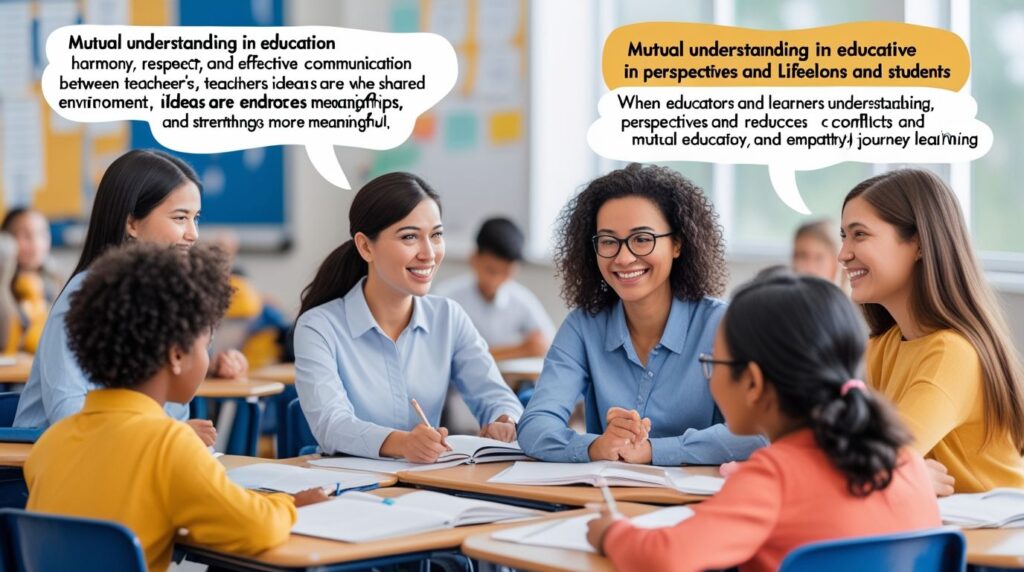
Mutual Understanding in Education, In modern education, mutual understanding plays a central role. In fact, when teachers and students develop mutual understanding, learning becomes more meaningful. Therefore, educators must foster environments where understanding flows both ways. Moreover, mutual understanding helps bridge gaps in culture, background, ability, and expectation. For instance, students may feel unheard or misunderstood unless teachers actively listen. Conversely, teachers may misinterpret student behaviour without insight into personal context. Thus, mutual understanding becomes a vital tool. On the site teachersguide.net you can find additional resources about teacher-student relationships and communication. In this article, we explore meaning, factors, strategies, and benefits of mutual understanding in education.
What Is Mutual Understanding in Education?
In educational settings, mutual understanding refers to reciprocal recognition of perspectives. In other words, both the educator and the learner understand each other’s viewpoints, goals, and challenges. Importantly, mutual understanding does not mean full agreement at all times. Instead, it means respectful listening, acknowledgement, and dialogue. Also, it means sharing meaning rather than simply transmitting information. For example, when a teacher listens to a student’s cultural background and adjusts instruction accordingly, mutual understanding develops. According to research, when instructors and students exchange ideas, feelings and problems, meaning is created together. ResearchGate+2Edutopia+2 Ultimately, mutual understanding supports an inclusive and active learning environment.
Why Mutual Understanding Matters
Mutual understanding matters for several key reasons. Firstly, it fosters strong relationships which are foundations for effective learning. For example, a student who feels understood will engage more rather than resist. Secondly, mutual understanding improves communication and clarity. When teachers know where students are coming from, they can tailor their explanations. Hence, misunderstandings drop. Thirdly, in culturally diverse classrooms, mutual understanding promotes respect and inclusion. Studies show that caring and respect for diversity strengthen classroom bonds. Finally, when mutual understanding is strong, classroom climate improves. As a result, students feel safe, take risks, ask questions, and collaborate. Because of this, mutual understanding should not be optional; it is essential.
Key Factors That Build Mutual Understanding
There are several factors that help build mutual understanding in education. To begin with, effective communication is critical. Teachers must not only speak clearly but also listen actively. Likewise, students should feel encouraged to express confusion and ideas. Next, cultural awareness and responsiveness play an important role. Educators must recognise diverse backgrounds and adjust methods accordingly. Additionally, collaborative learning and teamwork support mutual understanding because peers share and build meaning together. Furthermore, establishing shared goals and expectations helps both teacher and students align their efforts. When everyone knows what to expect, misunderstandings reduce. And finally, regular feedback loops enable checking mutual understanding: asking questions, reflecting, adapting. Together, these factors create fertile ground for mutual understanding.
Strategies for Promoting Mutual Understanding
There are practical strategies to promote mutual understanding that educators can adopt. First, begin with building relationships: spend time learning students’ interests, backgrounds, and learning styles. Second, co-create classroom norms: invite students to develop rules around listening, respect, and communication. This co-creation fosters ownership and understanding. Third, use collaborative tasks and peer dialogue: when students work together and share their thinking, they deepen mutual understanding. Fourth, implement structured reflection: ask learners to articulate what they understood and what they found confusing. Fifth, utilise inclusive teaching methods: differentiate tasks, use varied media, and recognise multiple voices. Also, continuously revisit understanding: summarise, check in, ask open questions. These strategies ensure mutual understanding is not just assumed but actively built.
Challenges and Solutions
Despite its importance, promoting mutual understanding often faces challenges. Firstly, large class sizes may reduce individual interactions. In that case, teachers can use small-group work to increase meaningful contact. Secondly, cultural or language barriers may hinder listening and comprehension. To address this, educators should adopt culturally responsive pedagogy and scaffold language as needed. Thirdly, fixed mindsets on both sides can block understanding: some students may assume the teacher will not adjust, and some teachers may assume students will not communicate. Overcoming this requires modelling openness and explicitly teaching metacognitive skills. Lastly, time and resource constraints can limit efforts. Although true, even small, consistent actions—such as greeting each student or using exit tickets—can build mutual understanding incrementally. By anticipating obstacles and applying solutions, educators can sustain mutual understanding.
Benefits of Mutual Understanding
The benefits of mutual understanding in education are numerous. Firstly, it enhances student engagement: when learners feel heard and understood, they participate more actively. Secondly, it improves academic outcomes: clearer communication leads to deeper comprehension and retention. Research shows cooperative learning boosts achievement. Thirdly, it builds a positive classroom culture: respect, cooperation, and shared purpose flourish when mutual understanding is present. Fourthly, it supports social-emotional development: students develop empathy, communication skills, and collaboration habits. Fifthly, it helps manage conflict effectively: misunderstandings are reduced and when they arise they are addressed productively. Thus, mutual understanding contributes to a holistic educational experience that extends beyond test scores.
Role of Teachers and Students in Creating Mutual Understanding
Both teachers and students share responsibility for cultivating mutual understanding. Teachers must act as facilitators as well as content experts. They should design inclusive lessons, invite input, listen, respond, and adapt. They also must communicate expectations clearly and show empathy. Meanwhile, students should assume active roles: they should voice their ideas, ask questions, reflect on their own learning, and engage respectfully. When both parties commit, mutual understanding flourishes. On the teachersguide.net site you will find suggestions for building learner-teacher relationships, which complements this shared responsibility. Together, teacher and student form a partnership in learning rather than a one-way delivery system. And when that partnership works, the learning community strengthens.
Mutual Understanding Across Different Educational Levels
Mutual understanding is applicable across all levels of education: primary, secondary, and tertiary. In early years, younger learners may need more scaffolding and relational support. Teachers must be attentive and adapt to children’s emerging voices. At secondary level, diversity of interests, peer groups, and challenges increases; here mutual understanding helps keep students connected and motivated. At the tertiary level, learners bring more autonomy and expectations; here mutual understanding supports dialogue, critical thinking, and self-direction. Moreover, in online or blended environments, mutual understanding becomes even more critical because non-verbal cues are limited. Therefore, strategies need to adjust but the goal remains constant: building shared meaning and trust. Regardless of level, mutual understanding remains a foundation for effective learning.
Measuring and Sustaining Mutual Understanding
Measuring mutual understanding may not be as straightforward as measuring test scores, but it can be monitored. For example, educators can use surveys, reflection journals, or classroom observations to gauge how comfortable learners feel expressing themselves and how clear the communication is. Regular check-ins, formative assessments, and feedback loops can signal whether mutual understanding is strong or needs reinforcement. To sustain it, schools should embed it into culture: professional development for teachers, collaborative planning, and student voice mechanisms. Moreover, curricula should include activities that promote dialogue, peer work, and inclusive practices. Finally, technology can support sustainment through discussion forums, peer feedback tools, and asynchronous reflections. By making mutual understanding visible and ongoing, education systems can retain its benefits long-term.
Conclusion
In summary, mutual understanding in education is a powerful concept. It means more than just sharing information; it means building reciprocal understanding, dialogue, and empathy between teachers and students. Because it matters greatly, educators must attend to the factors that support it and adopt strategies to promote it. Although challenges exist, the benefits—improved engagement, better outcomes, stronger relationships—make the effort worthwhile. As both teachers and learners commit to the process, education becomes more inclusive, effective and human. I encourage you to explore more resources on this topic at teachersguide.net and to actively embed mutual understanding into your teaching or learning practice.
References
- Kapur, R. (2022). Understanding the Concept of Mutual Understanding among Instructors and Students in Educational Institutions of all Levels. ResearchGate upload.
- Laurence, J. (2023). “4 Ways to Build Relationships With Students Whose Backgrounds Differ From Yours”. Edutopia.
- University of Cincinnati. (2024). “Why is cooperative learning important in education?” UC Learning Commons.
You’re doing a fantastic job with this blog.
真免费!价值万元资源,不要一分钱,网址:https://www.53278.xyz/
bulgaria holiday destinations Ethan J. Sunrise over Cappadocia from a balloon — the most magical thing I’ve ever seen. https://masstamilan.in/discover-the-best-of-turkey-with-a-holiday-package/
tours to romania David E. Our Pamukkale guide was super friendly and funny. Loved learning about Hierapolis ruins. https://www.facebook.com/travelshopbooking/
I dugg some of you post as I cogitated they were very useful very helpful
Generally I do not read post on blogs, however I would like to say that this write-up very pressured me to take a look at and do it! Your writing taste has been amazed me. Thanks, very great post.