
1. Introduction & Context
School Management by M. Dash and Neena Dash is a foundational text in the field of educational administration, designed chiefly for B.Ed. (Bachelor of Education) students and teacher-educators, especially in India. The work tackles the theory and practice of managing schools as social and administrative organizations. According to its description, the book views school management not simply as a technical task, but as a cooperative social endeavour that brings together teachers, students, parents, administrators, and community stakeholders to achieve educational objectives.
By positioning management as a central force in coordinating systems and resources towards defined goals, the authors echo a contemporary understanding of educational leadership that blends organizational theory with social psychology and community engagement. This emphasis situates the book within the classic tradition of educational administration texts while attempting to make it relevant to the Indian educational context, where schools often grapple with infrastructural, policy, and human-resource challenges.
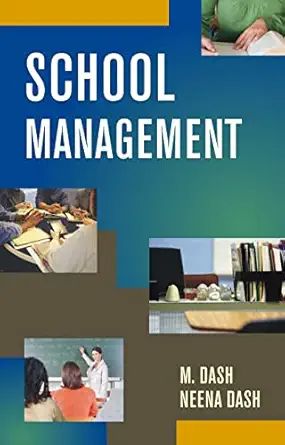
2. Authors & Their Perspective
Understanding the authors’ backgrounds helps contextualize the book’s emphases:
- M. Dash brings decades of experience in teacher education and administration. Holding degrees in psychology and education and having served as principal and director, Dash’s voice reflects both academic depth and institutional insight.
- Neena Dash adds expertise from her work in education and inclusive practices, bringing a pedagogical perspective that complements managerial analysis.
Their combined perspective strives to balance theoretical frameworks with practical applications — a common aim in educational textbooks but one that is not always successfully achieved in practice.
3. Book Structure & Table of Contents
The book is organized into 12 core chapters, each focusing on a key component of school management:
- School Management – Conceptual foundations and definitions
- Management Approaches and Decision-Making
- Physical Infrastructure
- The School Head
- The Teacher and His Profession
- Classroom Management
- Administration of Education in the State of Himachal Pradesh
- Co-curricular Activity
- Time Table
- School Records and Registers
- Supervision and Inspection
- Institutional Planning and School Complex
This structure reveals the authors’ multi-layered approach: starting with broad theoretical constructs, moving into the roles of key school actors, and ending with systems and procedural concerns. The inclusion of specific chapters like “Administration of Education in the State of Himachal Pradesh” shows an effort to root managerial concepts in actual regional contexts (something less common in many general management texts).
4. Core Themes & Content Review
4.1. Conceptual Foundations
The opening chapters lay a foundation by defining management in the context of schools. Here, the authors underline that schools are not just instructional sites but social organizations that must coordinate people, materials, time, and ideas to deliver education. They articulate management as the “use of people and other resources to accomplish the objectives of the school.”
Strengths:
- Clear articulation of management as a blend of human and material resource coordination.
- Explanation of internal vs. external management: internal dealing with admissions, library and lab management, infrastructure, etc., and external relating to community and educational boards.
- Emphasis on the human element — echoing contemporary educational leadership research that recognizes relational dynamics as central to effective schooling.
Critique:
- The conceptual discussion may lean towards definitions rather than in-depth critical analysis of competing management theories (e.g., transformational vs. transactional leadership).
- Readers seeking robust engagement with international research may find the discussion more introductory than analytical.
4.2. Management Approaches & Decision-Making
This chapter addresses diverse management approaches (possibly traditional, democratic, participative, etc., though specifics vary by edition). Decision-making is rightly highlighted as a cornerstone of management practice.
Strengths:
- Connects theory to critical managerial tasks: planning, organizing, decision-making, coordinating, and evaluating.
- Useful for student readers as a bridge between theoretical management language and real school practices.
Critique:
- Without extensive case studies or empirical examples, the discussion risks being descriptive rather than deeply practical for real-world dilemmas faced by school leaders.
4.3. Physical Infrastructure & Resources
An important and often overlooked domain in many educational texts is the material and infrastructural side of school operation. This chapter likely discusses adequacy, availability, utility, and optimal usage of facilities like classrooms, libraries, labs, and equipment.
Strengths:
- Brings attention to the physical basis of learning environments.
- Integrates infrastructure with broader management themes rather than isolating it as a technical concern.
Critique:
- Readers might desire deeper engagement with latest research on learning environment design, technology integration, and safety standards.
4.4. The School Head & Teacher Roles
Separate chapters on the school head and teachers highlight organizational roles within schools. Exploring leadership traits, professional expectations, and the managerial duties of principals and teachers connects administration with educational outcomes.
Strengths:
- Recognizes that leadership is distributed — both heads and teachers contribute to school management success.
- Aligns well with modern views of instructional leadership.
Critique:
- Depth can vary; readers seeking discourse on leadership styles, motivation theories, conflict resolution, and performance appraisal may find this section foundational but not exhaustive.
4.5. Classroom Management
Classroom management is a classic and indispensable topic in teacher education. The book’s treatment likely covers behavior management, instructional flow, environment setup, and routines — linking them to overall school management goals.
Strengths:
- Bridges school-wide management with the most immediate site of teaching and learning.
- Helpful for B.Ed. students preparing for real classrooms.
Critique:
- The chapter may replicate standard pedagogical material found in other texts unless it actively integrates managerial concepts like data-driven decision-making or differentiated accountability.
4.6. Administrative Tools & Systems
Chapters on time tables, records, supervision, inspection, and planning handle procedural work that is sometimes neglected in higher-level texts. They ground readers in the nuts and bolts of organizational administration — from timetabling to formal documents and oversight systems.
Strengths:
- Practical and detailed, serving as a useful reference for aspiring administrators.
- Shows how management theory translates into daily tasks.
Critique:
- Risk of being overly procedural; critical reflection on bureaucratic burdens or digital transformation of these systems could enhance relevance.
5. Strengths of the Book
5.1. Balanced Scope
The book successfully balances theoretical introduction with practical operational guidance, making it suitable for undergraduate teacher education programs.
5.2. Accessibility
Written in clear, accessible prose, the book is approachable for students encountering the subject for the first time. It avoids unnecessary jargon without sacrificing academic rigor.
5.3. Educational Context
By embedding examples and references to educational boards and Indian school structures, the book gains contextual relevance — a strength for its primary audience of Indian education students and practitioners.
5.4. Comprehensive Coverage
The broad range of topics — from infrastructure to leadership roles to supervision — allows readers to see the full spectrum of managerial concerns that define effective schooling.
6. Limitations & Areas for Critique
6.1. Limited Critical Engagement
Readers seeking deep critique of management theories, comparisons with Western leadership models, or evidence-based analysis may find the text less challenging. It tends toward descriptive rather than analytical exposition.
6.2. Sparse Empirical Content
Compared to scholarly monographs or international texts, School Management may not offer extensive case studies, data analysis, or research citations that connect theory to empirical findings.
6.3. Review Availability
Public reviews (e.g., on Goodreads) are limited and mixed, with some student readers describing it as primarily written to help pass exams. This suggests the book functions well as a textbook but may have limited appeal as a research-oriented or professional leadership resource.
7. Comparative Positioning
To understand where School Management sits in the field, consider it alongside other educational administration literature:
- Unlike dense academic texts (e.g., university press titles that focus on leadership theory and global education policy), Dash & Dash’s work is introductory and practice-oriented.
- Compared to management books that emphasize business principles applied to schools, this text leans more toward the social and community dimensions of education.
- Its regional examples and alignment with Indian teacher education syllabi make it particularly useful in South Asian contexts.
In sum, it is not a comprehensive leadership manual nor a global policy critique, but a strong foundational textbook for early career educators and administrators.
8. Practical Use & Audience
8.1. For Students
This book is particularly effective for B.Ed. and M.Ed. students seeking a solid grounding in educational management concepts, administrative procedures, and the roles of key actors in schools.
8.2. For Practitioners
School heads, teachers aspiring to leadership roles, and junior administrators may find it useful as a structured reference to everyday managerial tasks.
8.3. For Educators and Trainers
Teacher educators can use its chapters as syllabus anchors, supplementing them with case studies, research articles, and policy discussions to deepen learning.
9. Conclusion
School Management by M. Dash and Neena Dash is a comprehensive introductory text that successfully unpacks the multifaceted responsibilities involved in running a school — from infrastructure and human resources to supervision and community engagement. It stands out for being accessible, practically oriented, and well-aligned with teacher education curricula, especially in India. However, its theoretical depth and scholarly engagement may be limited for readers seeking advanced critique or empirical research emphasis.
As a textbook, it offers clarity and structured knowledge; as a professional guide, it provides foundational tools; but for leadership research or policy analysis, it should be supplemented with broader literature.
this is an interesting article, i enjoy reading it, keep up the good work, do you post often, i want to start following you. my site is https://webdesignfreelancermunchen.de/ it is the top webdesign freelancer platform in Germany.
Thanks, I have just been looking for information about this subject for a long time and yours is the best I have came upon till now. But, what concerning the bottom line? Are you positive about the supply?
g casino bolton
References:
https://cox-savage-2.thoughtlanes.net/