

Abstract
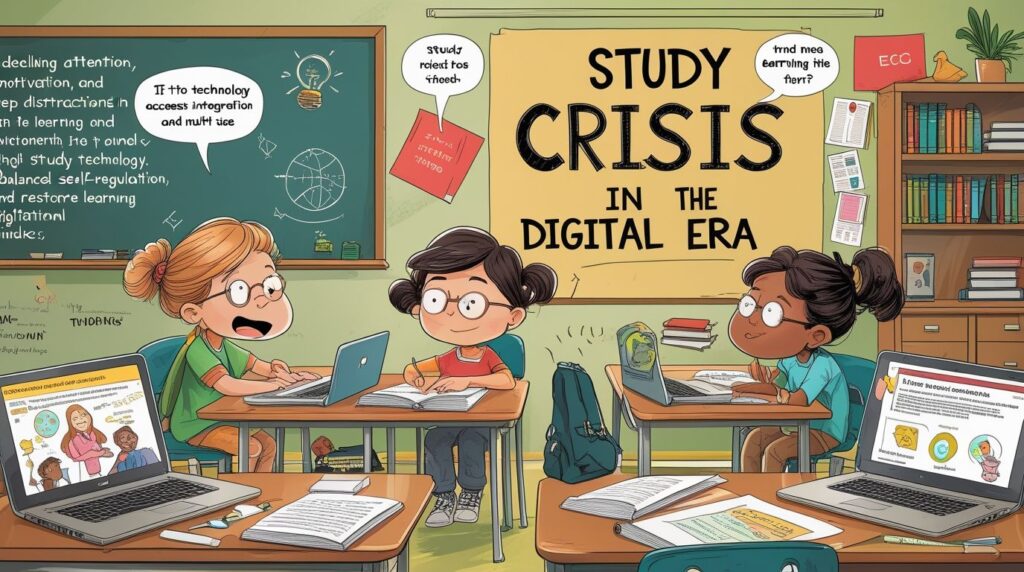
Study Crisis in the Digital Era in Classrooms, Firstly, the rapid expansion of digital technologies has fundamentally reshaped contemporary classrooms, giving rise to what scholars describe as a study crisis in the digital era. Although digital tools were introduced to enhance access, engagement, and efficiency, evidence increasingly suggests that they have also disrupted students’ attention, motivation, and study habits. Therefore, this study aims to examine the nature, causes, and consequences of the study crisis within digitally mediated learning environments. Using a qualitative-analytical research design, the paper synthesizes existing empirical studies and theoretical perspectives. Moreover, key findings indicate that excessive screen exposure, multitasking, weak digital self-regulation, and inadequate pedagogical integration significantly undermine deep learning. Consequently, the study argues that the crisis is not technological but pedagogical and cultural. Ultimately, the paper recommends structured digital pedagogy, attention-aware instructional design, and digital literacy education to restore meaningful study practices in classrooms.
Keywords
Study Crisis, Digital Era, Classrooms, Attention, Digital Pedagogy, Student Learning
Introduction
In recent decades, the integration of digital technology into education has accelerated at an unprecedented pace. As a result, classrooms have evolved into complex digital ecosystems where laptops, tablets, and smartphones coexist with traditional instructional practices. However, alongside these changes, educators and researchers have identified a growing study crisis characterized by declining concentration, superficial learning, and reduced academic perseverance. According to Carr (2010), continuous digital engagement reshapes cognitive habits, making sustained attention increasingly difficult. Moreover, students are often encouraged to multitask, despite evidence that such behavior undermines learning efficiency. Therefore, the present study investigates how digital environments contribute to the study crisis in classrooms. By doing so, it seeks to provide a research-based understanding of this phenomenon and propose informed solutions for educators and institutions.
Review of Related Literature
To begin with, existing literature highlights significant cognitive changes associated with digital learning environments. For instance, Ophir, Nass, and Wagner (2009) demonstrated that heavy media multitaskers show reduced attentional control. Furthermore, Rosen et al. (2011) found that frequent digital interruptions negatively affect academic performance. In addition, motivational theories suggest that digital overstimulation weakens intrinsic motivation. Deci and Ryan (2000) emphasized that autonomy and focus are essential for deep learning, both of which are compromised by constant screen interaction. Meanwhile, pedagogical scholars such as Selwyn (2016) argue that technology often amplifies existing educational inequalities rather than resolving them. Consequently, the literature reveals that the study crisis is multidimensional, involving cognitive, motivational, pedagogical, and socio-economic factors.
Research Objectives
Specifically, this study is guided by the following objectives:
- To examine the key factors contributing to the study crisis in digital classrooms.
- To analyze the impact of digital technologies on students’ attention, motivation, and study habits.
- To identify pedagogical and institutional challenges faced by teachers in digital learning environments.
- To propose evidence-based strategies for mitigating the study crisis.
Research Methodology
Methodologically, the study adopts a qualitative descriptive research design based on secondary data analysis. Rather than collecting primary data, the research systematically reviews peer-reviewed journal articles, books, and empirical studies related to digital learning and study behavior. In particular, sources published between 2000 and 2024 were prioritized to ensure relevance to contemporary classrooms. Moreover, thematic analysis was employed to identify recurring patterns across the literature. As a result, data were categorized into themes such as attention disruption, motivation decline, pedagogical challenges, and digital inequality. Therefore, this methodology enables a comprehensive understanding of the study crisis without the constraints of a single institutional context.
Data Analysis and Discussion
Based on the reviewed literature, several dominant themes emerged. Firstly, attention fragmentation was identified as a core component of the study crisis. According to Ophir et al. (2009), multitasking significantly impairs cognitive control. Secondly, motivation decline was evident across multiple studies. For example, Twenge (2017) linked excessive digital exposure to increased anxiety and reduced academic engagement. Thirdly, pedagogical challenges were prominent, as teachers often lack training in effective digital integration. Koehler and Mishra (2009) emphasized that technological pedagogical content knowledge is essential for meaningful learning. Thus, the analysis confirms that poorly managed digital environments weaken study discipline and depth of learning.
Findings
The findings of this study reveal that the study crisis in the digital era is driven by interconnected factors. Firstly, excessive multitasking reduces sustained attention and comprehension. Secondly, algorithm-driven digital platforms promote instant gratification, thereby weakening perseverance. Thirdly, inadequate teacher training results in superficial technology use rather than transformative pedagogy. Moreover, digital inequality exacerbates learning gaps among students. Consequently, the crisis manifests as shallow learning, reduced academic resilience, and declining study effectiveness. Importantly, these findings suggest that technology itself is not the primary problem; rather, ineffective integration and weak digital self-regulation are central issues.
Implications for Educational Practice
In light of these findings, several practical implications emerge. Firstly, educators should promote structured digital use rather than unrestricted access. Secondly, explicit instruction in digital literacy and self-regulation is essential. Moreover, curriculum design must prioritize coherence and cognitive load management, as suggested by Mayer (2014). Additionally, institutions should provide sustained professional development for teachers. Therefore, addressing the study crisis requires coordinated efforts across curriculum, pedagogy, and policy. Ultimately, balanced digital integration can restore depth and discipline in student learning.
Conclusion
In conclusion, this research paper demonstrates that the study crisis in digital classrooms is a significant educational challenge shaped by cognitive, motivational, and pedagogical factors. Although digital technologies offer powerful learning opportunities, their unregulated use undermines effective study practices. Therefore, intentional pedagogical design, digital literacy education, and institutional support are essential for mitigating the crisis. As long as technology use remains guided by educational values rather than convenience, classrooms can transform digital disruption into meaningful learning. Thus, the digital era need not diminish study; instead, it can redefine it with purpose and balance.
References
Carr, N. (2010). The shallows: What the Internet is doing to our brains. Norton.
Deci, E. L., & Ryan, R. M. (2000). The “what” and “why” of goal pursuits. Psychological Inquiry, 11(4), 227–268.
Koehler, M. J., & Mishra, P. (2009). What is technological pedagogical content knowledge? Contemporary Issues in Technology and Teacher Education, 9(1), 60–70.
Mayer, R. E. (2014). The Cambridge handbook of multimedia learning. Cambridge University Press.
Ophir, E., Nass, C., & Wagner, A. D. (2009). Cognitive control in media multitaskers. Proceedings of the National Academy of Sciences, 106(37), 15583–15587.
Rosen, L. D., Lim, A. F., Smith, J., & Smith, S. (2011). The distracted student. Computers in Human Behavior, 27(6), 243–250.
Selwyn, N. (2016). Education and technology. Bloomsbury.
Twenge, J. M. (2017). iGen. Atria Books.
Warschauer, M., & Matuchniak, T. (2010). New technology and digital worlds. Review of Research in Education, 34(1), 179–225.
**finessa**
Finessa is a natural supplement made to support healthy digestion, improve metabolism, and help you achieve a flatter belly.