
Introduction
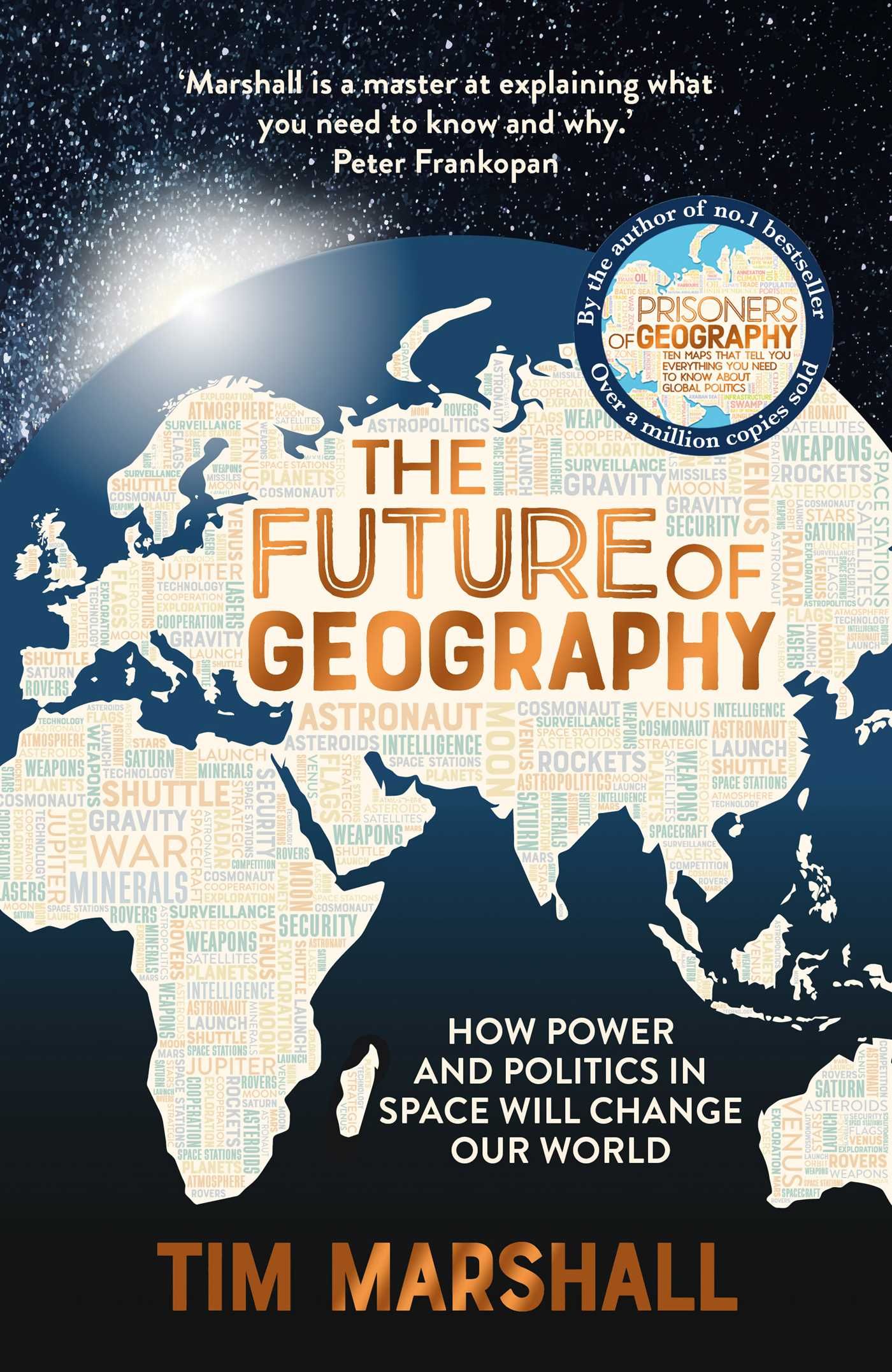
The Future of Geography: How Power and Politics in Space Will Change Our World is a bold and ambitious work by British journalist and geopolitics author Tim Marshall. Best known for bestselling titles like Prisoners of Geography and The Power of Geography, Marshall ventures beyond terrestrial borders in this fifth installment of his Politics of Place series, arguing that the next great frontier of geopolitics is not land or sea—but space. In exploring how competition for orbital real estate, lunar resources, and military dominance beyond Earth’s atmosphere will shape humanity’s future, Marshall presents a far-reaching analysis of what he calls “astropolitics”—a new form of geopolitics centered on space power and influence.
The book is both informational and speculative, integrating historical context, technological detail, political analysis, and future projections. Its core claim is that space is already a crucial component of modern life and global power structures and that developments in space in the next few decades will profoundly influence life on Earth. This review will critically examine Marshall’s key arguments, narrative structure, strengths, and limitations, and assess the book’s significance for readers interested in geopolitics, space policy, and global strategy.
Summary of Content
Historical Context and the Origins of Space Politics
Marshall begins by situating the reader in humanity’s long fascination with the heavens, tracing astronomical inquiry from ancient civilizations through the scientific revolution and into the dawn of the space age. He outlines the development of rocket technology during World War II and the Cold War space race that propelled the launch of Sputnik, Yuri Gagarin’s orbit, and the Apollo moon landings. While this material provides useful context, some readers find it familiar or overly detailed compared to the book’s later focus on future agendas.
In the early chapters, Marshall also explains the mechanics of orbital dynamics and satellite technology, showing how space has rapidly evolved from a purely scientific domain to a strategic and economic arena. The proliferation of satellites now impacts communications, navigation, agriculture, weather forecasting, and national defense.
Astropolitics and the Strategic Importance of Space
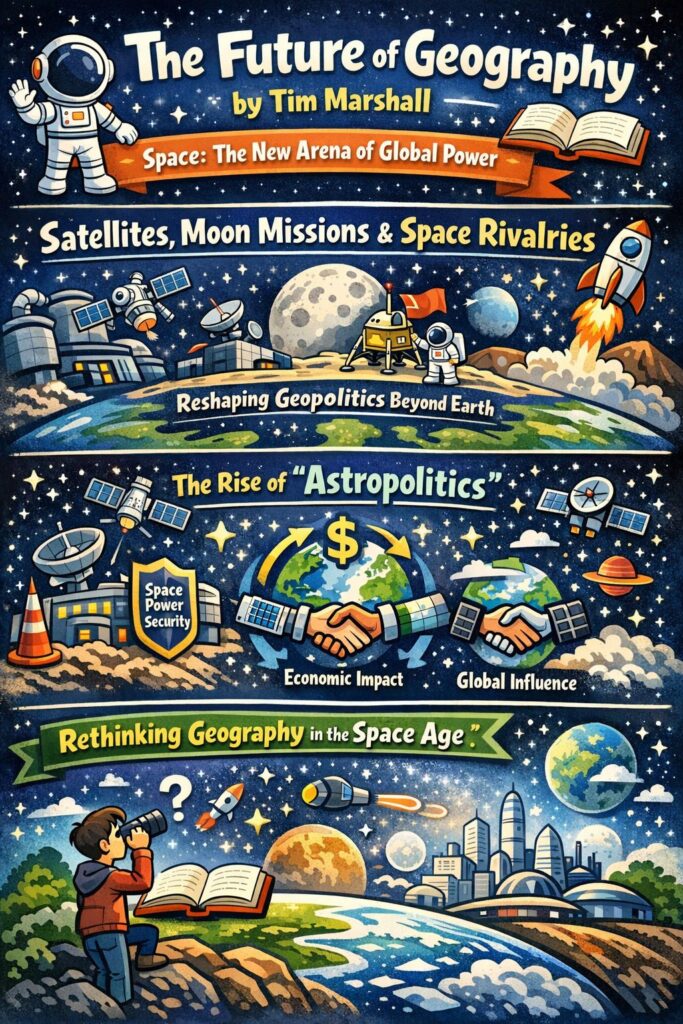
The heart of The Future of Geography lies in Marshall’s analysis of how space has become a geopolitical playing field. He argues that space is no longer a “global common” untouched by national interests; it is now subject to intense competition among the world’s leading powers. This new contest for influence involves rivalries over:
- Orbital slots and satellite dominance
- Lunar and asteroid resources
- Military capabilities in space
- Space law and governance frameworks
Marshall documents the increasing militarization of space, where satellites serve both civilian and defense functions, and nations like the United States, China, and Russia vie for technological and strategic supremacy. He details how satellites enable precision warfare, intelligence gathering, and global communications—making space infrastructure central to national power.
He also shows that the laws governing space—largely Cold War era treaties like the 1967 Outer Space Treaty—are outdated and inadequate for regulating contemporary space activity. Current legal frameworks were written when only a few nations could access space; today, private companies and emerging space nations are vast players, creating a legal and diplomatic vacuum. Marshall argues that these gaps could lead to conflicts or exploitation unless new international agreements are forged.
The Return to the Moon and Resource Competition
One of the book’s most striking sections explores the renewed global interest in the Moon. Unlike the symbolic Apollo missions of the 20th century, today’s lunar ambitions are driven by resource potential and strategic advantage. Marshall highlights scientific interest in lunar ice deposits at the Moon’s poles—a potential water source and a waystation for further space missions—and economically valuable materials like Helium-3, which could fuel future fusion energy.
He also examines how nations plan to establish permanent lunar bases and space stations, describing initiatives by NASA’s Artemis program and China’s lunar exploration missions. These projects reflect a shift from fleeting scientific missions to long-term habitation and resource extraction.
Major Powers and Their Space Agendas
Marshall devotes chapters to the space policies of the “big three” space powers:
- The United States: Continues to lead in space launches, military satellites, and private space partnerships. The U.S. aims not only to maintain its dominance but also to create legal structures like the Artemis Accords to shape future space governance.
- China: Has rapidly scaled up its space capabilities, landing probes on the Moon’s far side and building modular space stations. Marshall presents China’s program as both technologically ambitious and strategically assertive, signaling an intent to challenge U.S. dominance.
- Russia: Once a pioneer in the space race, Russia’s role now appears more uncertain. Budget constraints and geopolitical isolation have pushed it toward partnerships, especially with China.
Marshall also discusses the growing influence of private aerospace companies, such as SpaceX, Blue Origin, and Virgin Galactic, which have outpaced government agencies in launch frequency and innovation. These corporations blur lines between commercial and national interests and raise questions about regulation, accountability, and equitable access to space.
Future Scenarios: Cooperation, Conflict, or Competition
Toward the end of the book, Marshall lays out potential futures for space governance and the consequences for Earth. He warns of a scenario in which major powers replicate terrestrial geopolitical rivalries in space, leading to conflicts or an “arms race” beyond Earth’s atmosphere. Without robust treaties and cooperative frameworks, space could become a new arena of tension rather than a shared frontier.
Marshall also points to the dangers posed by space debris, anti-satellite weapons, and a lack of inclusive policies that consider the interests of less powerful nations. The book advocates for new, comprehensive space law and diplomatic efforts to build trust and shared norms in space exploration and exploitation.
Critical Analysis
Strengths of the Book
- Accessibility and Engagement:
Marshall writes in a clear, engaging style that makes complex geopolitical and scientific issues accessible to general readers. His use of real-world examples and narrative history helps demystify the technical aspects of space exploration. - Timely and Thought-Provoking:
The book tackles an urgent and evolving subject—how space competition will shape geopolitical power in the 21st century. It encourages readers to think beyond Earth-centric geopolitics and consider the implications of space infrastructure on global security, economics, and diplomacy. - Comprehensive Scope:
Marshall covers a wide range of topics, from orbital mechanics and satellite strategy to lunar resources and private space enterprises. This breadth gives readers a holistic view of contemporary space geopolitics. - Call for Legal Reform:
A major strength of the book is its analysis of legal and diplomatic gaps in current space governance. Marshall persuasively argues that outdated treaties are insufficient for modern challenges—a point that resonates in policy discussions today.
Limitations and Criticisms
- Repetitive Historical Sections:
Some readers note that the book’s opening chapters spend considerable space recounting well-known aspects of space history, which can feel repetitive compared to the more original content later in the text. - Balancing Advocacy and Analysis:
While Marshall provides a compelling overview, critics argue that his optimism about cooperative frameworks may understate the depth of geopolitical divisions and commercial interests that could hinder meaningful treaties. - Depth of Technical Detail:
Specialists in space policy may find the analysis at times surface-level or lacking in technical depth. The focus remains more on strategic implications than on detailed space science or engineering. - Varied Reader Reception:
Feedback from readers shows mixed reactions, with some praising the book’s insights and others finding parts less engaging. Reviews on public platforms like Goodreads reflect this range, highlighting both appreciation for the “astropolitics” concept and occasional disappointment in pacing or focus.
Conclusion
The Future of Geography is a compelling and necessary read for anyone interested in the future of global politics, space exploration, and how humanity’s next great frontier will shape life on Earth. Tim Marshall successfully expands his geopolitical lens beyond terrestrial borders, presenting space not as a technological fantasy but as a strategic domain with profound implications for economics, law, security, and international relations.
While the book has limitations, particularly in its historical sections and occasional lack of deep technical detail, its strength lies in bridging complex subjects for a broad audience and stimulating vital conversation about the emerging world of astropolitics. Marshall’s insights shed light on the ways in which power, competition, cooperation, and conflict in space will influence the geopolitics of the 21st century and beyond.
For students, policymakers, and general readers alike, The Future of Geography offers a thought-provoking and accessible exploration of the forces that will shape not only the next fifty years of space activity but also life back on Earth.
**mitolyn reviews**
Mitolyn is a carefully developed, plant-based formula created to help support metabolic efficiency and encourage healthy, lasting weight management.