
Introduction
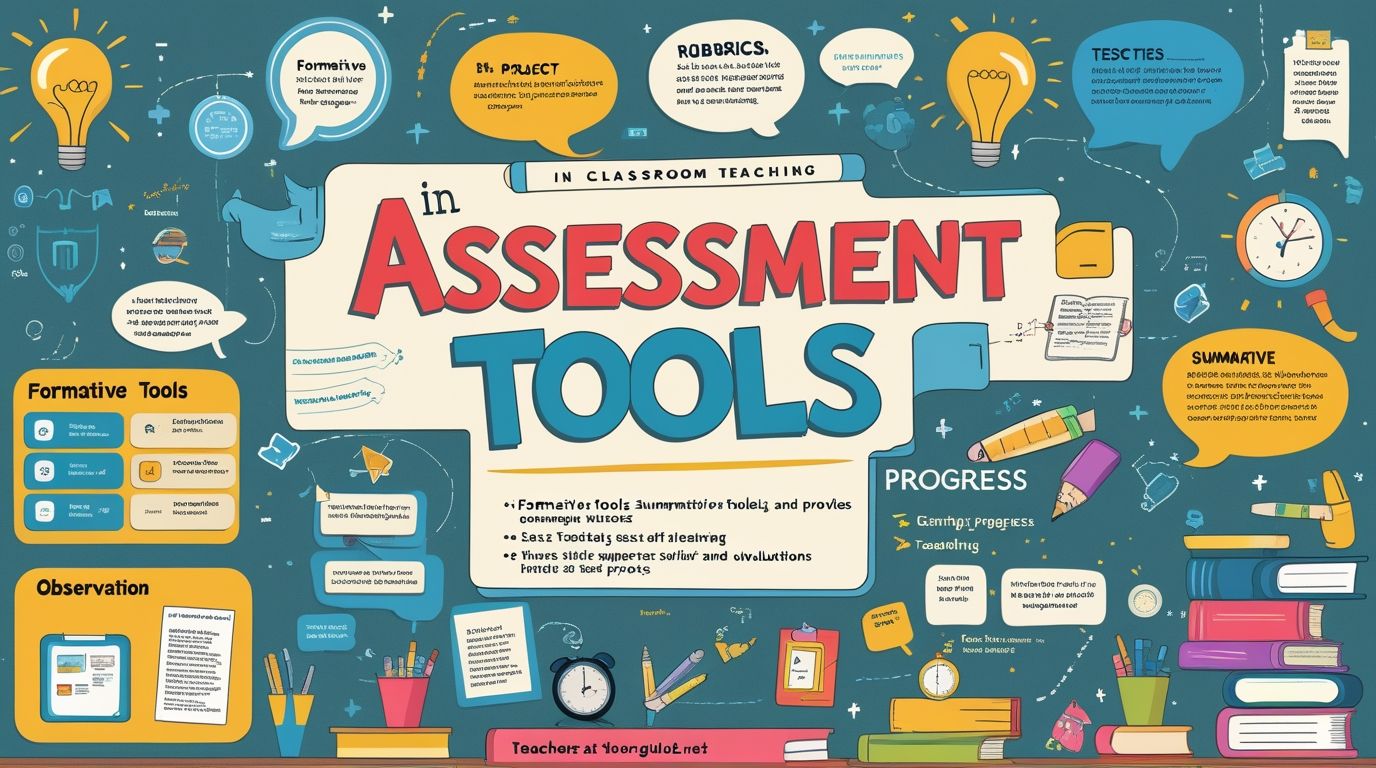
Tools Asessment tools in Classroom Teachings , Assessment tools in classroom teaching serve as instruments to measure student understanding. They help teachers track progress. Moreover, they inform instruction. Thus, they are integral. Without proper tools, teaching may drift. Conversely, with the right tools, learning is guided. Assessment tools include quizzes, rubrics, surveys, observations, self-assessment, peer-assessment, etc. They work both formally and informally. Importantly, they address both what students have learned and how. They allow feedback loops. Additionally, they support differentiation. Because each student learns differently, assessment tools provide ways to adapt. They also motivate students. When used well, they raise engagement and clarity. Finally, they anchor effective teaching practices. For further ideas on tools, you may visit TeachersGuide.net’s assessment tools resources for detailed examples and guidance.
Types of Assessment Tools: Formative & Summative
There are two major types of assessment tools: formative and summative. Formative assessment tools are used while learning is ongoing. They provide quick feedback. They help identify gaps. Teachers adjust instruction accordingly. Summative tools happen after instruction concludes. They measure what students have learned overall. Examples include final exams, projects, and portfolios. Formative tools include quizzes, in-class discussions, exit tickets, peer reviews. According to research, formative assessment allows frequent interactive assessments to recognize student needs and adjust teaching appropriately. PMC Summative tools, by contrast, measure learning outcomes, often in a graded way. Teachers use both types together. Together they help improve learning, build confidence, and guide long-term growth. For how to select tools, see TeachersGuide.net’s guide on selecting classroom assessment tools.
Key Features of Effective Assessment Tools
Effective assessment tools have certain key features. First, they are valid. They measure what they intend. Second, they are reliable. They yield consistent results. Third, they are timely. Feedback happens soon after assessment. Fourth, they are transparent. Students know the criteria. Fifth, they are aligned with learning goals. Also, they provide opportunities for revision. Moreover, they are fair and inclusive. They consider diverse learners. Also, they are authentic. That is, they resemble real tasks. In addition, they are actionable. Teachers and students can use results to improve. Further, they promote self-reflection and metacognition. Effective tools often include rubrics, peer assessment, self-assessment, observations and interactive tools. These features ensure learning is visible. They support growth rather than just judgment. You can find tools with these features at TeachersGuide.net’s collection of classroom assessment examples.
Digital Tools and Technology-Based Assessments
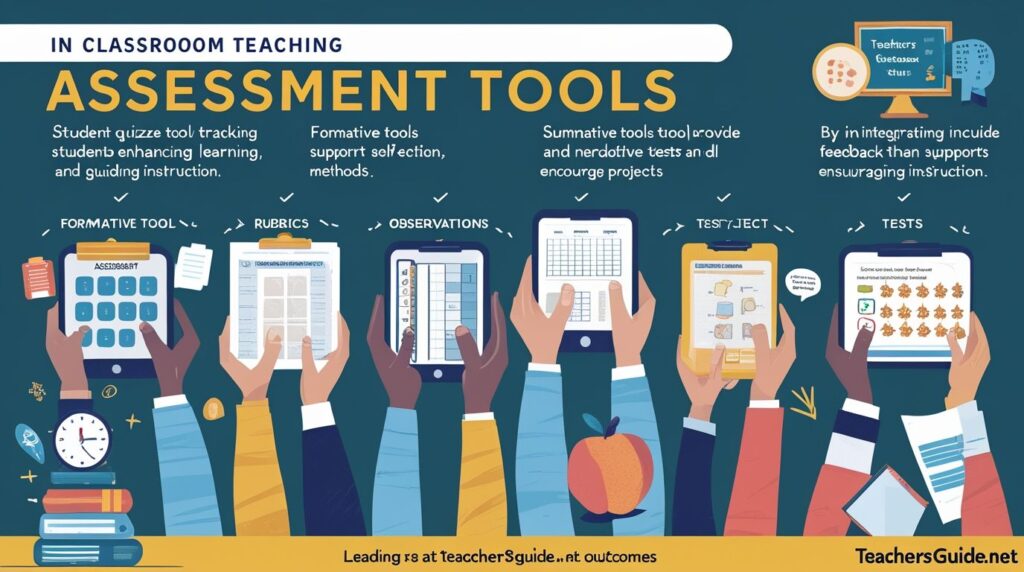
In recent years, digital assessment tools have become prominent. They bring speed. They bring interactivity. Tools like Google Forms, Kahoot, Quizizz, Nearpod, SurveyMonkey are used widely. ResearchGate+1 They allow quizzes, polls, interactive tasks. They give real-time feedback. They enable data tracking. For example, Nearpod offers formative assessment options during lessons so teachers can monitor student’s understanding immediately. Nearpod Digital assessments also support remote or blended learning. They let students respond via devices. Moreover, they engage students with multimedia. For teachers, they reduce manual grading time. They provide analytics. Yet, digital tools must be used carefully. They need to maintain validity and avoid bias. They must be accessible. Also, teachers must ensure that tech enhances learning, not distracts. See TeachersGuide.net’s discussion on tech-enabled assessments.
Classroom-Based Assessment Methods
Classroom-based assessment methods include informal and formal approaches used during regular teaching. Informal methods involve observations, class discussions, exit tickets, KWL charts (What I Know, Want to Know, Learned). They are low-stakes. They help to gauge understanding immediately. Formal methods include quizzes, tests, projects, presentations. Both are essential. Classroom Based Assessment (CBA) blends them. CBA provides data that is authentic and meaningful. It links teaching, learning, and testing. SCIRP CBA captures student performance during actual tasks. It assesses not only content but skills like critical thinking. Moreover, it allows ongoing adjustments. Teachers can see what works and what doesn’t. Furthermore, classroom methods promote self-assessment and peer-assessment. These involve students in evaluating their own learning and each other’s. Thus, students gain responsibility. Ultimately, classroom-based tools support assessment for learning, rather than only assessment of learning.
Rubrics, Self-Assessment, and Peer Assessment
Rubrics, self-assessment, and peer assessment are powerful tools. A rubric is a scoring guide. It outlines criteria. It clarifies expectations. It helps fairness and consistency. Students see what is expected. Self-assessment invites students to reflect on their work. They identify strengths and weaknesses. Peer assessment allows students to evaluate each other. It promotes collaboration. It builds critical thinking. These tools provide immediate feedback. They also build metacognitive skills. Moreover, they support ownership of learning. When used regularly, they increase engagement. Teachers can combine these with rubrics. Students use rubric to assess themselves or peers. Also, peer feedback often improves revision. Self-assessment builds confidence. Teachers benefit because students become more independent. For examples and templates of rubrics or peer assessment forms, refer to TeachersGuide.net’s rubric samples.
Observation and Behavioral Checklists
Observation is an assessment tool where teachers watch and record student behavior or performance. They can note participation, interaction, effort, collaboration. A behavioral checklist is a structured form listing behaviors. Teachers tick off observed items. These tools work in real time. They help identify students needing support. Also, they show patterns over time. Observations and checklists capture things tests cannot. For example, attitude, teamwork, social interaction. Furthermore, they inform formative and summative feedback. According to studies, they are authentic and meaningful. SCIRP Teachers must be trained. Observations need consistency. Checklists must align with learning objectives. Also, feedback from observations should be shared with students. That promotes trust. It encourages improvement. These tools complement quizzes and tests. They round out assessment.
Feedback and Its Role in Assessment
Feedback is central in assessment tools. Without it, assessment loses power. Feedback tells students what they do well. Also, what to improve. Good feedback is timely. It is specific. It is constructive. It mentions strengths and strategies. Moreover, it is actionable. Students know what to do next. Feedback fosters growth. It also reduces student anxiety. Especially with formative tools, feedback helps close learning gaps. Studies show that formative assessment including feedback promotes metacognition and understanding. PMC Also, feedback can come via peer or self-assessment. That empowers students. Teachers should plan for feedback. It must be built into assessment tools. Also, students should know the criteria ahead. Feedback should be part of classroom culture. Finally, feedback loops help teachers adjust instruction for all learners.
Challenges and Considerations When Implementing Assessment Tools
While assessment tools offer many advantages, several challenges exist. First, time is a major issue. Teachers need time to plan, administer, grade and give feedback. Second, training is required. Teachers must know how to design valid tools. Third, technology access can be uneven. Digital tools may fail or be inaccessible. Fourth, bias and fairness must be managed. Tools must be inclusive. Fifth, keeping assessments aligned with learning goals is essential. Sixth, avoiding over-testing matters. Too many assessments can overwhelm students. Furthermore, parents’ and stakeholders’ expectations may conflict. Also, mindset matters: if assessments are used only for grading, students may fear them rather than grow. Finally, logistical concerns—resources, infrastructure, scheduling—can hamper implementation. Still, with planning and support, these challenges can be addressed. See TeachersGuide.net’s advice on assessment implementation.
Best Practices to Choose and Use Assessment Tools
Choosing the right tool matters. First, define clear learning objectives. Next, select tools matching those objectives. Then, ensure tools are valid and reliable. Also, ensure fairness and inclusion. Consider student diversity. Choose assessments that allow revision and multiple chances. Mix tools: formative, summative, peer, self, observation. Use technology wisely. Train teachers. Involve students in criteria. Share rubrics ahead. Make feedback timely and specific. Reflect on assessment outcomes. Adjust teaching accordingly. Collect data to evaluate assessment tools’ effectiveness. Use templates and resources. Monitor student reactions. Finally, embed assessment tools into routine. They should not be add-ons. With good practices, assessment tools can transform teaching and learning. For checklists of best practices, see TeachersGuide.net’s best practice guidelines.
Conclusion:
In conclusion, assessment tools in classroom teaching are not optional. They are essential. They guide teaching. They inform learning. They help teachers see what works. Also, they help students grow. When used well, they increase understanding. They build confidence. They promote self-reflection. They support differentiation. They produce evidence for improvement. Formative and summative tools together bring balance. Digital tools add speed and data. Rubrics, peer/self-assessment, observation, feedback—each plays a role. Challenges remain, but they are surmountable. With proper training, planning, and support, these tools transform classrooms. Ultimately, high-quality assessment tools lead to better learning outcomes. Every teacher who embraces good assessment tools helps students not only know but understand deeply. For more articles and tools, you can check TeachersGuide.net.
References
- Ismail, S. M., et al. “Formative vs. summative assessment: impacts on …” PMC-NCBI. 2022. PMC
- Schildkamp, K. etc. “Formative assessment: A systematic review of critical …” ScienceDirect. 2020. ScienceDirect
- Tools in Classroom-Based Formative Assessment. SCIRP. SCIRP
This gave me a whole new perspective. Thanks for opening my eyes.
I’m definitely going to apply what I’ve learned here.
Thanks for taking the time to break this down step-by-step.
I appreciate the real-life examples you added. They made it relatable.
This content is really helpful, especially for beginners like me.
I always look forward to your posts. Keep it coming!
Your writing style makes complex ideas so easy to digest.
I agree with your point of view and found this very insightful.
Thank you for sharing this! I really enjoyed reading your perspective.
This is now one of my favorite blog posts on this subject.
What a helpful and well-structured post. Thanks a lot!
Thank you for offering such practical guidance.
I wasn’t expecting to learn so much from this post!
This article came at the perfect time for me.
I agree with your point of view and found this very insightful.
Your passion for the topic really shines through.
I enjoyed every paragraph. Thank you for this.
You bring a fresh voice to a well-covered topic.
You’ve clearly done your research, and it shows.
This was very well laid out and easy to follow.
I’ve bookmarked this post for future reference. Thanks again!
You’re doing a fantastic job with this blog.
Your passion for the topic really shines through.
This was incredibly useful and well written.
I love the clarity in your writing.
I wasn’t expecting to learn so much from this post!
I really appreciate content like this—it’s clear, informative, and actually helpful. Definitely worth reading!
What a helpful and well-structured post. Thanks a lot!
So simple, yet so impactful. Well written!
What an engaging read! You kept me hooked from start to finish.
This is one of the best explanations I’ve read on this topic.
Very relevant and timely content. Appreciate you sharing this.
Your breakdown of the topic is so well thought out.
You always deliver high-quality information. Thanks again!
This topic really needed to be talked about. Thank you.
You bring a fresh voice to a well-covered topic.
Thanks for making this easy to understand even without a background in it.
I love how practical and realistic your tips are.
This was very well laid out and easy to follow.
You’ve done a great job with this. I ended up learning something new without even realizing it—very smooth writing!
I appreciate how genuine your writing feels. Thanks for sharing.
Such a refreshing take on a common topic.
What an engaging read! You kept me hooked from start to finish.
Thank you for making this topic less intimidating.
I’ve gained a much better understanding thanks to this post.
I hadn’t considered this angle before. It’s refreshing!
Your advice is exactly what I needed right now.
I’ve bookmarked this post for future reference. Thanks again!
You’ve built a lot of trust through your consistency.
Great article! I’ll definitely come back for more posts like this.
This was a great reminder for me. Thanks for posting.
I’ll be sharing this with a few friends.
What’s Happening i’m new to this, I stumbled upon this I have discovered It positively
useful and it has aided me out loads. I hope
to contribute & aid other users like its aided me. Great job.
This topic really needed to be talked about. Thank you.
It’s refreshing to find something that feels honest and genuinely useful. Thanks for sharing your knowledge in such a clear way.
Wow that was odd. I just wrote an very long comment but after I clicked submit my comment didn’t appear. Grrrr… well I’m not writing all that over again. Anyway, just wanted to say excellent blog!