
Introduction:
Understanding of Conceptual Teaching, Conceptual Teaching is a pedagogical approach that foregrounds concepts over mere facts. In this method, instructors emphasize big ideas, relationships, and transferable principles. Rather than having students memorize details, teachers help learners see how smaller facts fit into overarching structures. Thus, learners use conceptual frameworks to organize new information, interpret data, and solve new problems. Conceptual Teaching is more than an instructional flavor. It is a systematic way to help students think, not just recall. In practice, conceptual teaching requires the teacher to plan lessons around key concepts, link them, and scaffold student exploration. When done well, conceptual teaching encourages deeper understanding, lasting retention, and ability to generalize. You can find resources and lesson ideas at teachersguide.net to support implementing concept-based lessons.
Theoretical Foundations of Conceptual Teaching
Conceptual Teaching draws from constructivist theory, cognitive science, and inquiry-based learning. Constructivism posits that learners build new understanding by linking new ideas to prior knowledge. Wikipedia In the conceptual approach, knowledge is not isolated but structured: broad organizing concepts support subordinate ones, with links and relationships. narst.org+1 Moreover, research on human memory shows that understanding relationships helps retrieval, integration, and transfer of knowledge. narst.org+1 Because conceptual teaching demands linking and re-organizing, it challenges superficial learning. It promotes conceptual understanding instead of rote memorization. In effect, students build a web of knowledge, rather than a series of disconnected facts. This theoretical foundation ensures that conceptual teaching is not a fad, but a well-grounded approach with cognitive plausibility.
Key Principles of Conceptual Teaching
There are a number of guiding principles educators should keep in mind when using conceptual teaching. First, focus on big ideas: identify the few essential concepts that underlie the topic. Second, make connections explicit: link facts to concepts and link concepts to each other. Third, use multiple representations: visual, verbal, symbolic, and concrete forms of the concept help solidify understanding. Fourth, scaffold gradually: guide students from concrete to abstract, from simple to complex. Fifth, promote transfer: ask students to apply concepts in new contexts or unfamiliar problems. Sixth, activate prior knowledge: begin by surfacing what students already believe, then help them refine. Finally, assess conceptual understanding, not just recall. These principles ensure that lessons remain coherent and meaningful rather than disconnected or superficial.
Benefits of Conceptual Teaching
Conceptual Teaching offers multiple advantages over traditional fact-based instruction. First, it enhances deep learning: students grasp the “why” and “how,” not just the “what.” That depth helps retention over time. Second, it boosts transfer: learners are more likely to apply knowledge to new contexts when they understand underlying concepts. narst.org+2Edutopia+2 Third, it reduces cognitive overload: by organizing facts under concepts, the mental burden is lowered. Fourth, it fosters metacognition: students become more aware of their thinking when they see conceptual structure. Fifth, it improves motivation: learners often find meaning in big ideas rather than rote tasks. Finally, in empirical studies, conceptual teaching has been shown to improve achievement and attitudes. For example, a study in mathematics found that teaching conceptual knowledge improved student scores, reduced anxiety, and increased positive attitudes. Eurasia Journal
Challenges and Critiques of Conceptual Teaching
While powerful, Conceptual Teaching is not without challenges or criticisms. One major challenge is teacher preparation: many instructors are accustomed to teaching facts and procedures, so shifting to concept-based pedagogy demands professional development. Secondly, designing concept-based curricula is time consuming: it involves unpacking, mapping, scaffolding, and planning connections. Third, some critics argue that in certain domains (e.g. basic arithmetic or early skill learning), procedural fluency still matters, and conceptual approaches alone may be insufficient. In addition, if students’ prior knowledge is weak or contains misconceptions, conceptual teaching may confuse rather than clarify. Also, assessment culture (standardized tests) often emphasizes recall, making conceptual approaches harder to integrate. Finally, there is a risk of overgeneralization, where concepts become too broad or vague and lose meaning. Educators must balance breadth and depth carefully.
Strategies and Methods for Conceptual Teaching
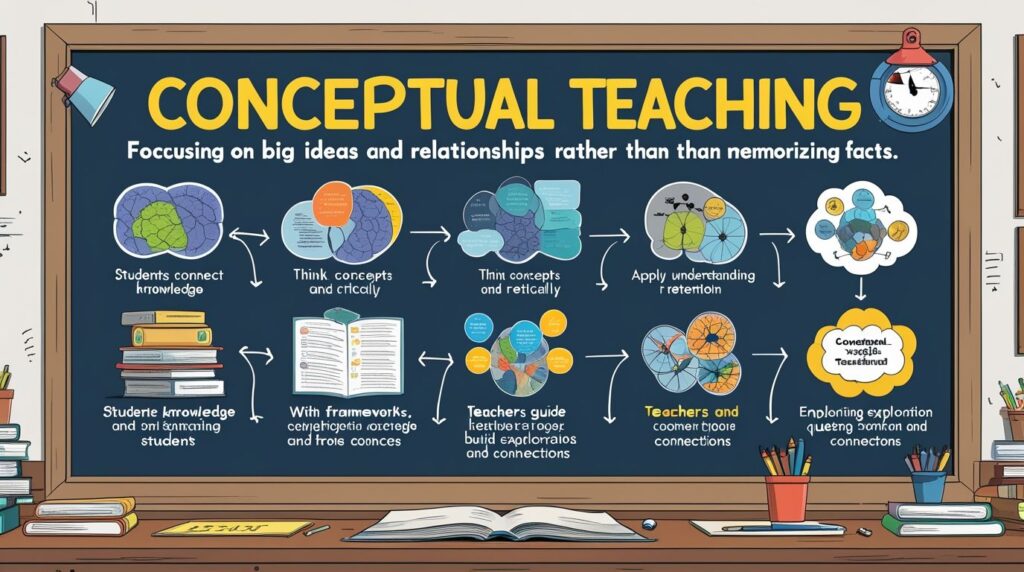
Several strategies help teachers put conceptual teaching into practice. One is concept mapping: students and teachers build visual maps showing key concepts and their relationships. lsc.cornell.edu+2Atlas+2 Another is asking concept-driven questions: “What is the big idea here?” or “How is this related to that?” A third is use of non-examples: showing what does not fit a concept helps sharpen definitions. A fourth is scaffolded inquiry: guiding students through exploration, then gradually removing scaffolds. Fifth is multiple contexts: presenting the same concept in varied scenarios to promote generalization. Sixth is vertical and horizontal linking: across time (link topics) and across subjects (interdisciplinary links). Seventh is frequent formative assessment: short tasks to check whether students grasp concepts, not just facts. Using these strategies, teachers can make conceptual understanding visible and robust.
Steps in Planning a Conceptual Lesson
Planning a conceptual lesson involves several sequential steps. First, identify the core concept(s) students must grasp. Then, determine essential questions that will drive inquiry. Next, unpack the concept into attributes, related ideas, and boundaries. Then, design tasks and activities that move from concrete to abstract, including scaffolding. After that, select multiple representations (visuals, manipulatives, diagrams). Then, plan for discussion and reflection, prompting students to articulate connections. Next, embed formative assessments to monitor conceptual grasp. Finally, plan transfer tasks, where students apply the concept in novel contexts. Throughout this planning, teachers should consult resources like teachersguide.net to find examples, templates, or conceptual lesson plans to adapt. By following these steps, lessons can remain coherent, inquiry-driven, and student-centered.
Examples of Conceptual Teaching in Practice
To see conceptual teaching in action, consider some examples from different subjects. In science, a unit on energy might center on the concept of conservation, linking kinetic, potential, thermal, and chemical energy across systems. In mathematics, instead of teaching separate formulas, instructors might frame lessons around the concept of proportional reasoning and then derive specific cases (ratios, similar triangles, scaling). In social studies, lessons might revolve around the concept of power and systems rather than just facts about governments. In language arts, one could teach the concept of theme and have students analyze varied texts by mapping how details support the theme. In each case, students see how topics fit a broader idea, and they practice transferring their understanding to new examples. These concrete instances illustrate how conceptual teaching turns fragmented topics into coherent, meaningful learning.
Assessing Conceptual Understanding
Assessment in a conceptual approach goes beyond asking for definitions or fact recall. Instead, assessment should probe understanding of relationships, transfer, and thinking. Some suitable assessment techniques include: conceptual essays (explain how concepts interrelate), novel problem tasks (apply concepts in new situations), concept mapping assignments, explanation tasks (ask students to explain “why” and “how”), and diagnostic questions (which probe misconceptions). Teachers may also use multiple-choice items designed to reveal conceptual thinking, not just memory. Frequent formative assessments help monitor progress; summative tasks should integrate transfer. Importantly, when grading, teachers should value reasoning, coherence, and conceptual linking, not just correct answers. In this way, assessment aligns with the goals of conceptual teaching.
Promoting Student Agency and Metacognition
Conceptual Teaching also aims to empower students to become self-regulated, reflective learners. To do that, teachers should invite metacognitive prompts, such as “How did I arrive here?” or “What else might this connect to?” They should encourage students to monitor their conceptual understanding, noticing when connections are weak. Teachers can also guide learners to generate their own concept maps, question their assumptions, and revise mental models. In group work, students can explain concepts to peers, deepening their own understanding. Over time, learners develop conceptual fluency: they can shift between concrete and abstract, see patterns, and reason with big ideas. In that way, conceptual teaching not only conveys content, but fosters cognitive habits of mind.
Challenges in Scaling Conceptual Teaching
Scaling conceptual teaching across a whole school, or grade level, presents special difficulties. First, curricular constraints and pacing guides may pressure teachers to cover many topics superficially. Second, assessment systems (standardized tests) may not align with conceptual goals. Third, teachers’ varying readiness and beliefs may hinder consistent implementation. Fourth, professional development must be sustained, not one-off, to support conceptual thinking. Fifth, instructional materials (textbooks) are often organized around facts and discrete topics, not concepts. Sixth, resource constraints (time, planning periods) limit collaborative design. Seventh, aligning conceptual teaching across disciplines (so that concepts in science, math, ELA reinforce each other) is complex. Overcoming these challenges requires leadership support, alignment of curriculum and assessment, ongoing coaching, and a shared vision of conceptual pedagogy.
Recommendations for Teachers and Schools
To adopt conceptual teaching successfully, teachers and schools can follow these recommendations. First, start small: pilot conceptual units in one subject or grade before full scale. Second, provide professional development that models concept-based planning and instruction. Third, create communities of practice where teachers share conceptual maps, units, and reflections. Fourth, revise curricular frameworks to emphasize concepts and essential questions. Fifth, align assessments to measure conceptual understanding and transfer. Sixth, adapt instructional materials or select textbooks that support concept-based approach. Seventh, promote reflective practice, asking teachers and students to examine their conceptual thinking. Eighth, use instructional coaching to support planning and classroom implementation. Finally, involve students in co-design of concept maps and encourage ownership over their conceptual learning.
Conclusion
Conceptual Teaching is a powerful, research-informed approach that emphasizes big ideas, relationships, and transfer, rather than isolated facts. It is grounded in constructivist and cognitive theories of learning, and its principles guide coherent, inquiry-based instruction. While it offers benefits in depth of understanding, retention, transfer, and student engagement, it also faces challenges — such as teacher readiness, curriculum alignment, and assessment constraints. Nevertheless, with careful planning, appropriate strategies (like concept mapping, scaffolding, and transfer tasks), and sustained support, conceptual teaching can transform learning. Schools and teachers may consult resources such as teachersguide.net to find lesson plans, concept maps, and professional insights. By centering understanding and connections, conceptual teaching helps learners become thinkers, not mere memorizers.
Thank you for putting this in a way that anyone can understand.
I really appreciate content like this—it’s clear, informative, and actually helpful. Definitely worth reading!
This is one of the best explanations I’ve read on this topic.
This is one of the best explanations I’ve read on this topic.
Your content always adds value to my day.
I love the clarity in your writing.
I love how well-organized and detailed this post is.
Your tips are practical and easy to apply. Thanks a lot!
I enjoyed your take on this subject. Keep writing!
Excellent work! Looking forward to future posts.
I’ve bookmarked this post for future reference. Thanks again!
I really appreciate content like this—it’s clear, informative, and actually helpful. Definitely worth reading!
Your writing always inspires me to learn more.
Thank you for being so generous with your knowledge.
Thank you for being so generous with your knowledge.
This is exactly the kind of content I’ve been searching for.
I appreciate your unique perspective on this.
Excellent work! Looking forward to future posts.
Keep writing! Your content is always so helpful.
This gave me a lot to think about. Thanks for sharing.
This made me rethink some of my assumptions. Really valuable post.
I’m definitely going to apply what I’ve learned here.
I appreciate the honesty and openness in your writing.
You really know how to connect with your readers.
Posts like this are why I keep coming back. It’s rare to find content that’s simple, practical, and not full of fluff.
You really know how to connect with your readers.
I love the clarity in your writing.
I wish I had read this sooner!
I wasn’t expecting to learn so much from this post!
Thank you for offering such practical guidance.
I really needed this today. Thank you for writing it.
You’ve built a lot of trust through your consistency.
You’re doing a fantastic job with this blog.
You have a real gift for explaining things.
Great job simplifying something so complex.
This was so insightful. I took notes while reading!
Thank you for covering this so thoroughly. It helped me a lot.
This topic really needed to be talked about. Thank you.
This made me rethink some of my assumptions. Really valuable post.
I feel more confident tackling this now, thanks to you.
You’re doing a fantastic job with this blog.
Your content never disappoints. Keep up the great work!
You have a real gift for explaining things.
What I really liked is how easy this was to follow. Even for someone who’s not super tech-savvy, it made perfect sense.
You have a real gift for explaining things.
This article came at the perfect time for me.
You’re doing a fantastic job with this blog.
I’ll be sharing this with a few friends.
This helped clarify a lot of questions I had.
I love how clearly you explained everything. Thanks for this.
I wasn’t sure what to expect at first, but this turned out to be surprisingly useful. Thanks for taking the time to put this together.
Great article! I’ll definitely come back for more posts like this.
I always look forward to your posts. Keep it coming!
I enjoyed your take on this subject. Keep writing!
This post gave me a new perspective I hadn’t considered.
Your breakdown of the topic is so well thought out.
I’ll be sharing this with a few friends.
Keep writing! Your content is always so helpful.
Excellent work! Looking forward to future posts.
Thank you for being so generous with your knowledge.
Your thoughts are always so well-organized and presented.
This content is really helpful, especially for beginners like me.
What a great resource. I’ll be referring back to this often.
Thanks for addressing this topic—it’s so important.
Keep writing! Your content is always so helpful.
Great article! I’ll definitely come back for more posts like this.
I always look forward to your posts. Keep it coming!
Your advice is exactly what I needed right now.
What an engaging read! You kept me hooked from start to finish.
You’ve clearly done your research, and it shows.
Great points, well supported by facts and logic.