

Introduction:
Why Classroom Ethics and Instructions Matter, Classroom ethics and instructions play a central role in effective teaching and learning. First, ethics in the classroom foster trust, fairness, and respect among students and teachers. Without ethical grounding, rules may seem arbitrary, and students may resist directions. Moreover, clear instructions support clarity, reduce confusion, and promote student success. Thus, both ethics and instructions combine to shape classroom culture. When a teacher models integrity and gives well-structured guidance, students are more likely to follow and internalize norms. Furthermore, strong ethics help teachers make difficult decisions fairly in ambiguous situations. In today’s diverse and complex classrooms, educators face moral dilemmas regularly, such as balancing individual needs and group equity. Indeed, the classroom can become “an ethical minefield.” Harvard Gazette For that reason, this article explores key elements of classroom ethics, principles that guide instruction, and practical strategies for implementation.
Core Principles of Classroom Ethics
At the heart of any classroom is a set of guiding moral principles. Teachers must show respect, equity, honesty, confidentiality, and responsibility in their daily conduct. First, respect means valuing each student’s dignity. Teachers should speak courteously and listen actively. Then, equity demands that all students receive fair treatment, regardless of background or ability. Honesty involves being truthful in assessments, feedback, and interactions. Confidentiality requires that private student information be kept secure, and only shared when essential. Lastly, responsibility means upholding one’s promises, fulfilling duties, and admitting mistakes. These principles form a Code of Ethics for educators. For example, the NEA’s Code of Ethics emphasizes commitment to students, to the profession, and maintaining high standards. National Education Association In practice, these values guide day-to-day decisions: grading, discipline, interactions, and curriculum planning. When a teacher lives by these principles, the classroom becomes a space of trust and fairness.
Ethical Challenges and Dilemmas in Classrooms
Even with clear principles, teachers often face ethical dilemmas—situations where two or more values conflict. For instance, how does one balance a student’s privacy against the need to report serious behavior? Or, how to treat a struggling student’s grades fairly while maintaining standards? In such cases, teachers must reflect critically and decide wisely. Moreover, teachers sometimes confront gray areas, like use of technology, fairness in participation, or favoritism perceptions. A helpful approach is to engage in open dialogue with students about ethical boundaries. In one study, educators used brainstorming to let students classify acceptable and unacceptable uses of AI tools. Harvard Graduate School of Education That method encourages shared ownership. Also, educational ethicists call for spaces to discuss uncertain decisions, because teaching is rife with moral nuance. Harvard Gazette In all, ethical dilemmas should not be ignored. Instead, they should drive reflection, policy development, and professional conversation.
Ethical Modeling: Teacher Behavior as Instruction
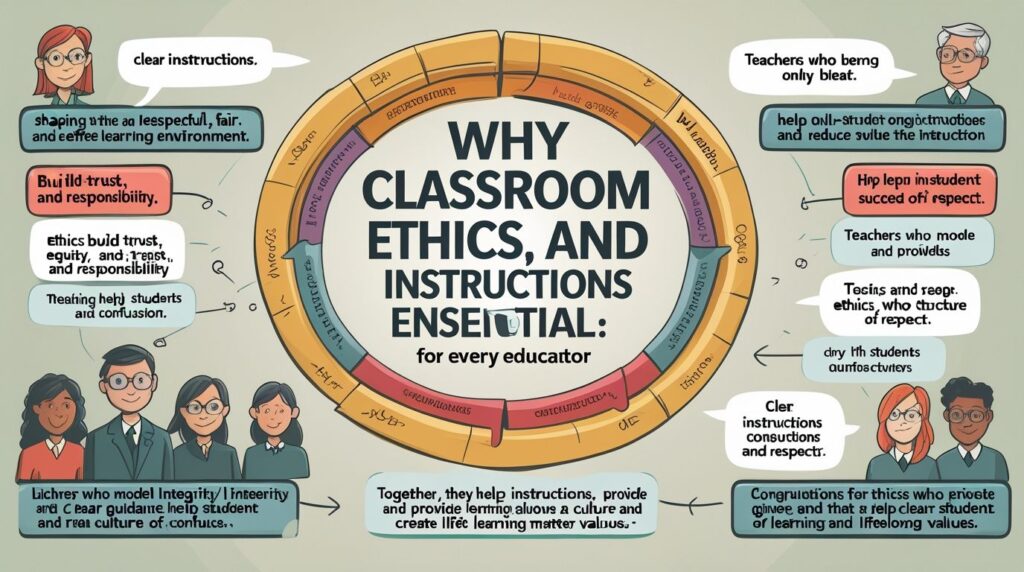
One of the most powerful tools in the classroom is modeling ethical behavior. Teachers must act with integrity because students observe and imitate them. When a teacher admits a mistake, respects others, or speaks calmly in conflict, students internalize those norms. Ethical conduct becomes part of the invisible curriculum. In fact, Margaret Regan argues that respect and well-being must be central to learning, and that every action by the teacher is a lesson in ethics. Edutopia Moreover, when teachers publicly apologize, correct errors, or treat errors as growth opportunities, it strengthens trust. Simple gestures—listening when a student speaks, acknowledging good contributions, or enforcing rules consistently—reinforce ethical norms. Over time, these small acts shape a classroom culture. Thus, instruction is not only about content but also about the teacher’s demeanor. To foster ethical habits, teachers should periodically self-reflect on how their actions align with their ethical principles.
The Link Between Ethics and Classroom Instructions
Ethics and instructions are deeply intertwined. Clear instructions are not neutral; they reflect ethical commitments to fairness, clarity, and accessibility. When instructions are vague, some students may suffer more than others. Conversely, when instructions are explicit, consistent, and fair, all students benefit. Ethical instruction means offering differentiated support to students without giving unfair advantage. It also means avoiding ambiguous rules that privilege some voices. In many school policy codes, teachers are required to “communicate consistent routines” and “clear expectations for student behavior.” Texas Education Agency In doing so, they prevent misunderstandings and reduce conflict. Also, instructions must respect students’ pace and learning differences, balancing rigor and compassion. When a teacher designs instruction with ethics in mind, it becomes inclusive and equitable. In short, ethical teaching is more than content delivery—it is instructional design infused with moral awareness.
Designing Ethical Instructional Plans
Good instructional design must include ethical considerations from the start. Teachers should plan lessons that respect student dignity, diversity, and autonomy. First, learning goals should be transparent. Students should know the purpose, criteria, and expectations. Then, tasks should align with students’ abilities while challenging them. Also, formative assessments should give feedback rather than punish. Furthermore, ethical design means offering multiple ways for students to demonstrate learning (writing, speaking, projects). That respects different strengths. In addition, instructions must avoid bias or cultural insensitivity. Teachers should review materials for stereotypes and inequities. Moreover, planning must consider fairness in group work, seating, and participation. When designing, the educator can refer to professional codes or guidelines like the Model Code of Ethics for Educators (MCEE). NAfME In sum, ethical instruction begins long before the classroom moment—it starts in planning.
Communication: Creating Clear, Ethical Instructions
Even a well-designed lesson fails if instructions are unclear. Hence, teachers must communicate instructions in simple, direct language. Use short sentences, bullet steps, examples, and checks for understanding. Also, provide written instructions and verbal ones. This reduces the risk of unfair advantage to those good at listening. In addition, allow students to ask clarifying questions and restate instructions. This is not a sign of weakness but of ethics. Use transitions (first, next, then, finally) to guide students through tasks. Also, embed ethical reminders: “Work respectfully,” “Ask permission,” “Use kind words.” Give time for students to plan before starting. If changes are necessary, communicate them promptly and fairly. Transparency matters: if you change criteria, explain why. Overall, ethically communicated instructions reduce confusion, conflict and bias.
Monitoring and Adjusting Ethical Instruction
Ethical instruction is not static. Teachers must monitor students’ progress, check for misunderstanding, and adjust instructions when needed. Use formative assessments—quizzes, thumbs up/down, exit tickets. If many students are lost, pause and clarify. When adjustments are needed, ensure fairness: do not penalize students who completed early. Additionally, solicit student feedback on clarity and fairness. Use short anonymous surveys to see which instructions were confusing. Also, observe whether some students lag behind because of language or resource difficulties. Then scaffold additional support. When adapting, explain changes to the whole class to maintain transparency. Ethical responsiveness ensures no student is left behind due to instruction design flaws. In this way, instruction and ethics remain in dynamic balance, guiding teaching toward justice and effectiveness.
Building a Classroom Culture of Ethical Instructions
A vital dimension is cultivating a culture, not merely imposing rules. When students help co-create norms and understand ethical reasons behind instructions, they own them. At the start of the term, hold a discussion on classroom ethics and co-design procedures. Ask: What makes rules fair? Why do we have instructions? Let students propose agreements. Then, post and refer to them. Over time, reinforce these norms by highlighting positive behavior. Use ethical language: “That was respectful,” “Thank you for honesty.” Celebrate when students follow procedures. Also, embed mini ethics moments: discuss when someone did unfairly, and together explore what better choice might have been. That practice builds moral reasoning. In such a setting, instructions are not seen as top-down edicts but as shared agreements. The classroom becomes a community guided by ethics and clarity.
Dealing with Misbehavior Ethically
Behavior challenges are inevitable. Yet responses must reflect ethics, not mere control. When misbehavior occurs, respond with dignity. First, address the student privately if possible. Public shaming undermines trust. Then, listen to their perspective. Ask what happened, why, and what remedy might be fair. Avoid jumping to punishment. Rather, aim for restorative responses: apology, rebuilding trust, making amends. In applying consequences, ensure consistency—so similar misbehaviors yield similar responses—and proportionality. Also, consider context: a student struggling with a problem at home may act out; respond with empathy. Above all, maintain confidentiality and fairness. By responding ethically, the teacher reinforces the very principles they teach. Misbehavior need not erode ethics; it can be a moment to deepen them.
Assessment and Grading with Ethical Integrity
Assessment is one of the most ethically charged aspects of teaching. Teachers must grade fairly, avoid bias, and maintain transparency. First, develop rubrics that clearly define expectations. Let students see the criteria. Next, grade “blindly” where possible (without knowing student identity). Also, give opportunities for revision or retakes to allow growth. If late penalties are applied, make them known in advance. Also, avoid conflict of interest: teachers should not give unfair advantage to favored students. Confidentiality is essential—student grades must be protected. When giving feedback, do so kindly, constructively, and honestly. In cases of borderline grades, err to the side of encouragement rather than harshness. Ethical assessment signals to students that fairness, growth, and accountability matter more than simply ranking.
Equity, Inclusion, and Ethical Instructions
True classroom ethics commit to equity and inclusion. That means paying attention to disadvantaged students, language barriers, and diverse learning styles. Ethical instructions adapt to these differences. For instance, provide scaffolds or translations to students who struggle with language. Offer multiple means of participation (oral, written, art). Monitor whether certain students rarely speak or dominate tasks. Intervene to ensure broad engagement. Use seating, groupings, and roles to balance power among students. Review materials for bias or exclusionary content. Encourage diverse voices and perspectives. Ethical instructions must not favor a dominant culture. Also, be aware of implicit bias: treat each student with respect and fairness. When a student points out a bias or hurtful content, listen and adjust. In doing so, the classroom becomes a place where equity is actively maintained.
Technology, Ethics, and Instruction
In modern classrooms, technology is indispensable but ethically complex. Using devices, online resources, or AI tools introduces risks: plagiarism, data privacy, and unequal access. Ethical instruction must explicitly address these issues. First, establish guidelines for technology use. Clarify what counts as acceptable help vs unethical copying. Brainstorm with students on these boundaries. For example, some teachers engage students to classify AI uses as “okay,” “gray,” or “unethical.” Harvard Graduate School of Education Also, guard student privacy: avoid posting personal data or images without consent. Choose tools that protect data. Ensure that technology does not privilege some students over others: provide alternative options if some lack devices. Monitor usage to discourage off-task behavior. In sum, ethical technology use must be taught, not assumed, and must always link back to the principles of fairness, responsibility, and respect.
Professional Reflection and Growth in Ethics
Ethics is not static. Teachers must reflect, learn, and grow continuously. After lessons, pause to analyze: Did instructions confuse students? Did I act fairly? Did I show bias? Journaling or peer discussion helps. Also, engage in professional development around ethics. Attend workshops, read current research, and join ethics discussion groups. Strong codes like the NEA, MCEE, or state codes can guide reflection. National Education Association+1 In ethical uncertainty, consult colleagues or mentors. Also, creating “ethical case studies” among faculty fosters collective wisdom. Over time, a teacher becomes more sensitive to subtle dilemmas and more confident in making principled decisions. This ongoing growth ensures that ethics remain alive in daily instruction, not just an abstract ideal.
Challenges, Barriers, and Strategies
Implementing ethical instructions faces challenges: time constraints, curriculum pressure, resistance, or ambiguous policies. Sometimes administrators demand compliance with superficial metrics that conflict with deep ethical goals. Some students may flout rules or question fairness. Teachers may feel moral fatigue. To overcome these barriers, start small: embed ethics in one lesson. Use short reflections or mini-discussions. Align ethical goals with curriculum goals so they support rather than compete. Engage students as partners rather than passive recipients. Document and share small successes to build momentum. Advocate for policy change when institutional rules conflict with ethics. Use peer collaboration and coaching to gain support. Also, schedule regular times for ethical reflection. With persistence, even amid pressure, a teacher can gradually shift culture and practice toward integrity.
Case Example: Ethical Instructions in Practice
Consider a teacher who begins the year by distributing a Classroom Ethics Contract. Together, students and teacher draft norms: how to ask questions, collaborate, treat others, use devices. The contract states that instructions will always be clear, that students may ask clarifications, and that misbehavior will be addressed with dignity. During a project, the teacher gives both verbal and written instructions. Halfway through task, many students struggle. The teacher pauses, checks understanding, and rephrases instructions. A student reveals they misunderstood because of language issues. The teacher offers scaffolded steps. For assessment, students use a rubric visible from the start. One student challenges the fairness of peer grading. The teacher facilitates a discussion, adjusts weighting, and ensures anonymity. Over time, the classroom becomes a cooperative environment where students respect rules because they helped shape them. This model illustrates how ethics and instructions intertwine.
Relation to Resources on TeachersGuide.net
For further reading and resources about classroom ethics, instructional strategies, and teacher practice, you might explore TeachersGuide.net. That site contains teaching tips, lesson plans, and guidance that can help operationalize ethical instruction in real classrooms. You can adapt frameworks from the site, and integrate those with the ethical principles discussed here. In particular, review their sections on classroom management, lesson planning, and student engagement. By combining the theoretical ethics laid out here with practical tools from TeachersGuide.net, you can build a more ethically grounded and instructionally sound classroom.
Conclusion
Ethics and instructions are two pillars of good teaching. Without ethics, instructions lack legitimacy. Without clear instructions, ethics remain abstract. When teachers embed ethical principles into instructional design, communication, assessment, and behavior management, the classroom becomes a space of trust, fairness, and growth. Teachers inevitably face dilemmas, but with reflection, modeling, shared culture, and ongoing professional growth, they can respond with integrity. I encourage you to combine the ideas here with practical materials from TeachersGuide.net and engage with colleagues in continued dialogue. That way, your classroom will not only teach content but also embody the moral values that education should nurture.
This was a great reminder for me. Thanks for posting.
You always deliver high-quality information. Thanks again!
This content is really helpful, especially for beginners like me.
This helped clarify a lot of questions I had.
Your content never disappoints. Keep up the great work!
tujdfp
z9q6at