Introduction
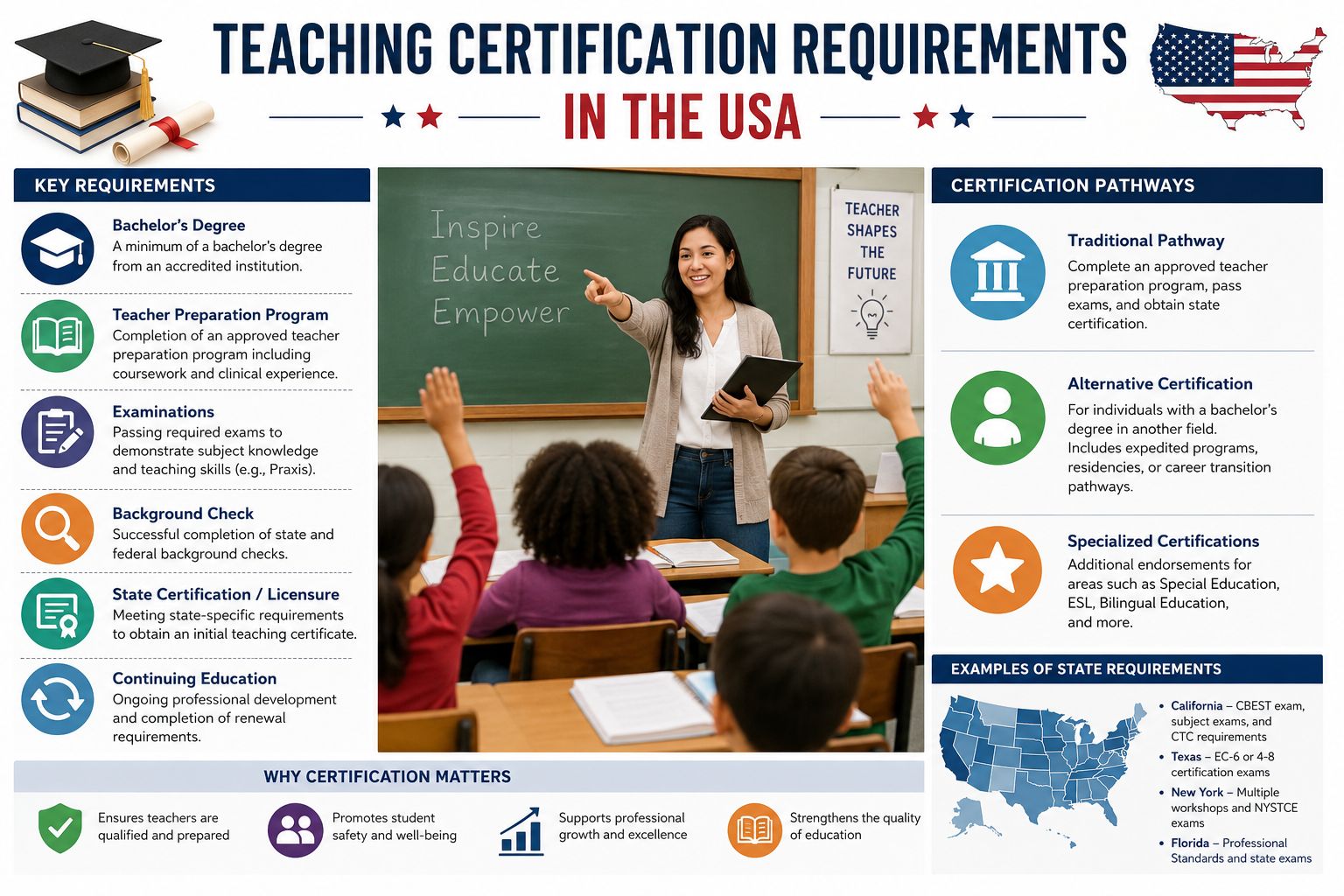
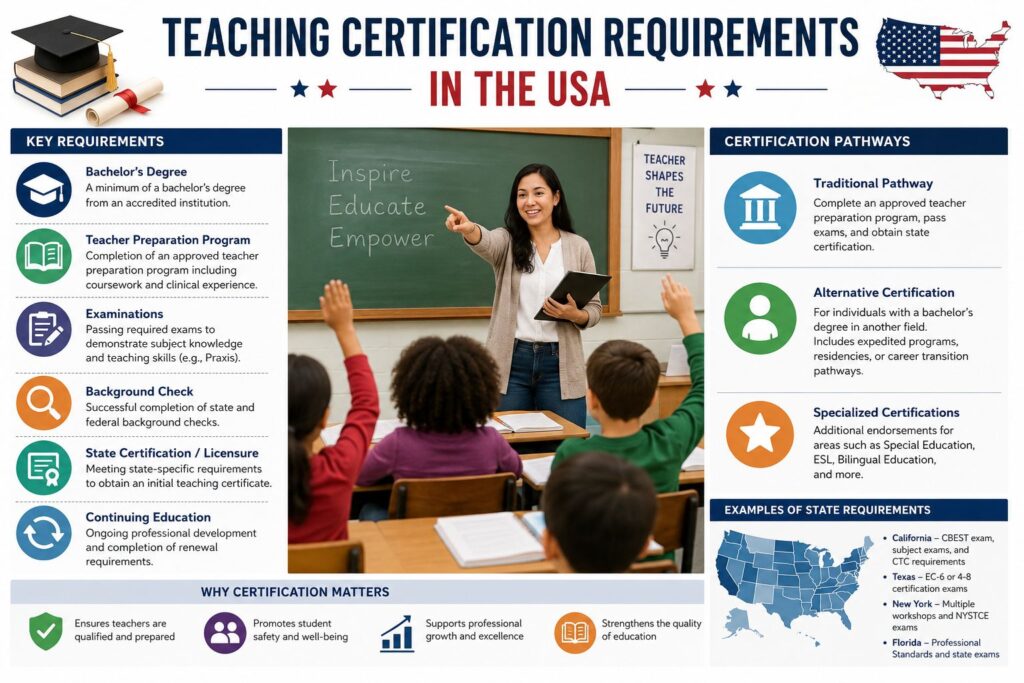
Teaching Certification Requirements in the USA, Teaching is one of the most influential professions in society, shaping the intellectual, social, and emotional development of future generations. In the United States, becoming a teacher requires meeting specific certification requirements established by individual states. These requirements are designed to ensure that educators possess the knowledge, skills, and professional competencies necessary to provide high-quality instruction and support student learning. Although certification standards vary from state to state, there are common elements across the country, including educational qualifications, teacher preparation programs, examinations, background checks, and continuing professional development.
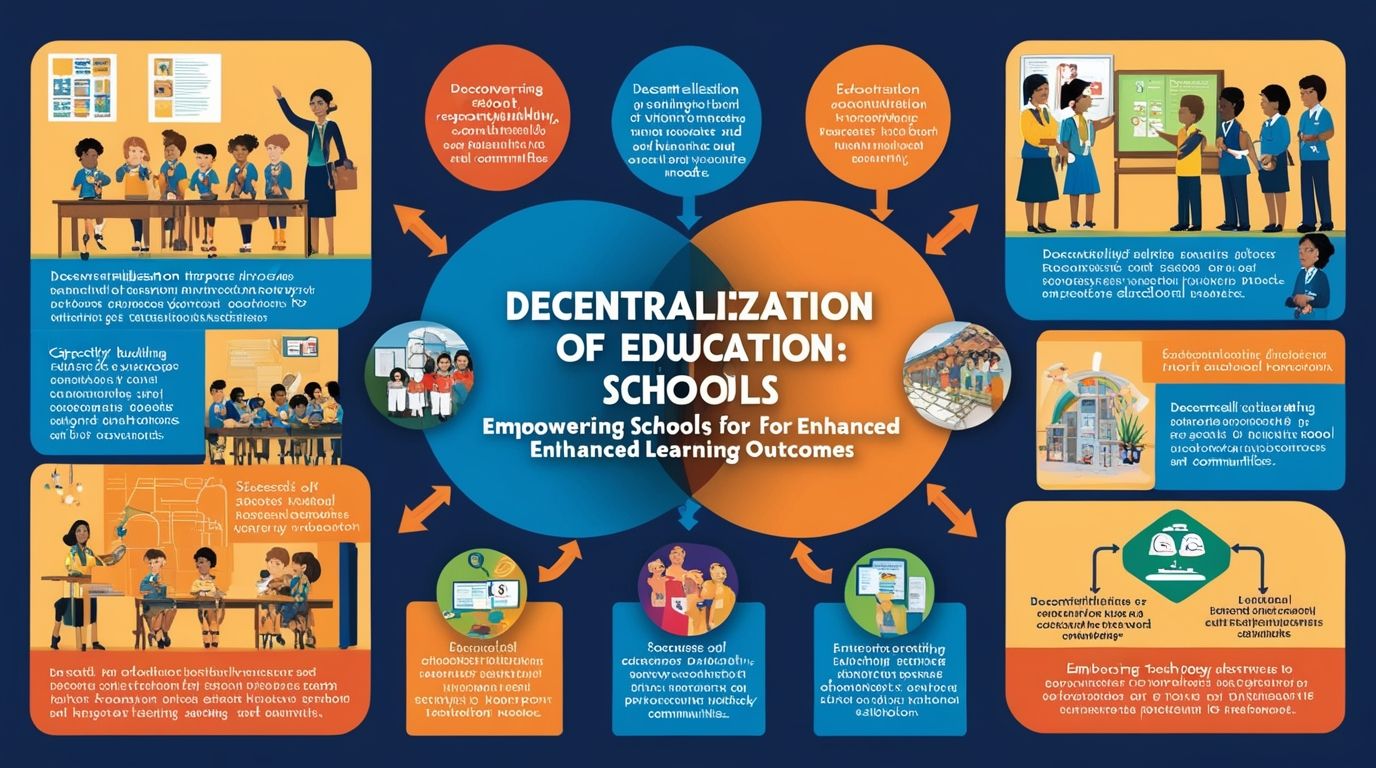
The teacher certification system in the United States reflects the nation’s decentralized educational structure. Unlike countries with a national certification framework, each U.S. state has its own department of education that establishes and regulates teacher licensing requirements. Consequently, aspiring teachers must understand the requirements specific to the state in which they intend to work. This article explores the teaching certification requirements in the USA, examining educational qualifications, licensure pathways, state-specific variations, alternative certification routes, and ongoing professional responsibilities.
Understanding Teacher Certification
Teacher certification, also known as teacher licensure, is an official credential granted by a state education agency that authorizes an individual to teach in public schools. Certification serves as evidence that a teacher has met established professional standards and possesses the qualifications necessary to educate students effectively.
The primary purpose of teacher certification is to ensure educational quality and accountability. Certified teachers are expected to demonstrate subject matter expertise, pedagogical knowledge, classroom management skills, and ethical professional conduct. Certification also helps protect students by requiring background checks and adherence to professional standards.
In most states, teachers working in public schools must hold valid teaching certificates. Private schools may have different requirements and, in some cases, may employ teachers without state certification. However, many private institutions prefer or require certified teachers due to the professional credibility associated with licensure.
Educational Requirements
A bachelor’s degree is the minimum educational requirement for teacher certification in all U.S. states. Most prospective teachers earn a Bachelor of Education (B.Ed.) or a bachelor’s degree in a specific subject area such as mathematics, science, English, history, or elementary education.
Teacher preparation programs are a critical component of the certification process. These programs are offered by accredited colleges and universities and combine academic coursework with practical teaching experiences. Coursework typically includes educational psychology, instructional methods, curriculum development, assessment techniques, classroom management, and educational technology.
In addition to theoretical knowledge, teacher candidates participate in supervised field experiences and student teaching placements. Student teaching allows candidates to work in real classroom settings under the guidance of experienced mentor teachers. This practical training helps aspiring educators apply instructional theories, develop classroom management skills, and gain firsthand experience in lesson planning and student assessment.
Accreditation of teacher preparation programs is important because many states require candidates to complete programs approved by recognized accrediting bodies. Accreditation ensures that programs meet established standards for quality and effectiveness.
Teacher Preparation Programs
Teacher preparation programs play a central role in the certification process. These programs are designed to equip future educators with both content knowledge and pedagogical expertise. Traditional teacher preparation programs generally include three major components:
Academic Coursework
Candidates study educational theories, child and adolescent development, instructional strategies, special education principles, and classroom assessment techniques. They also complete coursework in their chosen teaching subject.
Clinical Experiences
Field observations and classroom practicums provide opportunities to observe experienced teachers and interact with students in authentic educational settings.
Student Teaching
Student teaching is often considered the capstone experience of teacher preparation. During this period, candidates assume increasing responsibility for classroom instruction while receiving feedback and supervision from mentor teachers and university supervisors. Successful completion of a teacher preparation program is usually required before applying for initial teacher certification.
Certification Examinations
Most states require teacher candidates to pass one or more examinations before receiving certification. These tests assess academic skills, subject matter knowledge, and teaching competencies. Common categories of certification examinations include:
Basic Skills Tests
These assessments measure proficiency in reading, writing, and mathematics. They ensure that teachers possess foundational academic skills necessary for effective instruction.
Subject Area Tests
Candidates must demonstrate expertise in the content area they intend to teach. For example, a mathematics teacher may be required to pass a mathematics content examination.
Pedagogy Tests
These assessments evaluate knowledge of instructional methods, classroom management, assessment practices, and educational principles.
Many states utilize examinations developed by the Educational Testing Service (ETS), including the Praxis series. However, some states administer their own certification examinations tailored to state-specific standards. Passing scores vary among states, and candidates must meet the required benchmarks to qualify for certification.
Background Checks and Professional Conduct
Protecting student safety is a fundamental priority in education. Therefore, all states require teacher candidates to undergo criminal background checks before receiving certification.
Background screening typically includes:
- Fingerprinting
- Criminal history reviews
- Federal and state database checks
- Verification of professional conduct records
Individuals with certain criminal convictions may be denied certification, although eligibility determinations often depend on the nature and circumstances of the offense. Teachers are also expected to adhere to professional codes of ethics. Violations such as misconduct, fraud, abuse, or inappropriate relationships with students may result in disciplinary action, suspension, or revocation of certification.
Types of Teaching Certificates
Teacher certification systems generally include multiple levels of licensure.
Initial or Provisional Certification
New teachers typically receive an initial license after completing educational requirements, examinations, and background checks. This certificate often remains valid for a limited period, such as three to five years.
Professional Certification
After gaining teaching experience and meeting additional requirements, educators may qualify for professional certification. Professional licenses generally have longer validity periods and indicate a higher level of professional competency.
Advanced Certification
Some states offer advanced certifications for experienced teachers who complete graduate education, demonstrate exceptional teaching performance, or earn specialized credentials.
Specialized Certifications
Teachers may obtain endorsements or certifications in specialized areas such as:
- Special Education
- English as a Second Language (ESL)
- Bilingual Education
- Reading Specialist
- School Counseling
- Educational Leadership
These specialized credentials allow educators to work with specific student populations or assume leadership roles.
State-Specific Certification Requirements
One of the most distinctive features of teacher certification in the United States is state autonomy. Each state establishes its own licensure requirements, standards, and procedures.
For example:
- California requires candidates to complete approved preparation programs and pass state-specific examinations.
- Texas utilizes a combination of educator preparation programs and certification exams.
- New York requires workshops on child abuse prevention, school violence prevention, and dignity for all students.
- Florida has multiple certification pathways, including temporary and professional certificates.
Although requirements differ, most states share common expectations related to education, examinations, and professional training.
State departments of education provide detailed guidance regarding certification procedures, application processes, and eligibility criteria.
Interstate Certification Reciprocity
Teacher mobility is increasingly important in the modern workforce. To facilitate movement between states, many states participate in reciprocity agreements.
Reciprocity does not necessarily guarantee automatic certification. Instead, it may allow certified teachers from one state to obtain licensure in another state with fewer additional requirements.
Teachers seeking certification in a new state may need to:
- Submit official transcripts
- Verify teaching experience
- Pass additional examinations
- Complete state-specific training requirements
The National Association of State Directors of Teacher Education and Certification (NASDTEC) supports interstate collaboration and reciprocity efforts.
Alternative Certification Pathways
Recognizing the need to address teacher shortages and attract professionals from diverse backgrounds, many states offer alternative certification routes. Alternative certification programs enable individuals who already possess bachelor’s degrees in non-education fields to become teachers. Common alternative pathways include:
Alternative Teacher Preparation Programs
Candidates complete accelerated training while teaching under supervision.
Residency Programs
Participants engage in intensive classroom experiences alongside experienced mentor teachers.
Career Transition Programs
Professionals from fields such as engineering, business, healthcare, and science can transition into teaching through specialized certification routes. Alternative certification programs help schools recruit qualified individuals in high-demand subjects, particularly mathematics, science, technology, and special education.
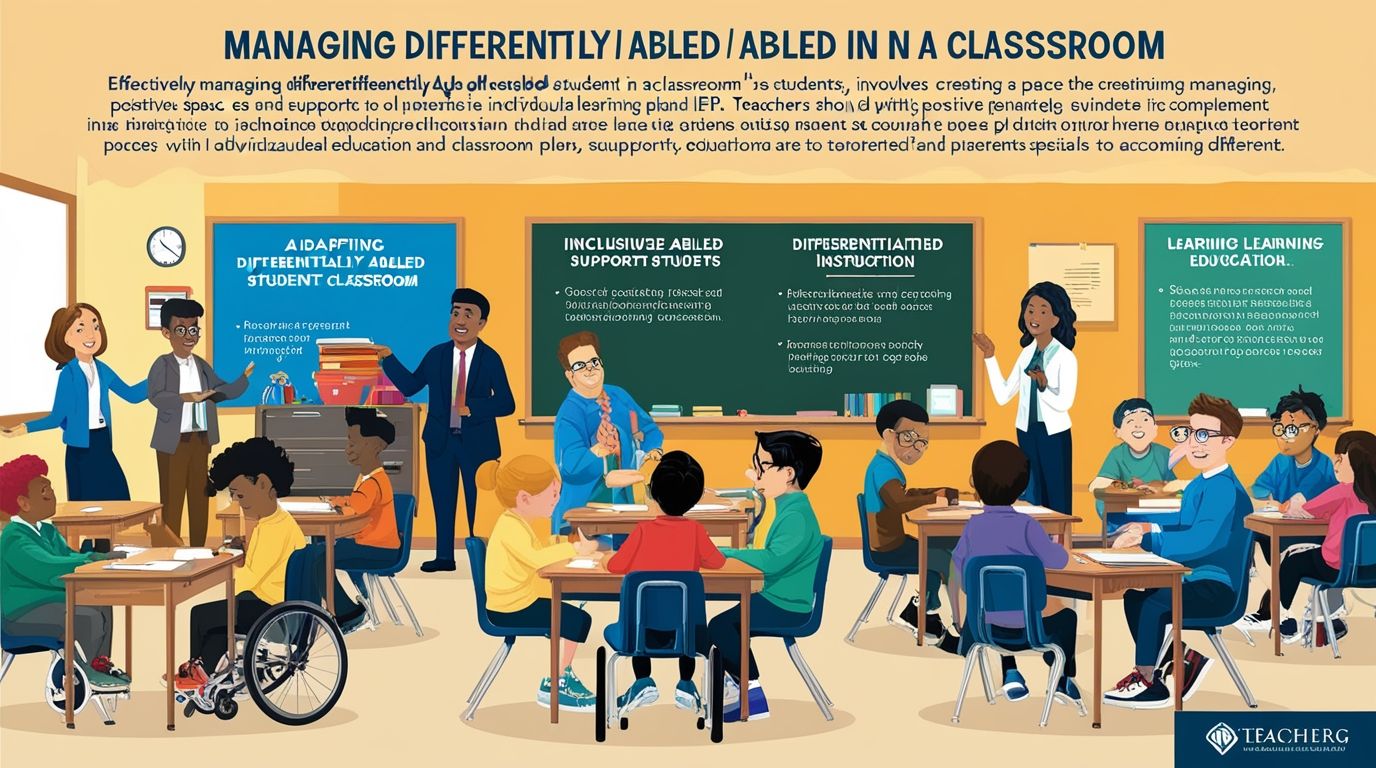
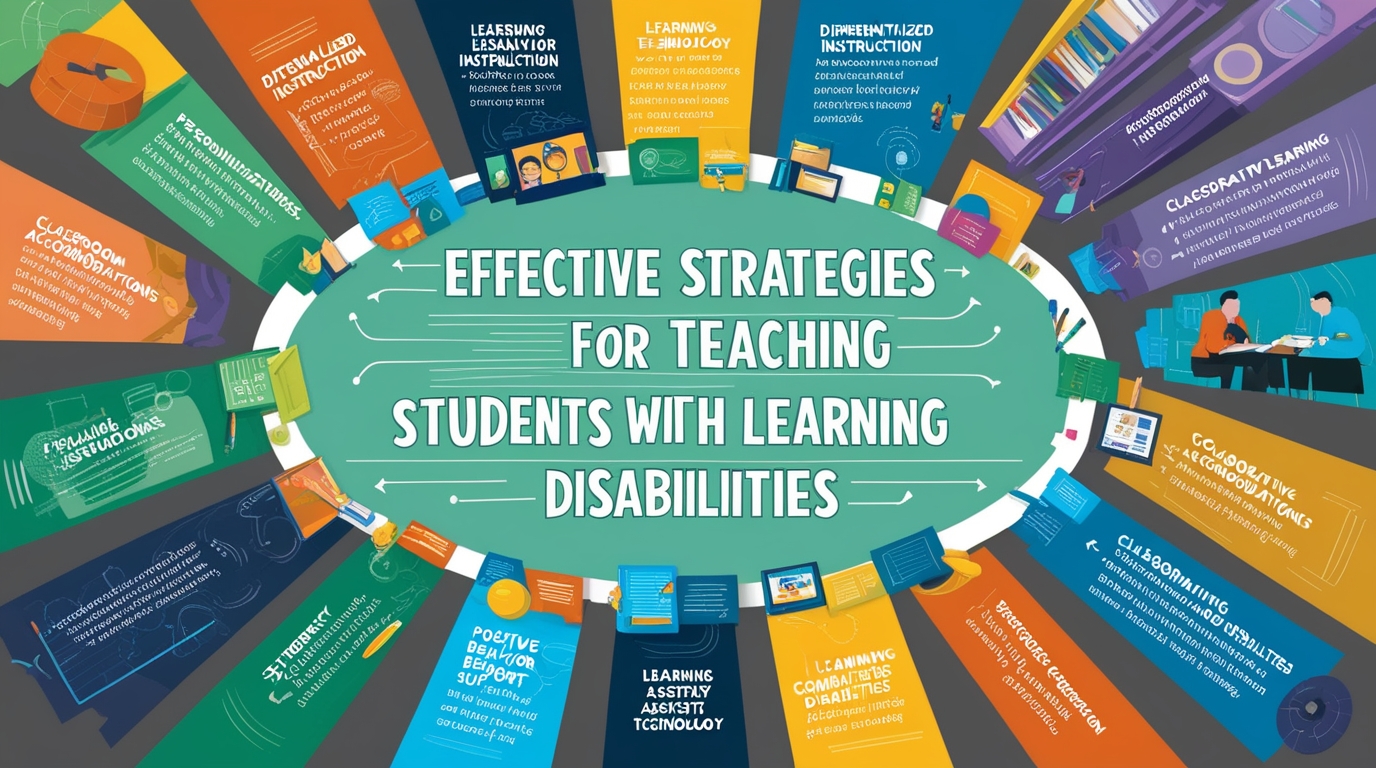
Certification for Special Education Teachers
Special education teachers must meet additional certification requirements due to the specialized nature of their responsibilities. These educators work with students who have disabilities and require individualized educational support. Requirements often include:
- Specialized coursework in special education
- Training in individualized education programs (IEPs)
- Knowledge of disability laws and regulations
- Additional examinations in special education
Special education certification prepares teachers to address diverse learning needs and promote inclusive educational environments.
Continuing Education and License Renewal
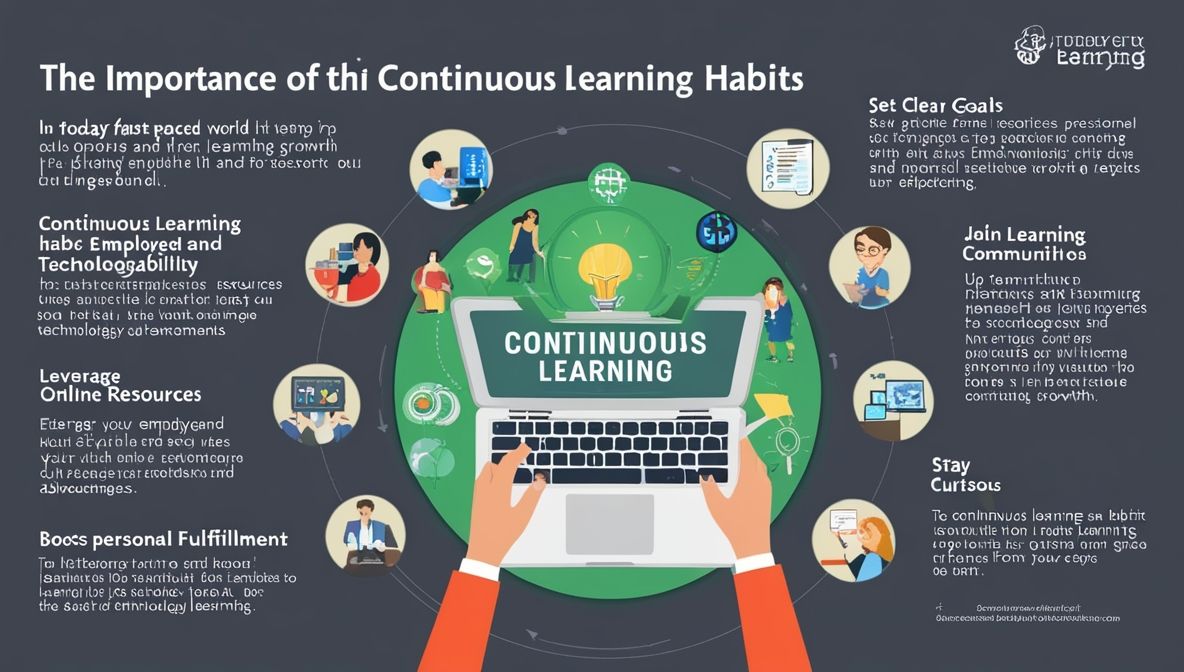
Teacher certification is not a one-time achievement. Most states require educators to participate in ongoing professional development to maintain licensure. Professional development activities may include:
- Workshops
- Conferences
- Graduate coursework
- Online training programs
- Professional learning communities
License renewal requirements vary among states but often involve completing a specified number of professional development hours within a renewal cycle. Continuing education helps teachers remain informed about educational research, technological innovations, instructional strategies, and policy changes.
National Board Certification
In addition to state licensure, teachers may pursue voluntary certification through the National Board for Professional Teaching Standards (NBPTS). National Board Certification is considered one of the highest professional credentials in education. It recognizes accomplished teaching practice through a rigorous assessment process. Benefits of National Board Certification include:
- Professional recognition
- Career advancement opportunities
- Enhanced instructional effectiveness
- Potential salary incentives in some states and districts
Although not required for employment, National Board Certification demonstrates a commitment to excellence and lifelong professional growth.
Challenges and Emerging Trends
Teacher certification systems continue to evolve in response to changing educational needs.
Several challenges and trends influence certification policies:
Teacher Shortages
Many regions experience shortages of qualified teachers, particularly in rural communities and high-need subject areas. States increasingly use alternative certification pathways to address these shortages.
Diversity in the Teaching Workforce
Educational leaders seek to increase workforce diversity by expanding access to certification opportunities for underrepresented groups.
Technology Integration
Modern certification standards increasingly emphasize digital literacy, online instruction, and educational technology competencies.
Competency-Based Assessment
Some states are exploring performance-based assessments that evaluate practical teaching skills rather than relying solely on standardized examinations.
Teacher Retention
Certification policies are being examined to ensure they support teacher recruitment and retention while maintaining professional standards.
Conclusion
Teacher certification in the United States is a comprehensive process designed to ensure that educators possess the qualifications, knowledge, and professional competencies necessary for effective teaching. While certification requirements vary among states, common elements include earning a bachelor’s degree, completing a teacher preparation program, passing certification examinations, undergoing background checks, and engaging in ongoing professional development.
The decentralized nature of the American education system allows states to tailor certification standards to local needs while maintaining high expectations for educator quality. Alternative certification pathways have expanded opportunities for individuals from diverse professional backgrounds to enter teaching, helping address workforce shortages and enrich the profession.
As education continues to evolve, teacher certification systems must balance accountability, accessibility, and innovation. By maintaining rigorous standards while adapting to changing educational demands, certification programs play a vital role in preparing teachers who can support student success and contribute to the advancement of society. Ultimately, effective teacher certification strengthens the educational system and helps ensure that every student has access to qualified, capable, and dedicated educators.