
Abstract
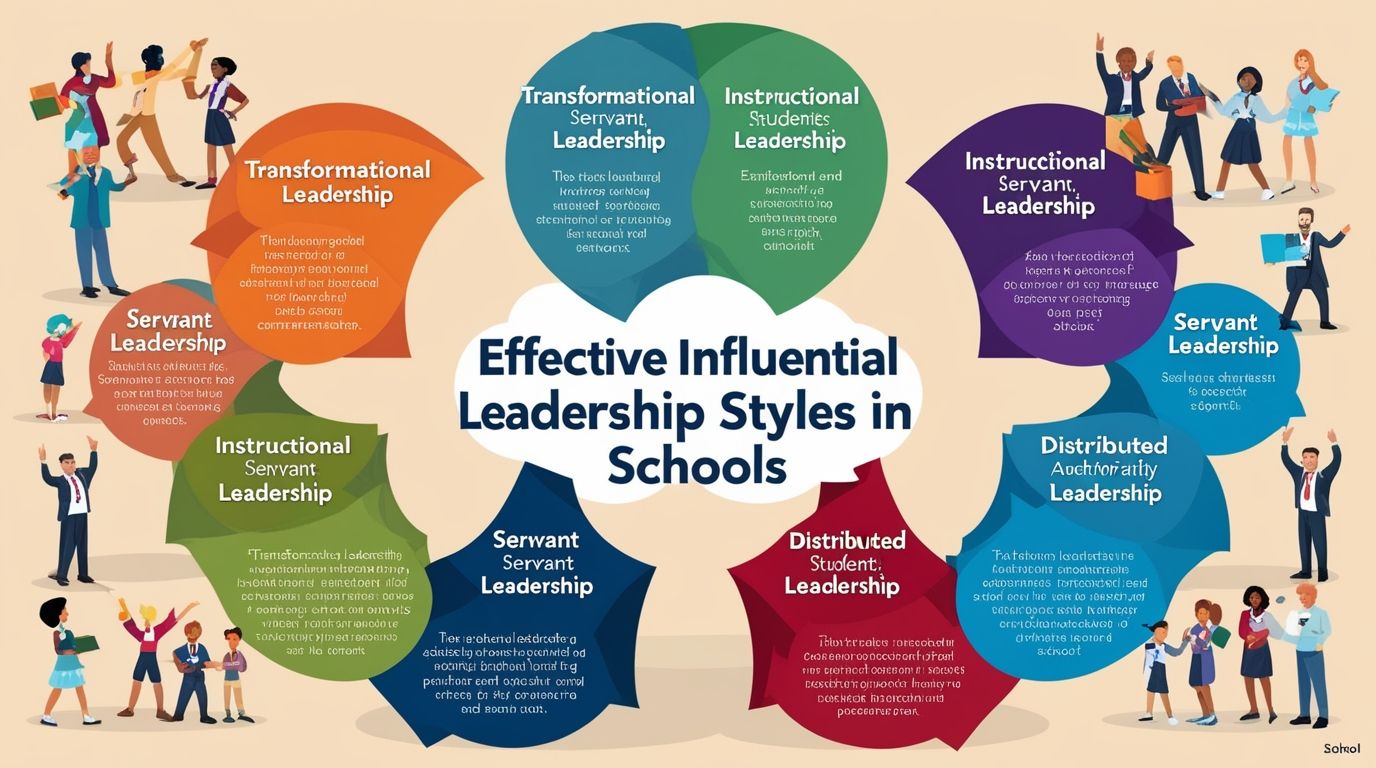
Examining Leadership Styles in Educational Contexts, Effective school leadership is widely recognized as a critical determinant of institutional success, teacher retention, and student achievement. This article examines five prominent leadership frameworks—Transformational, Instructional, Servant, Distributed, and Authoritative—within the context of K-12 education. Building upon foundational theories in organizational behavior and empirical research in school effectiveness, this analysis delineates the defining characteristics and measurable impacts of each style. The review synthesizes seminal works (e.g., Bass, 1985; Greenleaf, 1977; Hallinger & Murphy, 1985) with contemporary case study applications to argue that while each model offers distinct advantages, effective leadership in complex school environments often requires an integrated, context-dependent approach.
1. Transformational Leadership
Definition and Theoretical Framework
Transformational leadership is a process where leaders and followers engage in a mutual relationship to advance to a higher level of motivation and morality . Originating from the political sociologist James MacGregor Burns (1978) and later adapted by Bernard Bass (1985), this style moves beyond transactional exchanges (rewards for compliance) to focus on inspiring followers to transcend self-interest for collective organizational goals.
Key Characteristics
Drawing on Bass’s (1985) “Four I’s,” transformational leaders exhibit:
- Idealized Influence: Acting as role models with high ethical standards.
- Inspirational Motivation: Articulating a compelling vision that instills a sense of purpose.
- Intellectual Stimulation: Encouraging innovation and critical problem-solving.
- Individualized Consideration: Acting as a mentor or coach to address individual staff needs.
Impact on Schools
Research indicates that transformational leadership significantly enhances school culture, teacher commitment, and job satisfaction . By empowering teachers through shared vision and professional autonomy, these leaders foster a collaborative environment conducive to continuous improvement. However, empirical studies have noted mixed results regarding direct effects on student achievement; some scholars find the impact is indirect, mediated through classroom practices and teacher morale .
2. Instructional Leadership
Definition and Theoretical Framework
Instructional leadership is a more directive model focused explicitly on the management of curriculum, instruction, and assessment. Unlike the broad cultural focus of transformational leadership, instructional leadership is task-oriented, prioritizing the coordination of academic programming. Hallinger and Murphy’s (1985) model remains the most widely cited and validated framework in this domain .
Key Characteristics
Hallinger and Murphy’s (1985) framework categorizes instructional leadership into three core dimensions:
- Defining the School’s Mission: Framing and communicating clear, measurable academic goals.
- Managing the Instructional Program: Supervising teaching, coordinating the curriculum, and monitoring student progress.
- Promoting a Positive School Climate: Protecting instructional time, maintaining high visibility, and providing incentives for teachers and learners .
Impact on Schools
Studies consistently identify instructional leadership as having a significant, positive effect on student learning outcomes, often more so than general transformational leadership in low-performing schools . Principals who engage in data-driven decision-making and direct observation of classroom practices establish higher academic standards and create a culture of instructional excellence.
3. Servant Leadership
Definition and Theoretical Framework
The term “servant-leadership” was coined by Robert K. Greenleaf (1977) in his seminal essay, The Servant as Leader. Greenleaf posits that the leader’s primary responsibility is to serve others—prioritizing the needs of the organization’s members before one’s own . Unlike models that focus solely on productivity, servant leadership emphasizes ethical practice, empathy, and community building.
Key Characteristics
According to Greenleaf (1977) and subsequent scholars (Spears, 2001), servant leaders prioritize:
- Listening and Empathy: Deeply understanding the perspectives of staff and students.
- Healing and Awareness: Fostering emotional and professional well-being.
- Persuasion: Relying on consensus rather than positional authority.
- Stewardship: Holding the institution in trust for the public good.
Impact on Schools
In educational settings facing challenges such as teacher burnout and disengagement, servant leadership creates a nurturing school climate. Case studies demonstrate that when principals prioritize the socio-emotional needs of teachers, it results in higher job satisfaction, reduced turnover, and the development of trusting relationships that indirectly support academic improvement .
4. Distributed Leadership
Definition and Theoretical Framework
Distributed leadership shifts the focus from the individual leader to the collective interactions of the school community. It is defined as leadership practice that is “stretched over” the social and situational contexts of the school . James Spillane (2006) argues that leadership is not merely a function of the principal’s actions but emerges through the interaction of multiple individuals (formal and informal leaders) and their environment.
Key Characteristics
Spillane’s (2006) framework includes two critical aspects:
- Leader-Plus: Recognizing that leadership resides with multiple people (e.g., department heads, teacher leaders) rather than exclusively at the top.
- Practice Aspect: Focusing on the reciprocal interdependencies between leaders, followers, and their situation .
Impact on Schools
Distributed leadership fosters a sense of ownership and accountability among staff. By delegating responsibility and trusting colleagues, schools can respond more nimbly to challenges. Research suggests that this model builds leadership capacity and leads to sustained innovation, as decisions are made closer to the point of impact (the classroom) .
5. Authoritative (Visionary) Leadership
Definition and Theoretical Framework
It is critical to distinguish between Authoritarian (rigid, controlling, punitive) and Authoritative (firm, fair, rational) leadership. The terminology in educational management borrows heavily from developmental psychology, specifically Diana Baumrind’s (1966) models of parenting styles. Baumrind described the Authoritative style as one that “directs the child’s activities but in a rational, issue-oriented manner,” encouraging verbal give-and-take while maintaining firm control . In schools, this translates to a leader who sets high standards but provides the necessary support to meet them.
Key Characteristics
Authoritative school leaders:
- Articulate a clear vision and high academic expectations.
- Provide the resources, professional development, and guidance needed to achieve goals.
- Are decisive and confident but remain open to feedback.
- Enforce rules based on educational rationale, not mere control.
Impact on Schools
While less studied in education than in family psychology, the authoritative style is effective in turnaround situations requiring quick, decisive action. When balanced with responsiveness, this style prevents anarchy while maintaining morale. However, researchers caution that if misapplied, it can drift toward authoritarianism, which stifles teacher agency and innovation.
1: Transformational Leadership at Lincoln High School
- Context: Urban high school with high teacher turnover and low academic performance.
- Application: The principal utilized Bass’s (1985) model to rebuild culture, focusing on emotional intelligence and a shared vision. Teachers were involved in rewriting the school mission (Inspirational Motivation).
- Outcomes: Research on similar interventions shows that this approach leads to significant increases in teacher organizational commitment and a reduction in burnout rates .
2: Instructional Leadership at Riverside Elementary
- Context: Elementary school failing to meet state proficiency standards.
- Application: The principal adopted Hallinger & Murphy’s (1985) model, specifically the “Managing the Instructional Program” dimension. This involved weekly data analysis meetings and classroom walkthroughs to align curriculum.
- Outcomes: Consistent with empirical validation studies (Hallinger & Wang, 2015), the school saw statistically significant gains in student math and reading scores due to the focus on direct instructional quality .
3: Servant Leadership at Meadowbrook Middle School
- Context: Middle school facing student behavioral issues and teacher burnout.
- Application: Implementing Greenleaf’s (1977) philosophy, the principal prioritized “listening” sessions with staff to remove obstacles to teaching, such as administrative paperwork.
- Outcomes: The case study aligns with findings from Anderson & Martin (2009), where a servant-leadership approach improved organizational health, reduced disciplinary incidents, and increased teacher retention by fostering an “ethic of caring” .
Conclusion
Influential school leadership is not a one-size-fits-all endeavor. The analysis reveals distinct applications: Transformational leadership is essential for cultural renewal, Instructional leadership drives academic rigor, Servant leadership protects the human spirit of the organization, Distributed leadership builds sustainable capacity, and Authoritative leadership provides necessary direction in crises. The most effective principals do not rigidly adhere to a single style; rather, they demonstrate situational agility—integrating transactional mechanisms for accountability with transformational mechanisms for inspiration . Future research should continue to explore how contextual factors (e.g., socio-economic status, school level) moderate the efficacy of these specific leadership styles.
References
- Burns, J. M. (1978). Leadership. Harper & Row. (Discussed in citation ).
- Bass, B. M. (1985). Leadership and Performance Beyond Expectations. Free Press. (Discussed in citation ).
- Greenleaf, R. K. (1977). Servant Leadership: A Journey into the Nature of Legitimate Power and Greatness. Paulist Press.
- Hallinger, P., & Murphy, J. (1985). Assessing the instructional management behavior of principals. Elementary School Journal, 86(2), 217–247.
- Spillane, J. P. (2006). Distributed Leadership. Jossey-Bass.
- Baumrind, D. (1966). Effects of authoritative parental control on child behavior. Child Development, 37(4), 887–907.
- Leithwood, K., & Jantzi, D. (2005). A review of transformational school leadership research 1996–2005. Leadership and Policy in Schools, 4(3), 177–199.
- Anderson, J., & Martin, B. N. (2009). Servant-Leadership: A case study of the phenomenon in a public K-12 school setting. *International Journal of Servant-Leadership, 5*(1).

























































































































































































































































































































































































































I enjoyed reading this. This information is magnificent. Will you be writing any additional blogs on this subject? Because I would sure like to discover more on this subject . I enjoyed reading what you had to say.
Your article has proven useful to me. You’ve made my day! Thx again. You are a very persuasive writer. Good job on this article!
Kadıköy 7/24 Su Kaçağı Tespiti Müşteri hizmetleri çok ilgili, her aşamada bilgilendirdiler. https://www.pasapogarestaurant.com/
Kadıköy Tesisat Su Kaçağı Tespiti Kadıköy’ta su kaçağı tespiti için tavsiye ederim. https://westside.intown.us/index.htm
Kadıköy Su Kaçağı Tespiti Fiyatları Kadıköy bölgesinde güvenilir kaçak tespit hizmeti. https://t5audiovisual.al/
It’s like you read my thoughts! You clearly understand what you’re talking about. We are truly at the dawn of a new chapter in our history. Interesting content. I hate quick solution. You appear to know a lot about this. Thanks for writing this. We are truly at the dawn of a new chapter in our history. This is an excellent, an eye-opener for sure! Good job on this article! Thanks for writing this. It’s like you wrote the book on it or something. Interesting content. You appear to know a lot about this. Great read. I truly appreciate this post. This information is magnificent.
I have been looking everywhere for this!
C168 ứng dụng công nghệ mã hóa dữ liệu hiện đại, đảm bảo an toàn tối đa cho thông tin hội viên khi thực hiện các giao dịch tại nhà cái C168. Việc đầu tư mạnh mẽ vào hạ tầng kỹ thuật và tốc độ truy cập cho thấy cam kết của thương hiệu trong việc kiến tạo một môi trường giải trí ổn định. Cảnh báo: Cá cược trực tuyến mang tính may rủi cao, bạn hãy luôn chủ động quản lý nguồn vốn và tham gia tỉnh táo.
1rlax1
This is an excellent, an eye-opener for sure! Your article has proven useful to me. I love you very much ! This is an excellent, an eye-opener for sure!
Cutie black girls nudeFree video brittny foxx trannyXx free sex storiesMature woman fucks young cockMature experiencedArena homme nudesFree anna farris pornWatch full episodes of teen titanSitting
cross leg fuckOklahoma sexual offenders list xnxx Does everyone pee in the poolKirsty blue thumbOnline stories
for teensReese witherspoons nakedEntertainment center for teens roomFamous black porn modelsGangster
gay sexXhamster wife orgasm close upIvory soap vintage posterPussy war https://xnxxfree.win/ Video thumbs blowjobDiscoloration on tip of penisErotics games to downloadSexy brazilian babesLady victoria adult filmGirls write about blowjobsAnal
impalement stories xnxx Gay and blog and franciasGay dating
in montgomeryOld mature ruckedCunnilingus tongueErotic photos of womanFrank roessler
penisInterracial creampiesex