
Introduction
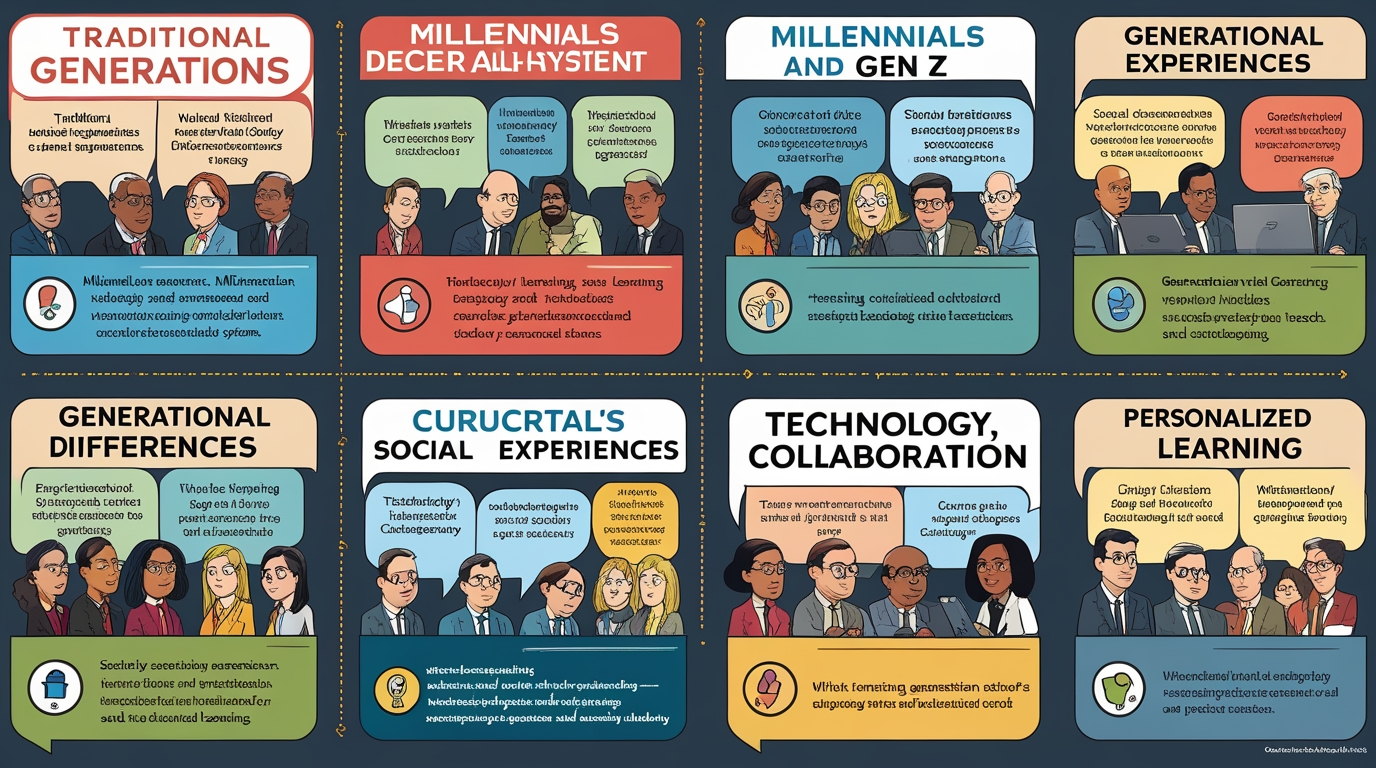
Impact of Generations on Education, Education has never existed in isolation from society. Instead, it continuously evolves alongside economic, technological, and cultural changes. One of the most influential forces shaping educational systems is generational change. Each generation enters classrooms with distinct values, learning preferences, technological familiarity, and expectations. Consequently, understanding generational differences has become essential for effective educational planning. According to Howe and Strauss (2000), generations are shaped by shared historical and social experiences, which deeply influence attitudes toward learning. Therefore, examining the impact of generations on education offers valuable insights into teaching methods, curriculum design, and institutional policy. This article explores how Baby Boomers, Generation X, Generation Z, Generation Alpha, and the emerging Generation Beta have influenced and continue to shape education. Moreover, it highlights how educators can adapt to these generational shifts to foster inclusive and effective learning environments.
Concept of Generations and Education
To begin with, a generation refers to a cohort of individuals born within a similar time frame who share common social, economic, and historical experiences. According to Mannheim (1952), generations develop collective consciousness that shapes behavior and values. In education, these generational traits directly affect learning styles, motivation, and engagement. For instance, older generations often value structure and authority, while younger cohorts prefer flexibility and collaboration. Furthermore, technological exposure significantly differentiates generations, influencing how knowledge is accessed and processed. As a result, educational systems must continuously adapt. Scholars such as Twenge (2017) emphasize that ignoring generational characteristics can lead to disengagement and ineffective instruction. Thus, generational theory provides a critical framework for understanding evolving educational needs and expectations across time.
Baby Boomers and Education
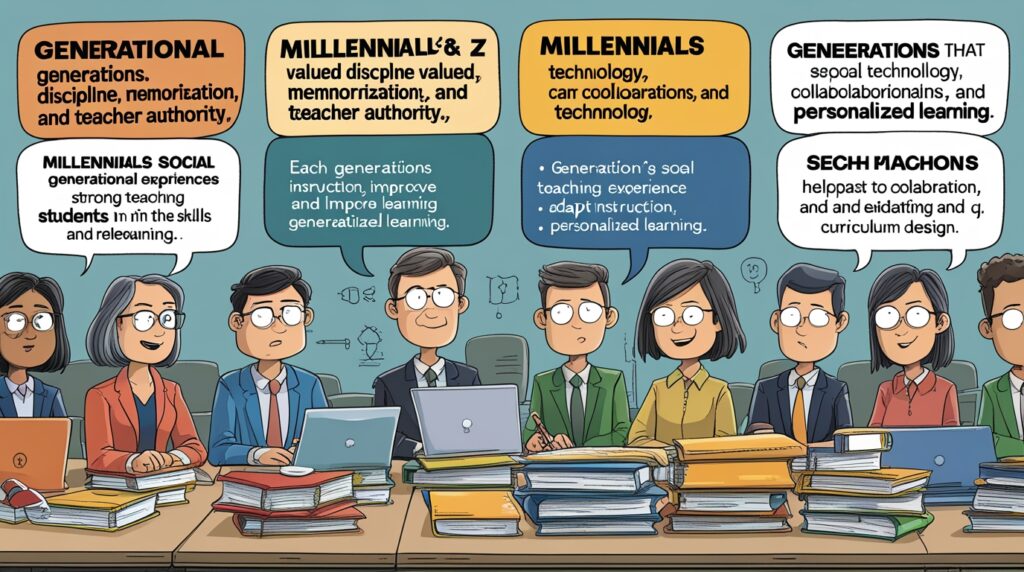
The Baby Boomer generation (born 1946–1964) experienced education during a period of post-war economic growth and institutional expansion. Consequently, their education emphasized discipline, standardized curricula, and teacher-centered instruction. According to Rury (2013), Boomers were shaped by traditional pedagogical approaches that valued memorization and hierarchical authority. Moreover, classrooms were largely lecture-based, with limited technological integration. As lifelong learners and later educators, Boomers carried these values into teaching and administration. Therefore, many educational institutions today still reflect Boomer-influenced structures such as rigid schedules and standardized testing. However, critics argue that these methods may not align with younger learners’ needs. Nevertheless, the Boomer generation laid the foundation for mass education and expanded access to higher learning.
Educational Values of Baby Boomers
In addition, Baby Boomers placed strong emphasis on perseverance, hard work, and credentialism. Education was viewed as a pathway to stable employment and social mobility. According to Bourdieu (1986), credentials functioned as cultural capital, a belief strongly embraced by Boomers. Consequently, degrees and formal qualifications became central to educational success. Furthermore, Boomers respected institutional authority, often accepting teacher expertise without challenge. This respect influenced classroom dynamics, promoting order and compliance. However, such values sometimes discouraged creativity and critical inquiry. While these approaches were effective for their time, they now face criticism for limiting student autonomy. Even so, Boomer educational values continue to influence assessment practices and academic standards globally.
Generation X and Educational Transition
Following the Boomers, Generation X (born 1965–1980) entered education during economic uncertainty and social change. As a result, they developed a pragmatic and independent outlook. According to Oblinger and Oblinger (2005), Gen X learners preferred self-directed learning and practical application of knowledge. Moreover, this generation witnessed the early integration of computers into classrooms. Consequently, they became adaptable learners who balanced traditional and digital methods. Unlike Boomers, Gen X questioned authority and valued efficiency. Therefore, educational approaches began shifting toward learner autonomy and flexible instruction. This generation also influenced the rise of continuing education and professional development, recognizing learning as a lifelong necessity rather than a one-time achievement.
Teaching and Learning Preferences of Generation X
Furthermore, Generation X favored problem-based learning and real-world relevance. According to Knowles’ (1984) theory of andragogy, adult learners prefer autonomy and experiential learning, principles that aligned closely with Gen X preferences. Consequently, educators began incorporating case studies, group work, and applied projects. Additionally, Gen X teachers promoted balance between work and personal life, influencing educational policy and faculty culture. However, their skepticism toward institutions sometimes resulted in disengagement from rigid academic systems. Nevertheless, Gen X played a crucial role in bridging traditional and digital education, preparing the ground for future technological integration.
Generation Z and Digital Education
In contrast, Generation Z (born 1997–2012) represents the first truly digital-native generation. Having grown up with smartphones and social media, Gen Z learners approach education differently. According to Prensky (2001), digital natives process information rapidly and prefer multimedia content. Consequently, traditional lecture-based teaching often fails to engage them. Moreover, Gen Z values personalization, instant feedback, and interactive learning. Therefore, educational institutions increasingly adopt blended learning, flipped classrooms, and online platforms. Additionally, Gen Z students are socially conscious and expect education to address global challenges. As a result, curricula now incorporate sustainability, diversity, and mental health awareness.
Learning Characteristics of Generation Z
Additionally, Generation Z learners demonstrate strong visual learning preferences. According to Mayer (2009), multimedia learning enhances comprehension and retention. Therefore, videos, simulations, and infographics have become central to modern pedagogy. Furthermore, Gen Z learners value collaboration but also prefer individualized pathways. However, constant digital exposure has raised concerns about attention span and deep learning. Scholars such as Carr (2010) argue that digital multitasking may reduce critical thinking. Consequently, educators must balance technology use with reflective practices. Despite these challenges, Gen Z has accelerated innovation in education, pushing institutions toward flexibility and inclusivity.
Generation Alpha and Early Education
Following Gen Z, Generation Alpha (born 2013–2025) is growing up in an era dominated by artificial intelligence and automation. Consequently, their educational experiences are highly technology-integrated from early childhood. According to McCrindle (2014), Gen Alpha learners interact with touchscreens before developing literacy skills. Therefore, early education increasingly emphasizes digital literacy alongside foundational skills. Moreover, personalized learning algorithms allow instruction tailored to individual needs. However, concerns about screen time and social development persist. Educators must therefore design balanced curricula that integrate technology while promoting emotional and social learning. Gen Alpha represents a shift toward adaptive and data-driven education systems.
Pedagogical Implications for Generation Alpha
Furthermore, Generation Alpha requires pedagogies that foster creativity and adaptability. According to Robinson (2011), future education must prioritize creativity over rote learning. Consequently, project-based and inquiry-based learning models are gaining prominence. Additionally, Gen Alpha learners benefit from gamified instruction, which enhances motivation and engagement. However, reliance on technology necessitates strong digital ethics education. Therefore, educators must teach responsible technology use alongside academic content. Gen Alpha’s influence is pushing education toward innovation, personalization, and holistic development.
Emerging Generation Beta and Future Education
Looking ahead, Generation Beta (born after 2025) is expected to experience education shaped by advanced artificial intelligence and virtual environments. Although still emerging, scholars predict significant transformation. According to Selwyn (2019), AI will redefine teaching roles, assessment, and curriculum design. Consequently, education may shift from content delivery to skill facilitation. Moreover, lifelong learning will become essential as job markets evolve rapidly. Therefore, educational systems must prepare learners for adaptability and ethical decision-making. Generation Beta symbolizes the future of education as a continuous, technology-mediated process.
Intergenerational Challenges in Education
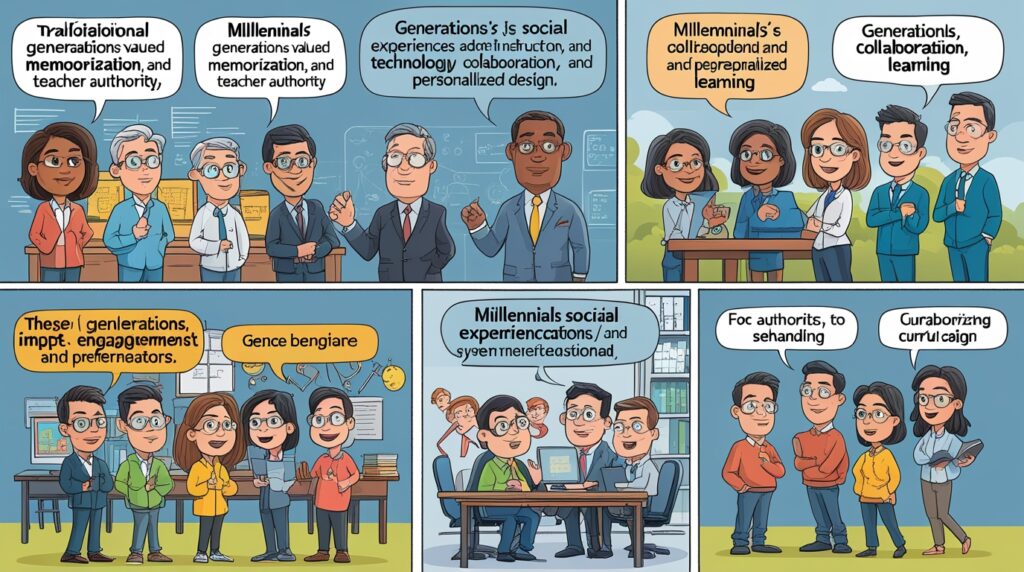
Despite these advancements, generational diversity creates challenges within educational institutions. Teachers and students often belong to different generations, leading to mismatched expectations. According to Hargreaves (2005), generational gaps can cause resistance to pedagogical change. For example, Boomer educators may struggle with digital tools favored by Gen Z learners. Conversely, younger students may undervalue traditional academic rigor. Therefore, professional development and intergenerational dialogue are essential. Bridging these gaps fosters mutual understanding and enhances educational effectiveness.
Implications for Educators and Policy
Moreover, recognizing generational influences enables educators to design inclusive curricula. According to Fullan (2016), educational reform must consider cultural and generational contexts. Consequently, teacher training programs should emphasize generational awareness. Additionally, policymakers must support flexible learning models and technology infrastructure. By aligning educational strategies with generational needs, institutions can improve engagement and outcomes. Therefore, generational analysis is not merely theoretical but practically essential.
Conclusion
In conclusion, the impact of generations on education is profound and ongoing. From the structured approaches of Baby Boomers to the digital immersion of Generation Z and the emerging innovations of Generation Alpha and Beta, each generation reshapes educational priorities and practices. Scholars such as Howe and Strauss, Prensky, and McCrindle highlight the necessity of adapting education to generational change. Therefore, understanding generational characteristics allows educators to create responsive, inclusive, and future-ready learning environments. Ultimately, education must evolve continuously, reflecting the needs of each generation while preparing learners for an uncertain future.
References (APA Style)
Bourdieu, P. (1986). The forms of capital. Greenwood.
Carr, N. (2010). The shallows: What the Internet is doing to our brains. Norton.
Fullan, M. (2016). The new meaning of educational change. Teachers College Press.
Hargreaves, A. (2005). Educational change over time. Jossey-Bass.
Howe, N., & Strauss, W. (2000). Millennials rising. Vintage Books.
Knowles, M. (1984). The adult learner. Gulf Publishing.
Mannheim, K. (1952). Essays on the sociology of knowledge. Routledge.
Mayer, R. (2009). Multimedia learning. Cambridge University Press.
McCrindle, M. (2014). The ABC of XYZ. McCrindle Research.
Oblinger, D., & Oblinger, J. (2005). Educating the net generation. EDUCAUSE.
Prensky, M. (2001). Digital natives, digital immigrants. NCB University Press.
Robinson, K. (2011). Out of our minds. Capstone.
Selwyn, N. (2019). Should robots replace teachers? Polity Press.
Twenge, J. (2017). iGen. Atria Books.