Introduction
Civil society shapes education through advocacy, community schools, and accountability. Every strong education system rests on more than classrooms and curricula. Parents, teachers’ unions, charities, faith groups, youth clubs, and local volunteers all push schools to improve. Together they form civil society, the space between the household, the market, and the state where people organize around shared goals.
The link between civil society and education runs deep. Governments set policy and fund schools, but civil society organizations (CSOs) fill gaps, test new ideas, and hold officials to their promises. In many countries, they have opened schools in places no ministry reached, collected data that changed national debates, and campaigned for laws that guaranteed every child a seat in class.
This article explains what civil society is, how it influences education, which examples prove its value, and which challenges limit its reach. It also offers practical steps for schools, donors, and community leaders who want to build stronger partnerships.
What Is Civil Society?
Civil society includes all voluntary associations that operate independently of government and business. The group covers a wide range of actors:
- Non-governmental organizations (NGOs) and charities
- Community-based organizations and village committees
- Parent-teacher associations
- Teachers’ unions and professional bodies
- Faith-based organizations
- Student groups and youth movements
- Foundations and philanthropic networks
- Independent research institutions and media watchdogs
These groups share three traits. Members join by choice, the organizations pursue public or collective benefit rather than profit, and they act independently from the state. Scholars argue that healthy civil society builds trust between citizens, a quality known as social capital. Robert Putnam’s research showed that communities rich in associations tend to have stronger schools, safer neighborhoods, and more responsive institutions.
Why Civil Society Matters for Education
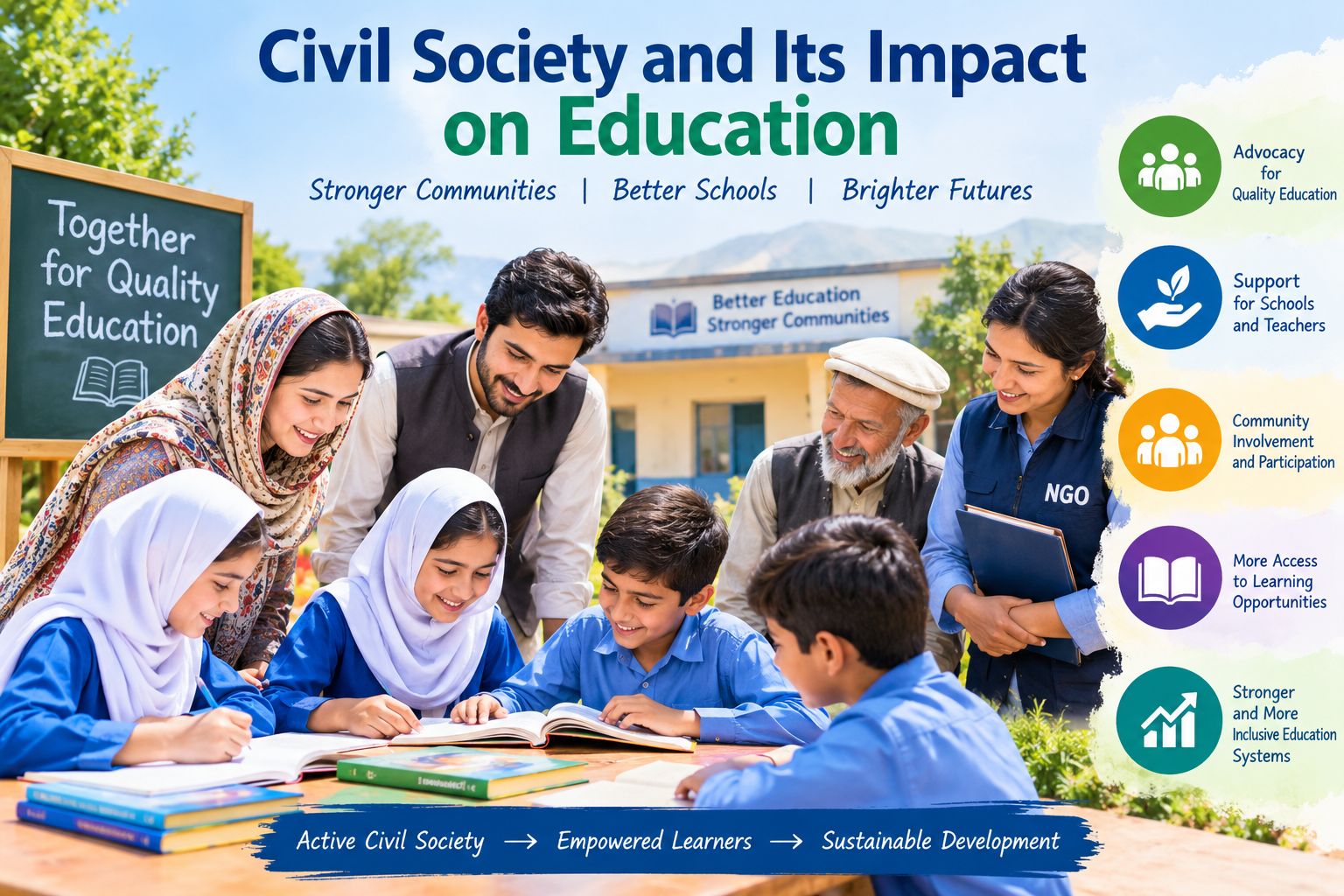
Education is a public good, yet no government can deliver it alone. Budgets run short, bureaucracies move slowly, and remote or marginalized communities often fall off official maps. Civil society answers these problems in four ways.
It reaches the excluded. Girls in conservative regions, children with disabilities, refugees, child laborers, and minority-language speakers often miss out on formal schooling. Local organizations know these families personally and design programs that fit their lives.
It innovates faster. A small nonprofit can pilot a new teaching method in a few villages, measure results, and adjust within months. Ministries then adopt what works at scale.
It gives citizens a voice. Parents who join school committees learn how budgets work, ask questions, and demand fair treatment. This participation turns passive recipients of services into active partners.
It builds accountability. Independent monitors publish learning data, audit spending, and track whether promises become results. Public pressure grounded in evidence moves policy far more effectively than private complaints.
Key Roles of Civil Society in Education
1. Expanding Access to Schooling
Many civil society organizations build and run schools where public provision falls short. BRAC in Bangladesh began a nonformal primary education program in the 1980s that gave millions of children, especially girls, a second chance to learn. In Pakistan, The Citizens Foundation operates hundreds of low-cost schools in urban slums and rural areas, and the Aga Khan Education Services supports schools in mountain and remote communities.
These efforts do not replace the state. They show what is possible, often prompting governments to extend similar services.
2. Improving the Quality of Learning
Enrollment alone does not guarantee learning. Millions of children sit in classrooms yet cannot read a simple paragraph. Civil society has pushed the conversation from attendance to outcomes.
The ASER survey, created by the Indian organization Pratham, sends volunteers into households to test whether children can read and do basic arithmetic. The model spread to Pakistan, Kenya, Tanzania, Uganda, and other countries, where citizen-led assessments revealed learning gaps that official statistics missed. The data forced governments to treat quality education as a priority, not an afterthought.
3. Advocacy and Policy Influence
Coalitions of NGOs, unions, and community groups lobby for stronger education policy. The Global Campaign for Education, formed in 1999, mobilized millions of people worldwide and helped keep education on the international agenda. National coalitions such as CAMPE in Bangladesh contribute to policy drafting, budget analysis, and public hearings.
Advocacy works best when it combines evidence with local stories. A budget analysis shows where money disappears; a parent’s testimony shows what that loss means for a child.
4. Strengthening Community Participation
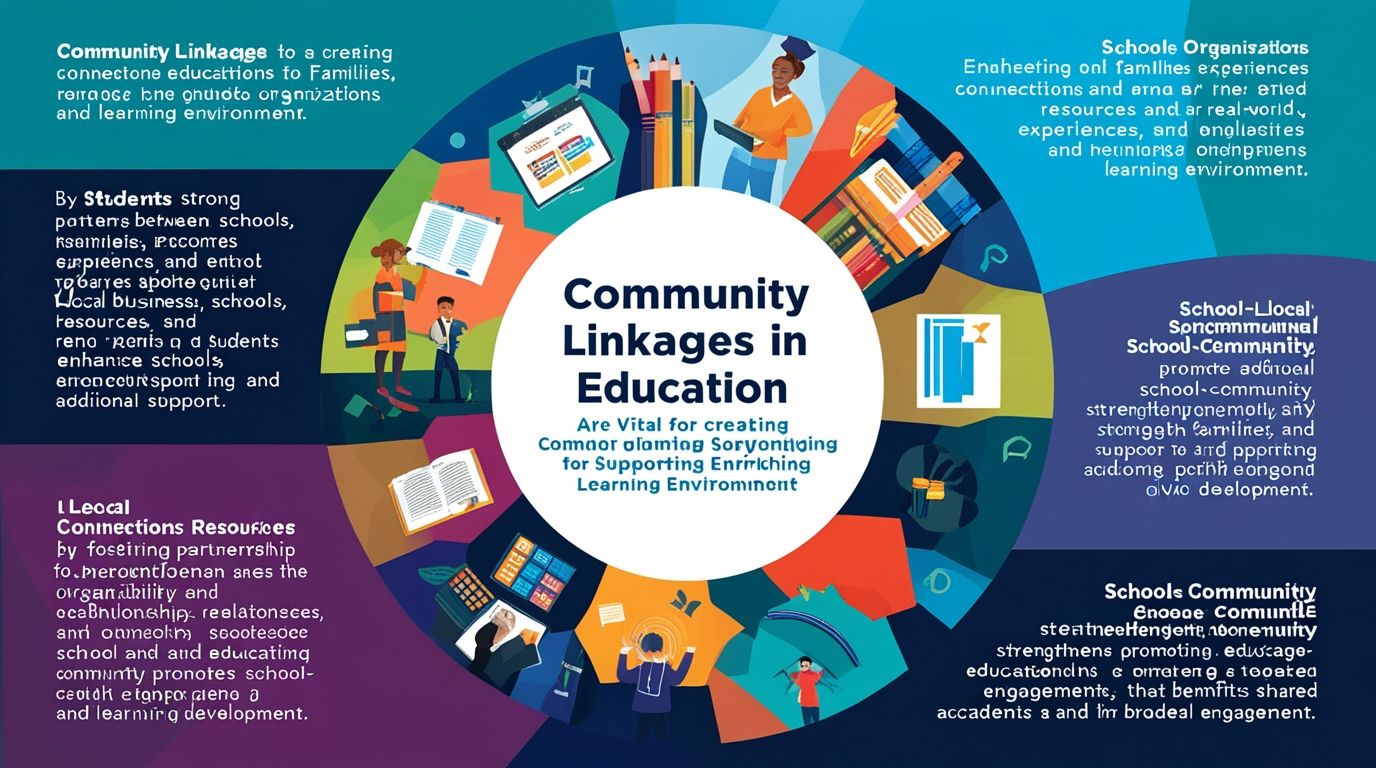
School management committees, parent groups, and village education councils connect classrooms to the neighborhoods around them. When families help monitor teacher attendance, repair buildings, or organize reading camps, schools perform better. Community participation also raises the status of teachers and reduces dropout rates, because children feel that adults around them value learning.
5. Supporting Teachers
Teachers shape learning more than any other school factor. Civil society supports them through training workshops, professional networks, mentoring, and resource libraries. Teachers’ unions defend fair pay and working conditions, which affects retention and morale. Well-run unions also collaborate on reforms rather than blocking them, a pattern visible in several high-performing systems.
6. Promoting Equity and Inclusion
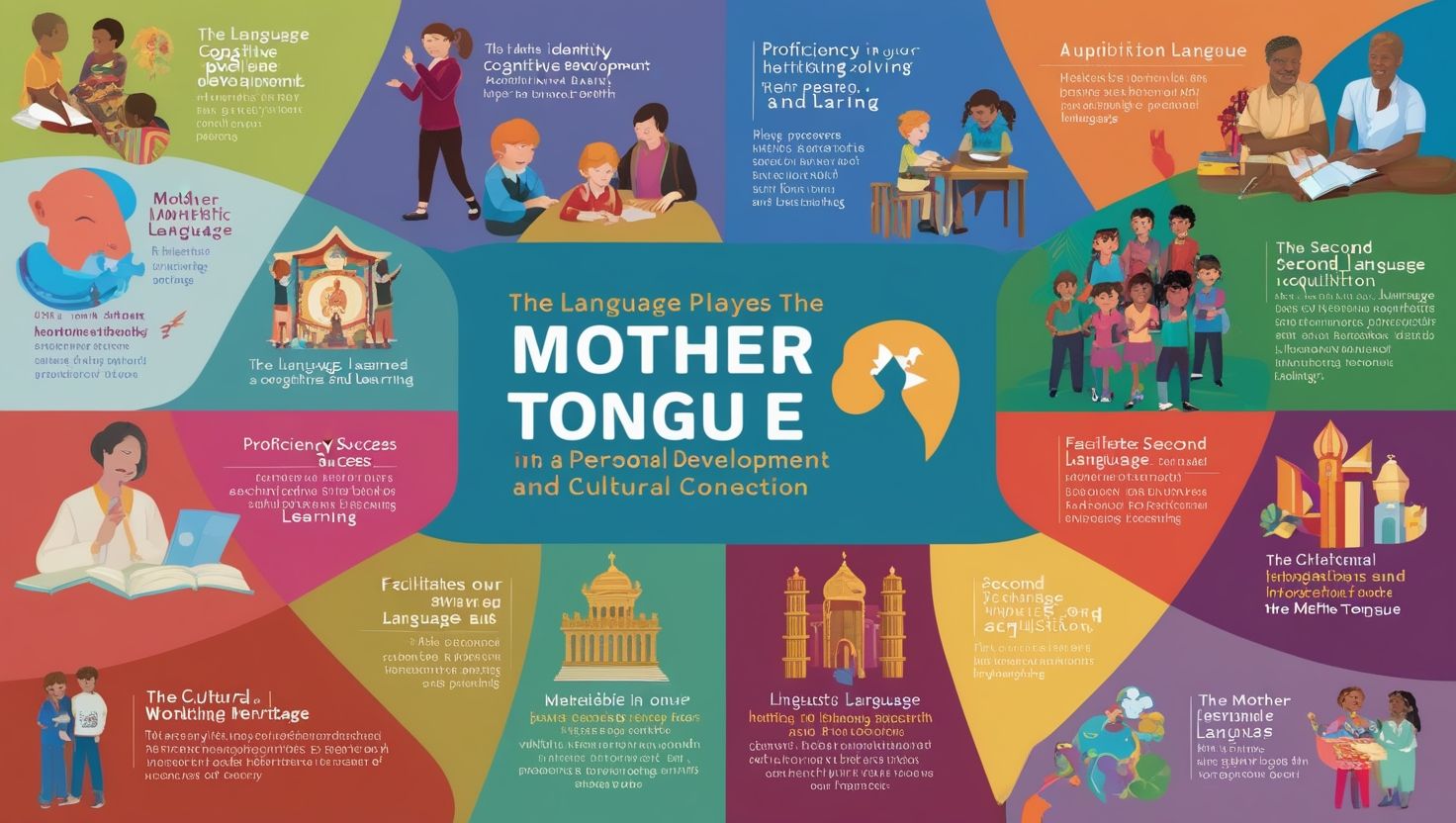
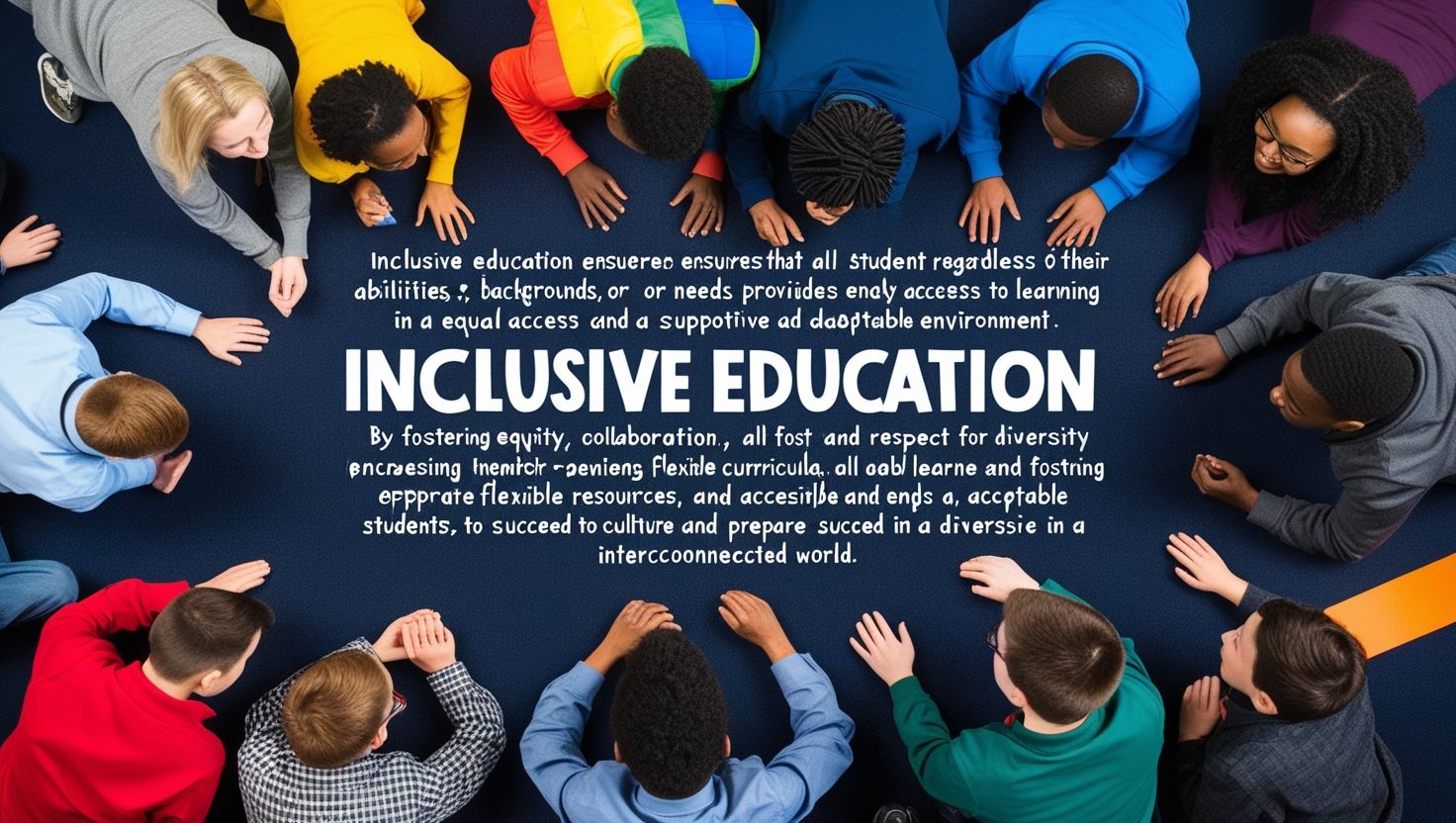
Inclusive education depends on organizations that champion groups easily forgotten. Disability rights associations push for accessible classrooms and trained specialists. Women’s groups challenge early marriage and unsafe travel routes that keep girls out of school. Indigenous and minority organizations preserve mother-tongue instruction, which research links to stronger early reading skills.
7. Expanding Lifelong and Nonformal Learning
Learning does not stop at graduation. Libraries, adult literacy circles, vocational centers, and community radio stations teach skills to people of all ages. Lifelong learning programs run by civil society help workers change careers, mothers gain literacy, and elders learn digital tools. These programs strengthen households and local economies, and they create a culture that values knowledge.
Real-World Examples of Impact
Bangladesh. BRAC’s schools, microfinance, and health programs created an integrated model that improved enrollment and gender parity. Its graduates fed into the formal system and reshaped expectations for rural girls.
India. Pratham’s reading camps and the ASER survey showed that targeted instruction, grouping children by learning level rather than grade, lifts reading ability quickly. Governments and donors adopted the approach in several states and countries.
Pakistan. The Citizens Foundation proves that community-funded schools can serve poor neighborhoods at scale. Citizen-led assessments by ASER Pakistan expose district-level learning gaps and inform local planning.
East Africa. The Uwezo initiative tested hundreds of thousands of children across Kenya, Tanzania, and Uganda. Its reports sparked national debates and pushed ministries to emphasize foundational literacy and numeracy.
Global level. UNESCO’s Global Education Monitoring Report examines how non-state actors, including NGOs, foundations, and private groups, shape education systems. It stresses that governments must regulate and coordinate these actors so that they advance equity rather than deepen divides.
Benefits of Strong Civil Society Involvement
Societies that nurture active civil society enjoy measurable advantages in education:
- Higher enrollment and completion rates, especially among girls and rural children
- Better learning outcomes through local innovation and evidence-based reform
- Greater transparency in how schools spend money
- Stronger social cohesion, because shared projects build trust across groups
- Civic skills for students, who learn democratic habits by joining clubs, debates, and service projects
- Resilience during crises, as community networks keep children learning through conflict, floods, or pandemics
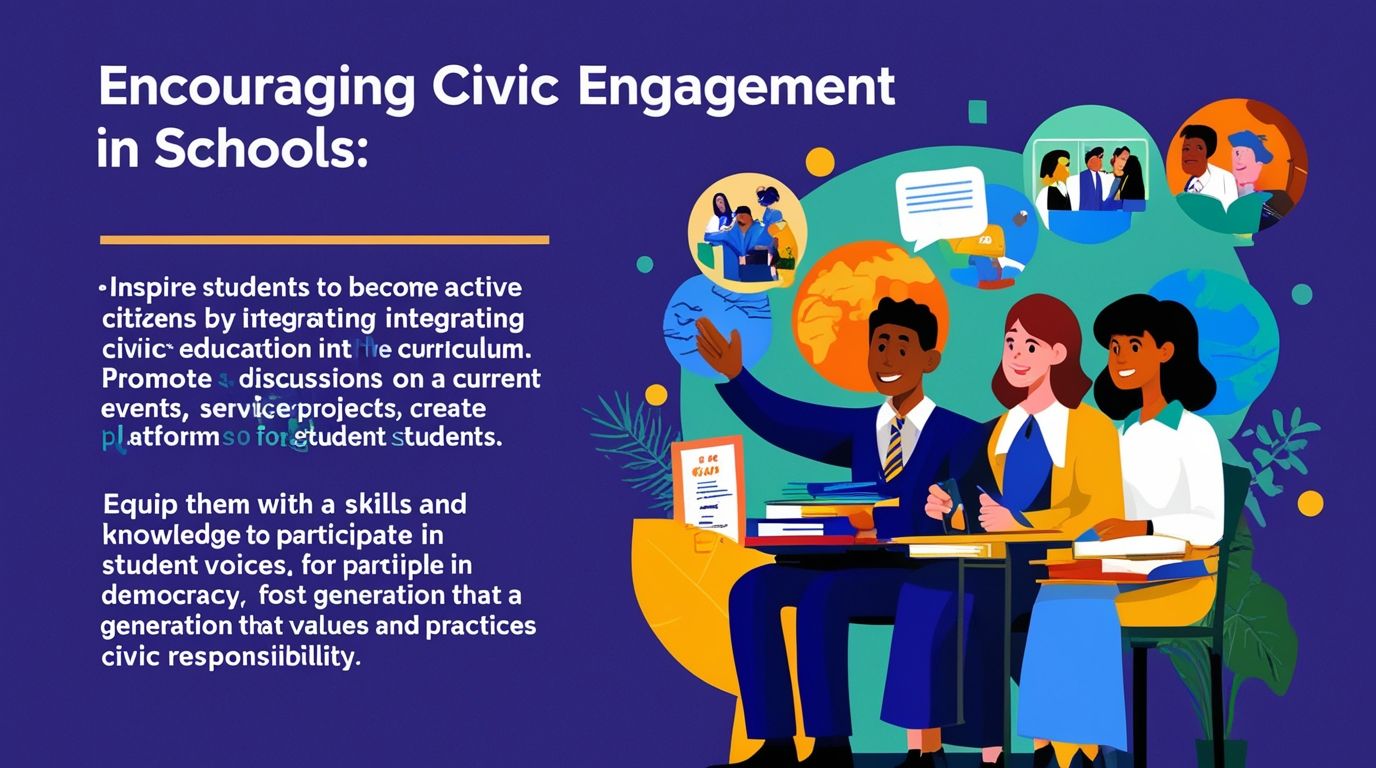
Students also benefit directly from civic education. Schools that partner with local organizations give young people chances to volunteer, research community problems, and practice leadership. These experiences prepare them for adult citizenship in ways textbooks cannot.
Challenges and Limitations
Civil society is no cure-all. Several obstacles limit its contribution.
Unstable funding. Many organizations depend on short-term grants. When donors shift priorities, programs close and communities lose services they relied on.
Fragmentation. Hundreds of small projects with different methods can overlap or contradict each other. Without coordination, effort gets duplicated while gaps remain.
Uneven quality. Not every organization has trained staff or reliable evaluation systems. Poorly designed programs waste resources and sometimes harm learners.
Accountability concerns. Civil society groups that scrutinize the state must also open their own books. Transparency about budgets, results, and leadership builds credibility.
Political pressure. In some countries, laws restrict foreign funding or limit public advocacy. Shrinking civic space weakens the watchdog function that makes civil society valuable.
Equity risks. When private or charity-run schools charge fees or select students, they can widen inequality. UNESCO warns that unregulated provision may leave the poorest children behind.
Recognizing these limits helps leaders design smarter partnerships rather than expecting too much or too little.
How Governments and Civil Society Can Work Together
The strongest results appear when the state and civil society act as partners with clear roles. Governments set standards, guarantee funding, and ensure fairness. Civil society brings local knowledge, flexibility, and independent oversight. Several practices strengthen this relationship:
- Create formal consultation channels. Invite coalitions, parents, and teachers’ representatives to review draft laws and budgets before approval.
- Share data openly. Publish enrollment figures, learning results, and spending reports so that citizens and researchers can analyze them.
- Fund long term. Multi-year agreements let organizations plan, train staff, and measure impact.
- Scale what works. Evaluate pilots rigorously and absorb successful models into public systems.
- Protect civic space. Respect the right of groups to organize, speak, and criticize without fear.
- Regulate fairly. Apply the same quality and inclusion standards to every provider, public or private.
Practical Steps for Schools and Communities
Local leaders do not need to wait for national reform. Schools can start with small actions:
- Form or revive a parent-teacher association with regular meetings and published minutes.
- Map nearby organizations, such as libraries, health clinics, youth clubs, and faith groups, and invite them to collaborate.
- Launch a volunteer reading program where community members read with young children weekly.
- Track basic indicators, including attendance, reading levels, and dropout numbers, and share results with families.
- Offer students service-learning projects that tackle real neighborhood problems.
- Seek small grants or in-kind support, and report outcomes honestly to supporters.
These steps cost little yet build trust, which fuels every larger reform.
The Future of Civil Society and Education
Several trends will shape the next decade. Digital technology lets organizations deliver lessons by phone, radio, and low-bandwidth apps, which matters for remote regions. Climate shocks and conflict displace families, so flexible community-run learning spaces will gain importance. Young people increasingly lead campaigns on school safety, climate education, and mental health, bringing fresh energy to civil society.
The global goal of inclusive and equitable quality education for all, set out in Sustainable Development Goal 4, cannot be met without broad participation. Governments, businesses, teachers, parents, and citizen groups each hold part of the solution.
Conclusion
Civil society and education support each other. Schools teach young people the knowledge and values that sustain active citizenship, and active citizens in turn demand, build, and improve schools. From BRAC’s classrooms in Bangladesh to citizen-led assessments across Asia and Africa, civil society organizations have widened access, raised standards, and given communities a voice.
The path forward requires honest partnership. Governments must protect civic space and fund public schools adequately. Organizations must measure results and stay transparent. Communities must keep showing up. When all three commit, every child gains a better chance to learn, and the whole society benefits.
Frequently Asked Questions
1. What is the role of civil society in education?
Civil society expands access to schooling, improves learning quality, advocates for better education policy, supports teachers, and holds governments accountable. It also reaches marginalized groups that formal systems often miss.
2. How do NGOs improve education quality?
NGOs pilot new teaching methods, train teachers, provide learning materials, and run citizen-led assessments that reveal what children actually learn. Governments often adopt the most successful approaches at scale.
3. Can civil society replace government in providing education?
No. Civil society complements the state but cannot replace it. Governments carry the responsibility to fund, regulate, and guarantee education for every child. The best outcomes come when both sectors collaborate under clear rules.
References
- UNESCO. (2021). Global Education Monitoring Report 2021/2: Non-state actors in education: Who chooses? Who loses? Paris: UNESCO Publishing.
- Putnam, R. D. (2000). Bowling Alone: The Collapse and Revival of American Community. New York: Simon & Schuster.