
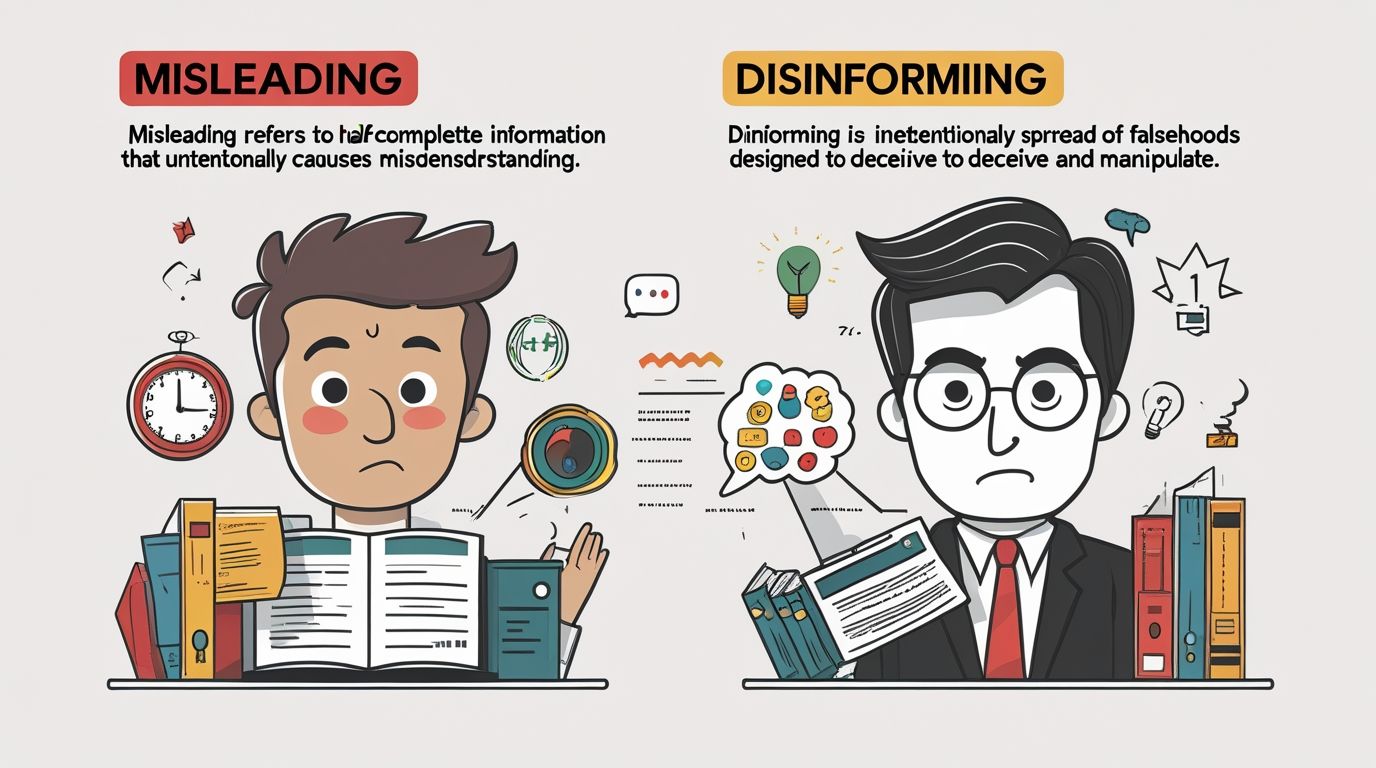
Misleading vs Disinforming, In the modern digital world, the difference between misleading and disinforming information has become a critical issue. Both concepts may seem similar, yet they have different roots, purposes, and consequences. While misleading information usually arises from misunderstanding, disinforming is often intentional. People, educators, and policymakers need to recognize this difference to protect truth, trust, and informed decision-making. Since the internet spreads knowledge rapidly, false or manipulated facts can influence communities within minutes. This guide explains how misleading differs from disinforming, why it matters in education and society, and how teachers and learners can develop skills to evaluate sources critically. By understanding the boundaries between the two, individuals can better recognize risks, reduce confusion, and strengthen their ability to separate truth from lies in learning and daily life.
Understanding the Concept of Misleading
The term misleading refers to providing information that causes people to form inaccurate conclusions, even when the statement itself may not be false. Misleading content often occurs because of incomplete context, vague wording, or selective presentation of facts. For example, an advertisement might highlight only the positive aspects of a product while ignoring its limitations. This creates a perception that is not entirely accurate. Misleading is dangerous because it blurs reality without completely fabricating data. In schools and classrooms, misleading information can affect how students learn history, science, or current events. Teachers who unknowingly share incomplete facts might unintentionally shape biased understanding. Unlike deliberate lies, misleading often lacks malicious intent but still damages trust. Therefore, individuals need strong critical-thinking skills to spot half-truths. Recognizing misleading statements allows learners to challenge assumptions and seek complete information before forming conclusions.
Understanding the Concept of Disinforming
In contrast, disinforming means spreading false information intentionally with the purpose of deception. Unlike misleading, which may occur unintentionally, disinforming is planned and systematic. It is often used in political propaganda, online manipulation, or social conflicts where actors aim to influence public opinion. Disinformation campaigns rely on false data, fabricated stories, and manipulated images to create division or control narratives. For instance, during elections, false news might be spread to confuse voters or damage reputations. The danger of disinforming lies in its direct attack on truth. In the educational sector, disinformation threatens the credibility of knowledge, undermines learning, and encourages mistrust in authentic sources. It also fuels polarization by creating opposing groups based on lies. To counter disinformation, students and teachers need media literacy skills and strong fact-checking practices. Only then can societies protect themselves from targeted falsehoods designed to harm.
Misleading vs Disinforming: The Core Differences
While both misleading and disinforming confuse people, their core differences lie in intention and accuracy. Misleading arises from omission, ambiguity, or lack of context. On the other hand, disinforming is intentional fabrication of lies. Misleading may involve partial truths, while disinforming involves complete falsehoods. For example, a teacher giving outdated statistics might mislead students without realizing it. But a group creating fake news about a political leader is disinforming deliberately. The outcomes of both are damaging, but disinformation usually has deeper consequences because of its calculated design. In education, distinguishing the two helps learners build awareness of how content can shape thought. Teachers must explain how to evaluate sources critically and verify authenticity. When students learn to separate misleading from disinforming, they build resilience against manipulation, whether it comes from social media, advertisements, or biased reporting.
The Role of Media in Spreading Misleading Information
The media plays a central role in shaping public opinion, yet it often spreads misleading content unintentionally. Headlines, for example, may exaggerate findings to attract readers, even if the article itself contains accurate details. Similarly, news outlets sometimes highlight one side of a story while ignoring others. This incomplete reporting leads audiences to make inaccurate assumptions. Social media amplifies this effect by prioritizing engagement over accuracy. A simple tweet, stripped of full context, can mislead thousands within minutes. In classrooms, students who rely on such sources may base projects or arguments on half-truths. Teachers must guide learners to look beyond headlines and analyze full stories before drawing conclusions. While media outlets carry responsibility, individuals also need awareness to question and compare sources. Recognizing media-driven misleading practices is the first step toward protecting communities from confusion and manipulation.
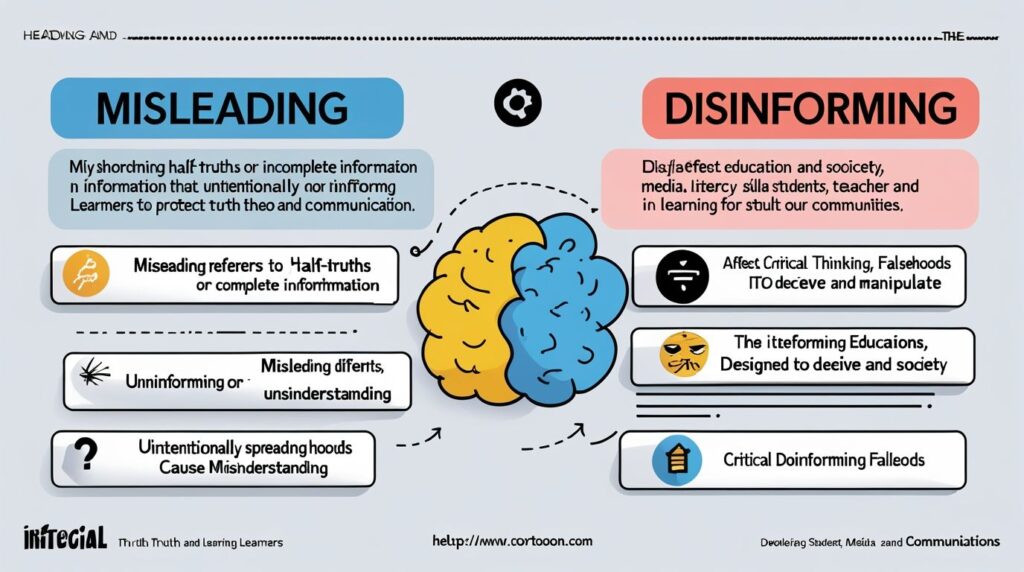
The Role of Media in Spreading Disinformation
Unlike accidental errors, disinforming through media is intentional and systematic. Certain outlets or online groups may deliberately create fake content to manipulate audiences. These campaigns often use images, videos, or fabricated statistics to create a sense of urgency or anger. For instance, doctored photos or deepfake videos are widely used to deceive. Social media platforms provide an easy way to spread such lies quickly to millions of people. Unfortunately, disinformation thrives because audiences often share content without verifying it. In education, this type of manipulation affects students’ understanding of truth, creating distrust in authentic sources. Teachers and schools need to introduce fact-checking activities and digital literacy programs. Encouraging learners to investigate sources, check multiple references, and verify authenticity helps reduce the influence of disinformation. Media responsibility, along with user awareness, is necessary to stop intentional lies from shaping public perception.
The Psychological Effects of Misleading
The psychological effects of misleading information are subtle but powerful. When people encounter half-truths, their minds fill the gaps with assumptions. This can create distorted memories and inaccurate beliefs. For example, if students are taught only positive aspects of historical figures without critical analysis, they may idealize them unrealistically. Misleading can also cause confusion and hesitation in decision-making because individuals feel uncertain about what is true. In the long run, repeated exposure to misleading statements can lower trust in information sources, even when they are genuine. This distrust affects learning, relationships, and community discussions. Furthermore, when people realize they were misled, feelings of disappointment or betrayal arise. This shows why detecting misleading information early is important. Developing the ability to ask critical questions helps learners protect themselves against long-term psychological impacts of half-truths.
The Psychological Effects of Disinforming
The impact of disinforming on the human mind is often stronger than misleading. Disinformation is designed to provoke emotions like fear, anger, or hate. For example, fabricated news about threats or conspiracies can cause panic in societies. This emotional manipulation reduces logical thinking and encourages impulsive decisions. In classrooms, disinformation may divide students by creating false beliefs that contradict one another. It can also erode trust in teachers, institutions, and science. Long-term exposure to disinformation may normalize lies, leading individuals to accept manipulated facts as reality. This undermines critical reasoning skills and increases social polarization. Educators must be aware of how disinformation influences emotions and decisions. By teaching students to identify emotional triggers and analyze information carefully, teachers can reduce the destructive psychological impact. Recognizing these tactics is essential to protecting mental clarity and social harmony.
Strategies to Detect Misleading Information
Detecting misleading information requires awareness, questioning, and verification. First, readers should check whether claims are supported by complete evidence. If statistics or facts are presented without context, the information may mislead. Second, comparing multiple sources helps reveal differences in reporting. When several outlets report the same story differently, it is wise to analyze them carefully. Third, individuals must look beyond headlines or summaries, since these often exaggerate or oversimplify. In classrooms, teachers can train students by analyzing news articles or advertisements, highlighting where details were omitted. Additionally, using fact-checking websites helps verify accuracy. Developing such habits ensures learners recognize when content is only partially true. By practicing critical thinking daily, students strengthen their ability to resist confusion. Overall, spotting misleading information is about asking the right questions before forming conclusions.
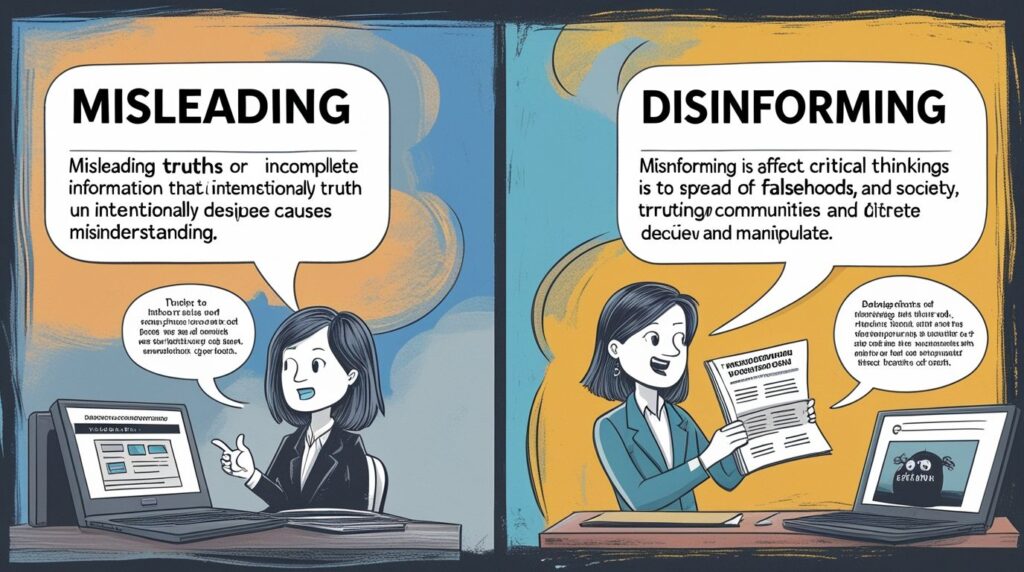
Strategies to Detect Disinformation
Spotting disinforming content requires stronger defense strategies. Unlike misleading, disinformation is intentional and often harder to recognize. First, individuals must evaluate the credibility of the source. Websites with unknown authors or hidden ownership are red flags. Second, reverse image searches help identify manipulated pictures. Third, emotional triggers in headlines or posts may signal disinformation, since creators often exploit fear or anger. In classrooms, students can practice fact-checking exercises using real-world examples of false news. Teachers may encourage learners to analyze claims using reliable databases, academic journals, or official reports. Media literacy training also plays a critical role, helping learners understand how fake content spreads online. By adopting systematic evaluation techniques, individuals build resistance to disinformation. Ultimately, protecting truth requires active vigilance and responsible digital behavior. Recognizing deliberate falsehoods strengthens society against manipulation and deception.
Impact of Misleading on Education
The influence of misleading information in education is significant. When students are exposed to half-truths, their learning becomes unbalanced. For example, studying incomplete historical accounts shapes biased views of events. Similarly, science lessons that highlight only benefits without discussing risks may create unrealistic expectations. Misleading textbooks, teachers, or online resources can damage knowledge development. Since education shapes future generations, misleading facts threaten long-term societal understanding. Teachers have a responsibility to double-check resources and ensure accuracy before presenting them. Students, on the other hand, must be taught how to question and evaluate content critically. Without these skills, they risk accepting incomplete or one-sided knowledge. Therefore, addressing misleading information within classrooms is essential. Education must remain balanced, objective, and reliable to guide learners toward genuine understanding and fair judgment.
Impact of Disinforming on Education
The effect of disinforming in education is even more destructive. False narratives intentionally planted in learning environments can destabilize trust in knowledge itself. For instance, spreading fabricated scientific claims in classrooms damages students’ confidence in authentic research. Similarly, political disinformation may divide students by creating conflicting groups. Teachers must also be cautious, as relying on unverified online materials can introduce falsehoods into learning. Once disinformation infiltrates education, correcting it becomes challenging because students may resist abandoning false beliefs. This weakens the role of schools as centers of truth and knowledge. Therefore, educational institutions must adopt strong policies against disinformation. Teachers should integrate fact-checking tasks and encourage open discussions about questionable claims. By creating awareness, schools can prevent disinformation from shaping students’ minds and protect the credibility of education.
Building Critical Thinking to Counter Misleading
One of the best defenses against misleading content is strong critical thinking. Students who ask “why,” “how,” and “what if” are less likely to accept incomplete truths. Teachers can introduce classroom activities that challenge learners to identify hidden assumptions in statements. For example, analyzing advertisements, headlines, or political speeches can reveal misleading techniques. Encouraging debates also allows students to explore different perspectives and uncover missing details. Furthermore, teachers should emphasize the importance of evidence. By demanding proof, students learn to separate facts from opinions. Critical thinking does not only protect against misleading, but it also strengthens lifelong learning. People who think critically are less vulnerable to manipulation in everyday life. Schools, therefore, must integrate these skills into every subject to prepare learners for a world full of complex, uncertain, and sometimes misleading information.
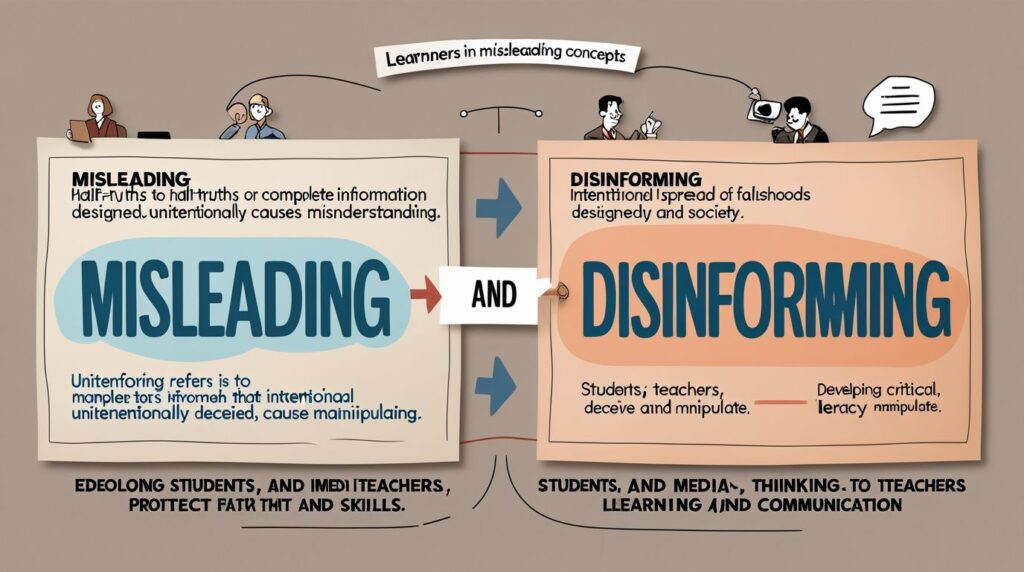
Building Critical Thinking to Counter Disinforming
Critical thinking also serves as a shield against disinforming practices. Since disinformation often uses emotional triggers, students must learn to pause before reacting. Teachers can create lessons that involve analyzing fake news examples and discussing why they were convincing. This helps learners recognize patterns of manipulation. Additionally, encouraging students to rely on credible databases and scholarly sources builds habits of evidence-based thinking. Group projects where learners investigate and expose false claims can be effective as well. By practicing these exercises, students build resilience against lies. Critical thinking also fosters confidence, empowering learners to question authority and challenge deceptive narratives. In the digital era, this skill is not optional but necessary. Schools that prioritize critical reasoning ensure students grow into informed citizens, capable of resisting targeted disinformation campaigns.
Conclusion: Why the Distinction Matters
The distinction between misleading and disinforming is more than a linguistic difference—it is a crucial defense against confusion, manipulation, and loss of trust. Misleading stems from incomplete truths, while disinforming involves intentional lies. Both affect education, society, and psychology in powerful ways. However, the strategies to counter them differ. Misleading requires careful questioning, while disinformation demands systematic fact-checking and emotional awareness. Teachers, students, and communities must work together to build resilience against both. Schools should focus on critical thinking, digital literacy, and media awareness. Recognizing the unique features of each form of falsehood allows individuals to protect themselves and others from harm. In an age where information travels at lightning speed, the ability to distinguish misleading from disinforming is not only important—it is essential for survival of truth.
References
- Wardle, C., & Derakhshan, H. (2017). Information Disorder: Toward an interdisciplinary framework for research and policy making. Council of Europe.
- Lewandowsky, S., Ecker, U. K., & Cook, J. (2017). Beyond misinformation: Understanding and coping with the “post-truth” era. Journal of Applied Research in Memory and Cognition, 6(4), 353-369.
- Fallis, D. (2015). What is disinformation? Library Trends, 63(3), 401–426.
- Tandoc, E. C., Lim, Z. W., & Ling, R. (2018). Defining “fake news.” Digital Journalism, 6(2), 137-153.















































































































































References:
Casino Spiele kostenlos Hotel Casino Deutschland
References:
Book of ra online spielen kostenlos Platin Casino Spiele
References:
Online Casino Test Lucherberg Spielhalle Öffnungszeiten