Introduction
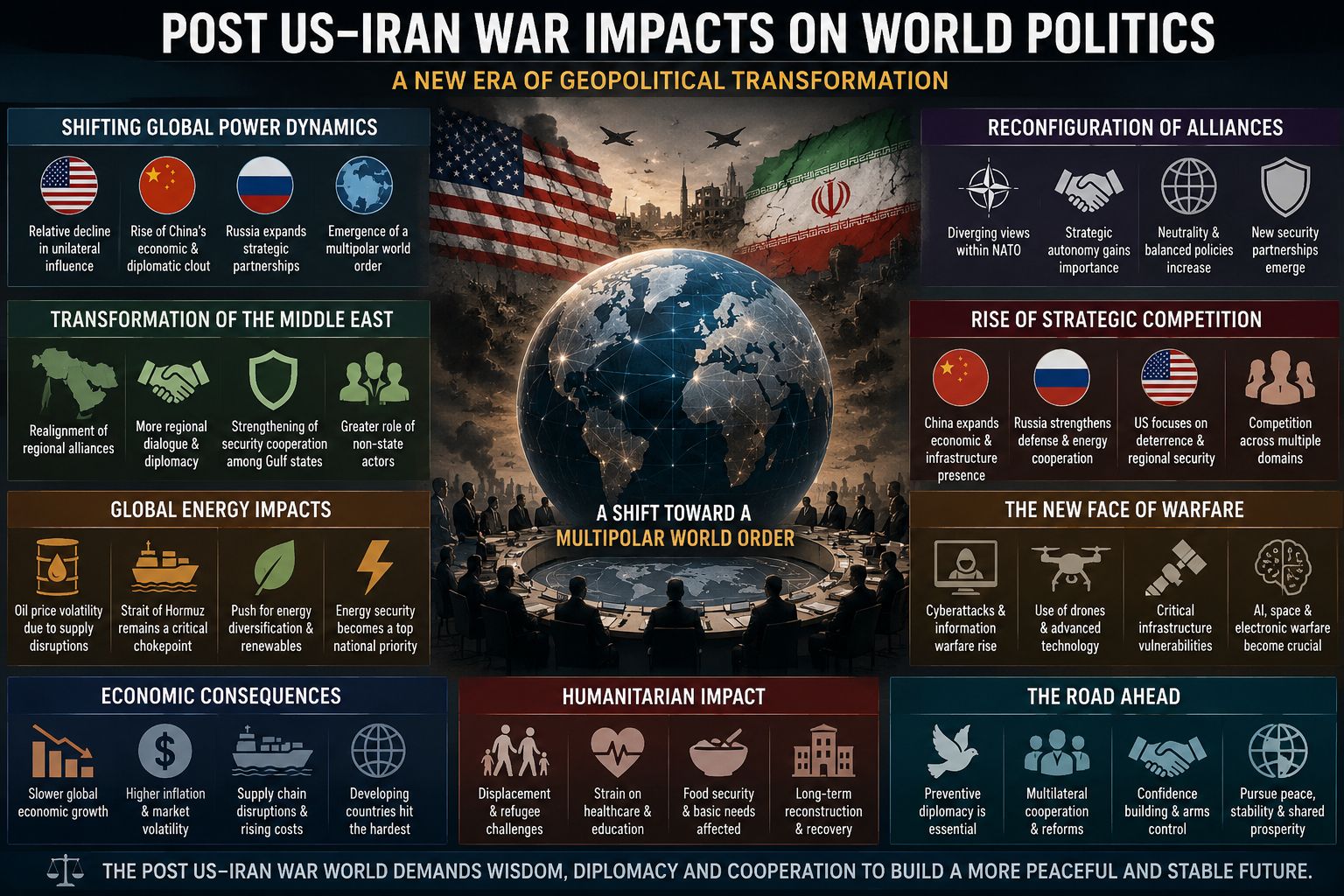
Post US–Iran War Impacts on World Politics, The recent military confrontation between the United States and Iran has emerged as one of the most consequential geopolitical events of the twenty-first century. Although the duration, intensity, and ultimate outcome of the conflict continue to be debated by analysts, its effects have already begun reshaping the international political landscape. The war not only altered the strategic balance in the Middle East but also influenced global diplomacy, international trade, energy markets, military alliances, and the future of the international order.
Unlike previous regional conflicts, the US-Iran war involved advanced military technologies, cyber warfare, proxy conflicts, economic sanctions, and extensive diplomatic engagement by global powers. Consequently, its repercussions extended well beyond the Middle East, affecting countries across Asia, Europe, Africa, and the Americas. Nations have been compelled to reassess their foreign policies, defense strategies, and economic partnerships in response to an increasingly uncertain international environment.
This article examines the major political, economic, strategic, and diplomatic consequences of the post US-Iran war period and evaluates how the conflict is transforming global politics.
Changing Global Power Dynamics
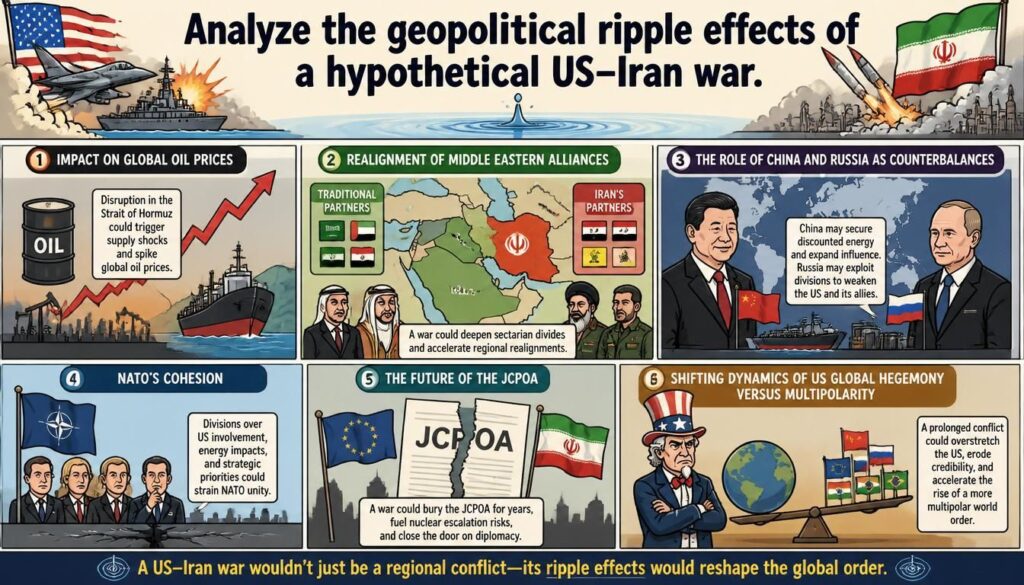
One of the most significant consequences of the US-Iran war has been the acceleration of changes in global power distribution. For decades, the United States has maintained its position as the world’s dominant military and political power. However, prolonged military engagements have often imposed substantial financial, diplomatic, and political costs.
The conflict provided opportunities for other major powers, particularly China and Russia, to expand their influence in global affairs. China intensified its diplomatic engagement in the Middle East through economic partnerships and infrastructure investments under the Belt and Road Initiative. Simultaneously, Russia strengthened its strategic cooperation with regional actors by increasing defense cooperation and diplomatic mediation efforts.
The emergence of a more multipolar international system has become increasingly evident. Rather than a world dominated by a single superpower, international politics now reflects greater competition among several influential states pursuing diverse regional and global interests.
Transformation of Middle Eastern Politics
The Middle East remains the region most directly affected by the conflict. The balance of power among regional states has undergone significant transformation.
Iran’s regional strategy has increasingly relied on strengthening relationships with allied non-state actors and sympathetic governments. Conversely, several Gulf Arab states have accelerated security cooperation among themselves and with external powers to address evolving security concerns.
Countries such as Saudi Arabia, the United Arab Emirates, Qatar, Türkiye, and Israel have recalibrated their foreign policies to adapt to the new strategic environment. Diplomatic initiatives, including renewed dialogue between historical rivals, have gained greater importance as governments seek to avoid another large-scale regional conflict.
The war also highlighted the growing importance of regional organizations and multilateral diplomacy in conflict prevention and crisis management.
Global Energy Security
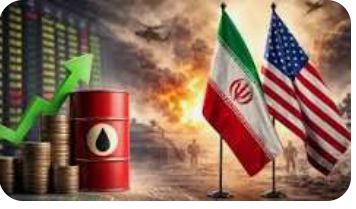
Perhaps no sector experienced more immediate consequences than global energy markets. The Persian Gulf remains one of the world’s most important oil-producing regions, and any military confrontation threatens the uninterrupted flow of energy supplies.
The temporary disruption of shipping routes through the Strait of Hormuz generated significant volatility in global oil prices. Higher energy costs contributed to inflationary pressures worldwide, affecting both developed and developing economies.
As a result, many countries accelerated efforts to diversify energy sources by:
- Expanding renewable energy investments
- Increasing strategic petroleum reserves
- Diversifying suppliers of oil and natural gas
- Investing in nuclear and hydrogen energy technologies
The conflict therefore reinforced the strategic importance of energy independence in national security planning.
Reconfiguration of International Alliances
The war also reshaped international alliances. Traditional security partnerships were tested as countries balanced strategic interests with domestic political considerations.
NATO members displayed varying levels of political support for US policies, reflecting differences in national interests and public opinion. Meanwhile, several Asian and African countries adopted more neutral diplomatic positions, preferring balanced engagement with both Western powers and emerging global actors.
This trend reflects the growing practice of strategic autonomy, whereby states seek to avoid exclusive alignment with any single major power while maintaining flexible diplomatic relationships.
Rise of Strategic Competition Between Major Powers
The post-war environment intensified strategic competition among the United States, China, and Russia.
China sought to portray itself as a stabilizing diplomatic actor by promoting dialogue, investment, and economic cooperation throughout the Middle East. Russia expanded military cooperation and energy partnerships with several regional governments. The United States continued emphasizing collective security arrangements, freedom of navigation, and regional deterrence.
Rather than direct confrontation, competition increasingly occurs through economic influence, technology, cyber capabilities, infrastructure development, and diplomatic engagement.
Expansion of Cyber Warfare
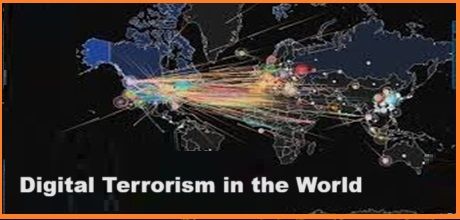
The US-Iran conflict demonstrated that modern warfare extends beyond conventional military operations. Cyberattacks targeted government institutions, energy infrastructure, financial systems, transportation networks, and communication platforms. Information warfare, including disinformation campaigns and digital propaganda, became central components of strategic competition.
Governments worldwide recognized cybersecurity as a critical dimension of national defense. Consequently, many countries increased investment in:
- Cyber defense commands
- Artificial intelligence for threat detection
- Digital infrastructure protection
- International cyber security cooperation
The conflict highlighted that future wars may involve fewer conventional battles and greater reliance on digital capabilities.
Impact on International Law and Global Governance
The conflict reignited debates concerning international law, sovereignty, and the legitimacy of military intervention.
Questions emerged regarding:
- Preventive military strikes
- Targeted killings
- Use of drones
- Economic sanctions
- Civilian protection
- Maritime security
International organizations, including the United Nations, faced criticism regarding their limited capacity to prevent escalation among major powers. The war therefore renewed discussions about reforming international institutions to better address twenty-first century security challenges.
Economic Consequences
Global economic uncertainty increased significantly during and after the conflict.
Higher oil prices, supply-chain disruptions, and investor uncertainty contributed to slower economic growth in many countries. International shipping costs increased, while insurance premiums for maritime transport rose considerably. Developing countries experienced disproportionate impacts because of:
- Dependence on imported fuel
- Rising inflation
- Currency depreciation
- Increased food prices
- Reduced foreign investment
Conversely, some energy-exporting countries temporarily benefited from higher global oil prices, although long-term market volatility limited sustained gains.
Arms Race and Military Modernization
The conflict accelerated military modernization across multiple regions. Governments expanded defense budgets to acquire advanced technologies including:
- Missile defense systems
- Unmanned aerial vehicles (drones)
- Artificial intelligence applications
- Hypersonic missiles
- Electronic warfare systems
- Space-based surveillance capabilities
Military planners increasingly emphasized integrated multi-domain operations combining land, sea, air, cyber, and space capabilities. The proliferation of advanced military technologies may increase future security risks if effective arms control agreements are not developed.
Humanitarian Consequences
Beyond geopolitical considerations, the war generated significant humanitarian challenges. Population displacement, damage to civilian infrastructure, and disruption of healthcare and education affected millions of people directly or indirectly. International humanitarian organizations faced increasing demands for:
- Refugee assistance
- Medical relief
- Food security
- Reconstruction support
- Post-conflict rehabilitation
Long-term regional stability depends not only on political settlements but also on successful reconstruction and social recovery.
Implications for South Asia
South Asia faces both opportunities and challenges in the post-war environment. Pakistan, India, and neighboring countries maintain important economic, diplomatic, and energy relationships with the Middle East. Potential implications include:
- Rising energy import costs
- Increased remittance uncertainty
- Expanded strategic competition among major powers
- Greater importance of regional diplomacy
- Opportunities for mediation and peace-building initiatives
Pakistan’s balanced foreign policy and longstanding relations with both Muslim-majority countries and Western partners may enable it to contribute constructively to regional diplomatic efforts.
The Future of Diplomacy
The post US-Iran war environment underscores the renewed importance of preventive diplomacy. Future international stability will likely depend upon:
- Confidence-building measures
- Regional security dialogues
- Nuclear non-proliferation agreements
- Economic cooperation
- Multilateral conflict resolution mechanisms
Middle powers and international organizations may assume increasingly important roles in facilitating negotiations between competing major powers.
Lessons for International Relations
Several important lessons emerge from the conflict. First, military superiority alone cannot guarantee lasting political success. Sustainable peace requires diplomatic engagement, economic development, and inclusive governance. Second, globalization has interconnected national economies to such an extent that regional conflicts rapidly generate worldwide consequences.
Third, technological innovation has fundamentally transformed warfare, requiring governments to rethink traditional defense strategies. Fourth, international cooperation remains essential in addressing transnational challenges such as cyber threats, terrorism, energy security, and humanitarian crises. Finally, strategic competition among great powers is likely to persist, making effective diplomacy even more important in preventing future conflicts.
Conclusion
The post US-Iran war period represents a critical turning point in contemporary world politics. The conflict accelerated the transition toward a more complex and multipolar international system characterized by intensified strategic competition, evolving alliances, technological transformation, and growing economic interdependence.
While the immediate military confrontation may have subsided, its geopolitical consequences will continue shaping international relations for years to come. Governments are increasingly prioritizing energy security, cyber resilience, military modernization, and diplomatic flexibility in response to a rapidly changing strategic environment.
At the same time, the conflict has reinforced the importance of international institutions, multilateral diplomacy, and conflict prevention mechanisms. The future stability of the international system will depend on whether major powers can balance competition with cooperation while addressing shared global challenges.
Ultimately, the legacy of the US-Iran war extends far beyond the battlefield. It serves as a reminder that in an interconnected world, regional conflicts possess global consequences, making diplomacy, dialogue, and collective security indispensable pillars of international peace and stability.