Introduction
Teacher Pay Impact on Students’ Learning, Among the many factors influencing educational outcomes—curriculum design, class size, school infrastructure, and parental involvement—teacher compensation stands out as one of the most contentious and consequential. Teachers are the single most important in-school factor affecting student achievement, more influential than any other school-based variable, including class size or facilities. Given this centrality, the question of how much teachers are paid, and how that pay is structured, has profound implications for the quality of education students receive. This article examines the relationship between teacher pay and student learning outcomes, exploring the mechanisms through which compensation affects classroom performance, the research evidence on the topic, and the broader policy debates surrounding teacher salaries.
The Theoretical Link Between Pay and Performance
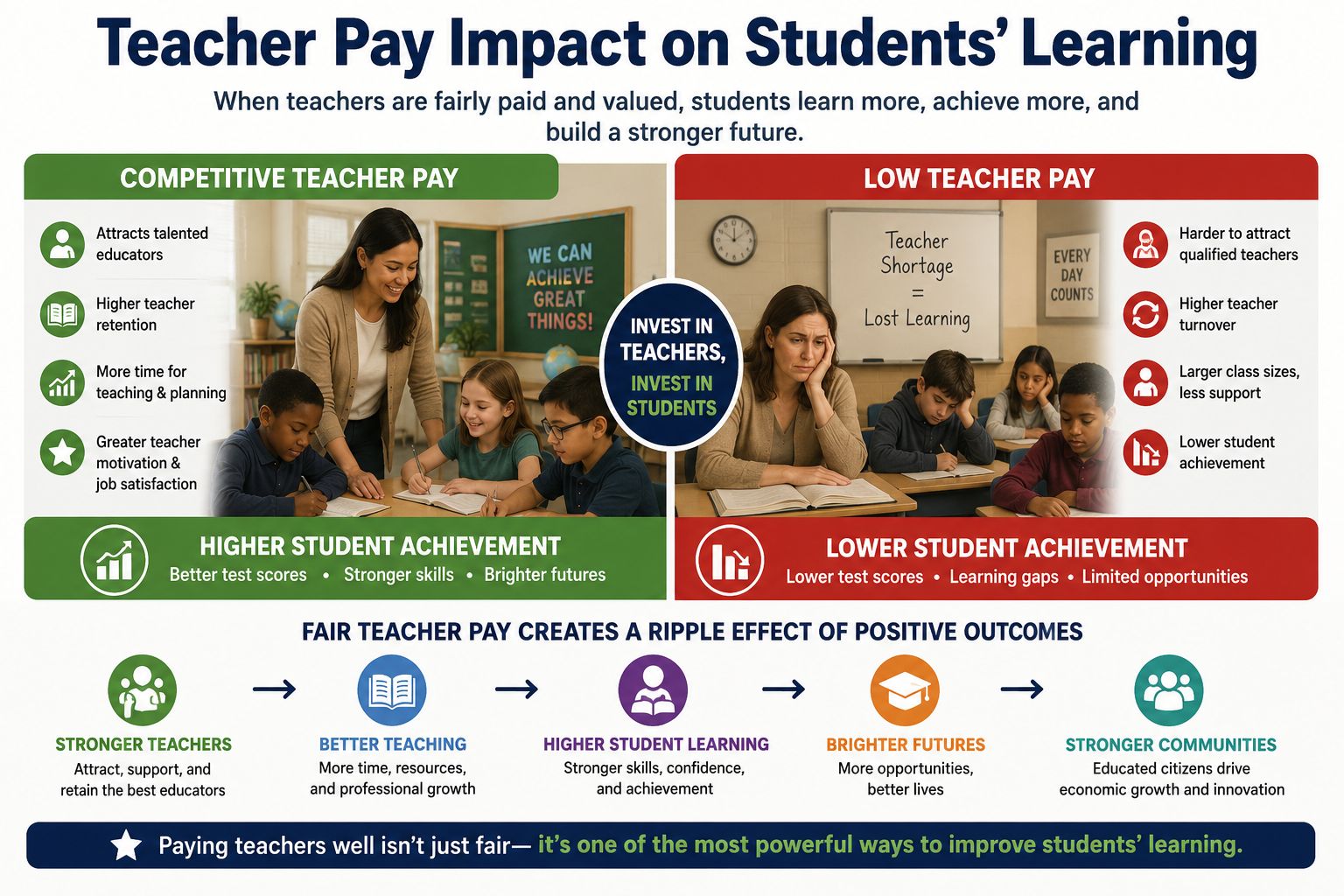
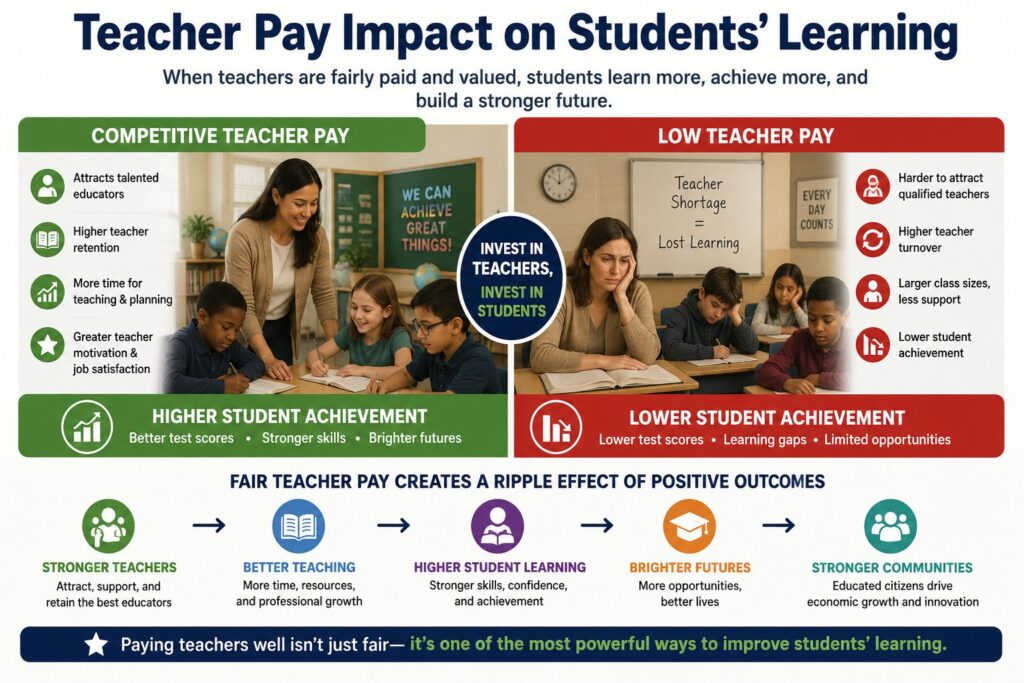
The relationship between teacher pay and student learning operates through several interconnected channels. First, compensation affects who chooses to enter and remain in the teaching profession. If salaries are uncompetitive relative to other professions requiring similar levels of education, talented individuals may opt for careers in fields such as business, law, medicine, or engineering, leaving teaching to attract a narrower or less qualified applicant pool. This is often referred to as the “opportunity cost” problem: the more attractive alternative careers appear relative to teaching, the harder it becomes to recruit high-caliber candidates into classrooms.
Second, pay influences retention. Teaching is a profession with steep learning curves; a teacher’s effectiveness typically improves substantially over their first several years in the classroom. When experienced, effective teachers leave the profession due to inadequate compensation, schools lose accumulated expertise and are forced to replace them with novices, who are, on average, less effective. High turnover also disrupts school culture, mentorship structures, and the continuity of relationships between teachers and students, all of which matter for learning.
Third, compensation may affect teacher motivation and effort directly. While intrinsic motivation—the desire to help children learn and grow—is a powerful driver for most educators, financial stress and the need to work second jobs can reduce the time and energy teachers have available for lesson preparation, grading, and professional development. A teacher working a second job in the evenings to make ends meet has less capacity to invest in the extra, unpaid work that often distinguishes excellent teaching from adequate teaching.
Empirical Evidence on Teacher Pay and Student Outcomes
Salary Levels and Recruitment Quality
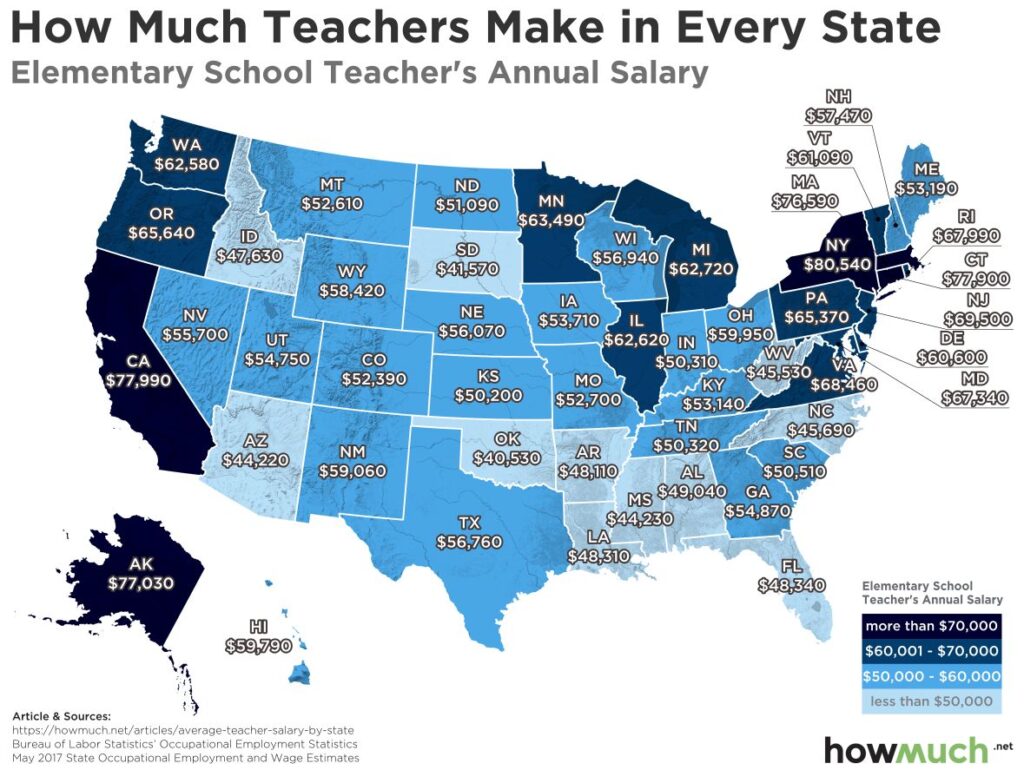
Research consistently shows that higher relative teacher salaries are associated with the recruitment of academically stronger candidates into the profession. In countries and states where teaching salaries are competitive with other graduate professions, teaching draws from a higher-achieving segment of the college graduate population. Conversely, in regions where teacher pay lags significantly behind comparable professions, teaching programs tend to attract candidates with lower average academic credentials, as measured by standardized test scores and undergraduate GPA. Since teacher content knowledge and cognitive ability are, on average, positively correlated with student achievement gains, this recruitment effect represents a meaningful pathway by which pay influences learning outcomes.
Retention and Teacher Turnover
A substantial body of research links teacher turnover to reduced student achievement, particularly in high-poverty schools where turnover rates tend to be highest. When a school experiences high turnover, it is not just the departing teachers’ students who are affected; the instability disrupts grade-level teams, curriculum coordination, and school-wide culture. Studies have found that schools with high turnover rates see measurable dips in student achievement even among classrooms taught by teachers who did not leave, suggesting a systemic disruption effect. Since low pay is one of the most frequently cited reasons teachers leave the profession or move to higher-paying districts, salary policy is directly implicated in this turnover-achievement relationship.
Merit Pay and Performance-Based Compensation
Beyond base salary levels, considerable research attention has focused on performance-based pay structures, often called “merit pay,” which tie compensation to measures of teacher effectiveness such as student test score gains, classroom observations, or peer evaluations. The evidence on merit pay is notably mixed. Some studies, particularly those examining well-designed programs with clear, achievable performance metrics and adequate bonus sizes, find modest positive effects on student achievement, particularly in mathematics. Other studies find negligible or no effects, especially when bonuses are small relative to base salary or when performance metrics are perceived as unfair or overly narrow.
A key finding across this literature is that merit pay appears more effective when it targets recruitment and retention of effective teachers into hard-to-staff schools or subjects, rather than when it attempts to motivate existing teachers to work harder through short-term financial incentives. This distinction matters for policy design: paying bonuses to attract skilled teachers to under-resourced schools tends to show more consistent positive effects than paying bonuses simply for improved test scores among teachers already in place.
Comparative International Evidence
International comparisons offer additional insight. Countries that consistently perform well on international assessments such as PISA (Programme for International Student Assessment) often share a common feature: teaching is a relatively high-status, well-compensated profession. In these education systems, teacher salaries are competitive with other professions requiring similar qualifications, teacher training is rigorous and selective, and teaching carries significant social prestige. While causation is difficult to establish definitively from cross-national comparisons alone, given the many other variables that differ between countries, the consistent correlation between teacher compensation, teaching prestige, and student outcomes lends support to the broader hypothesis that pay matters for education quality.
The Indirect Effects of Pay on Classroom Practice
Beyond recruitment and retention, teacher pay can influence the quality of instruction delivered in more subtle ways. Financially secure teachers are better positioned to invest in their own professional development, pursue advanced degrees or certifications, and dedicate time to innovative lesson planning rather than working additional jobs to supplement inadequate income. Financial stress has also been linked to increased teacher burnout and lower job satisfaction, both of which are associated with reduced instructional quality and increased likelihood of leaving the profession.
There is also a signaling effect. Compensation levels communicate societal value. When teacher pay is low relative to other professions requiring similar education, it can convey a message—both to teachers themselves and to prospective candidates—that teaching is undervalued. This can affect morale, professional identity, and the overall status of the profession, which in turn influences the caliber of individuals drawn to teaching careers and the effort and pride existing teachers bring to their work.
Counterarguments and Complicating Factors
It is important to acknowledge that the relationship between teacher pay and student learning is not simple or purely linear. Several complicating factors deserve consideration.
First, money is not the only, or even the primary, motivator for most teachers. Surveys of teacher job satisfaction consistently show that factors such as administrative support, classroom autonomy, manageable workloads, and positive school culture rank alongside or above salary in predicting job satisfaction and retention. This suggests that pay increases alone, absent broader improvements to working conditions, may have limited impact on teacher quality and retention.
Second, the relationship between spending and outcomes is not always direct. Simply raising salaries across the board does not automatically translate into improved instruction if the additional funds are not paired with effective teacher training, curriculum support, and school leadership. Some studies of large-scale salary increases have found smaller-than-expected effects on measured student achievement, suggesting that pay is a necessary but not sufficient condition for improving learning outcomes.
Third, how pay increases are structured matters considerably. Across-the-board raises, seniority-based pay scales, differentiated pay for hard-to-staff subjects (such as mathematics, science, and special education), and performance-based bonuses each carry different incentive structures and are likely to produce different effects on recruitment, retention, and effort. Policymakers must carefully consider which structure best aligns with their specific goals, whether that is attracting STEM teachers, retaining experienced staff in high-need schools, or rewarding demonstrated effectiveness.
Policy Implications
Given the evidence, several policy directions emerge as particularly promising. Raising base salaries to competitive levels relative to comparable professions appears important for improving the overall quality and stability of the teaching workforce, particularly in systems where teacher pay has stagnated relative to inflation or other professional salaries. Targeted pay increases or bonuses for teachers in high-need subjects or high-poverty schools show more consistent evidence of positive effects than broad, undifferentiated merit pay schemes.
Additionally, compensation reform should be paired with complementary investments in mentorship programs, manageable class sizes, quality curriculum materials, and supportive school leadership. Pay is one lever among many, and its effectiveness is amplified when working conditions more broadly support effective teaching.
Finally, policymakers should consider the long-term signaling value of teacher compensation. Investments in teacher pay communicate the value a society places on education and can influence the prestige of the profession over time, potentially reshaping who chooses to pursue teaching as a career in the first place.
Conclusion
The evidence broadly supports the conclusion that teacher pay meaningfully influences student learning outcomes, though the relationship operates through indirect channels—recruitment, retention, motivation, and professional investment—rather than a simple direct link between salary and classroom performance. Competitive compensation helps attract and retain skilled, committed educators, particularly in high-need schools and subjects where teacher shortages are most acute. However, pay reform alone is insufficient; it must be part of a broader strategy that includes supportive working conditions, effective professional development, and strong school leadership. As education systems worldwide continue to grapple with teacher shortages and achievement gaps, thoughtful, evidence-based compensation policy remains an essential, though not singular, tool for improving student learning outcomes.