
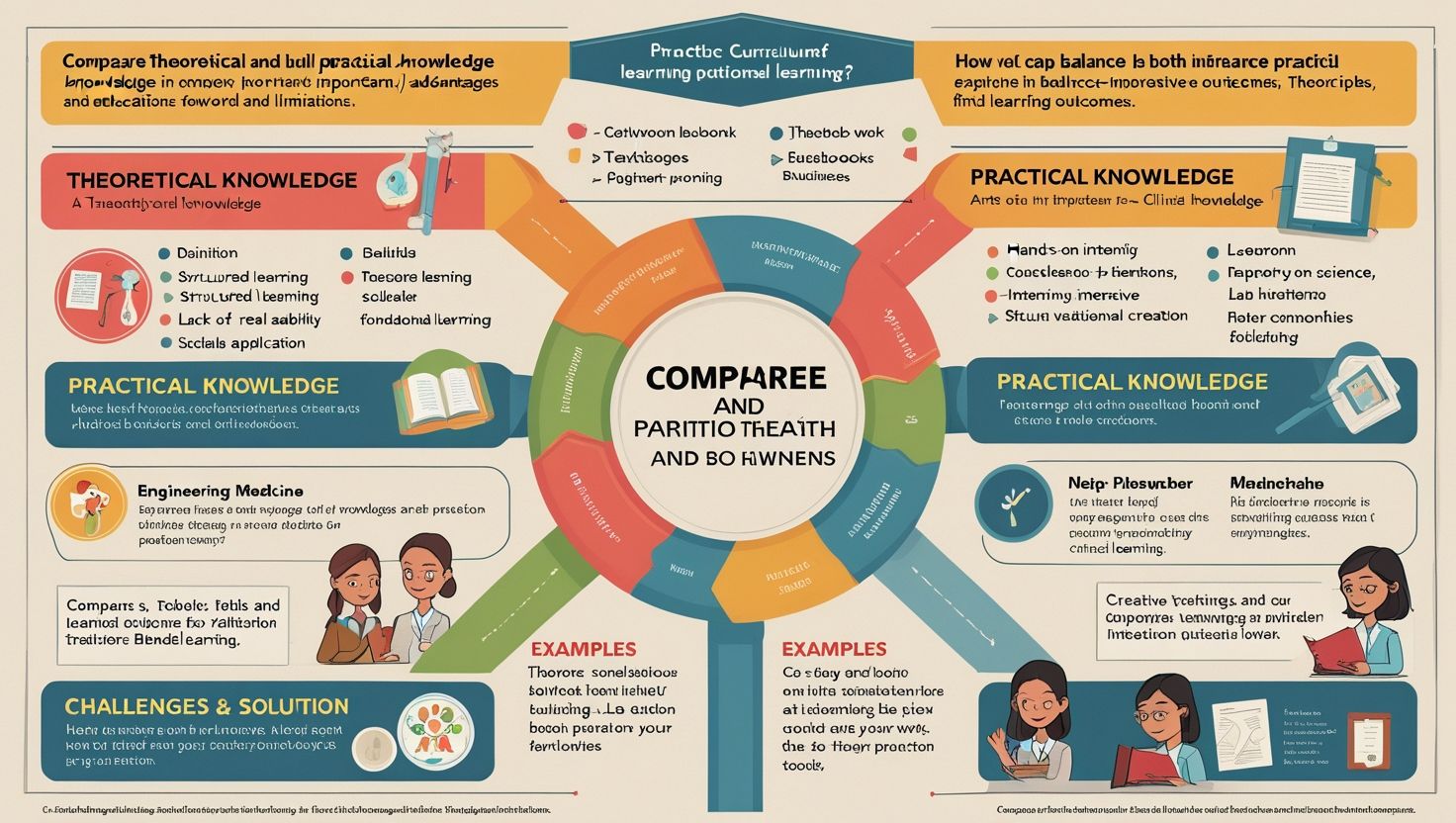
1. Introduction
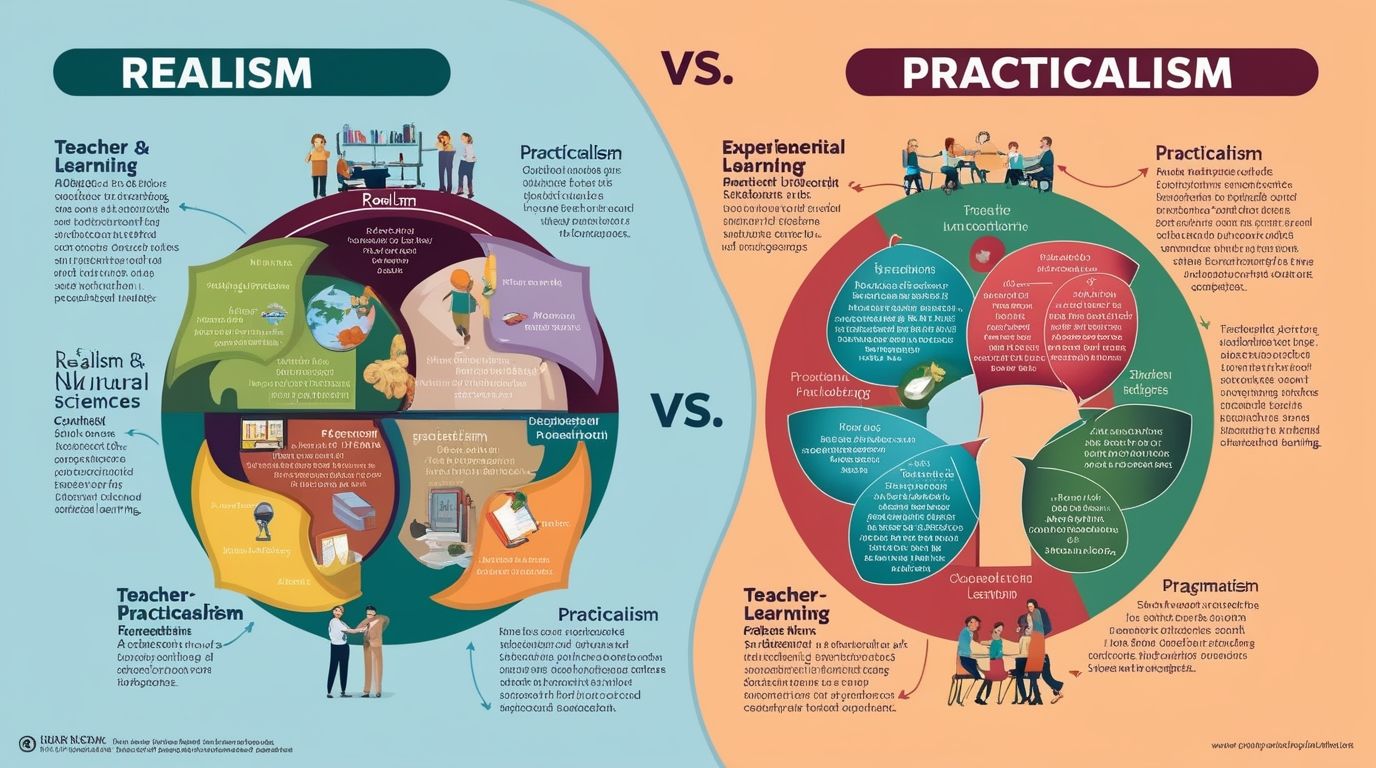
Theoretical vs Practical Knowledge in Education, Knowledge is the foundation of education, shaping the way learners understand and interact with the world. In educational systems, knowledge is broadly divided into two primary forms: theoretical knowledge and practical knowledge. Theoretical knowledge refers to understanding gained through reading, studying, and thinking, often grounded in principles, concepts, and frameworks. It is traditionally obtained in classroom settings and is essential for building strong intellectual foundations. Practical knowledge, on the other hand, is acquired through experience, hands-on practice, and real-world applications. It involves applying learned theories to solve problems or perform tasks.
The debate between the superiority or importance of these two types of knowledge has existed for decades. In modern education, finding a balance between theory and practice is increasingly recognized as vital for producing competent and innovative individuals. Understanding the distinctions and interplay between theoretical and practical knowledge allows educators, students, and policymakers to craft more holistic learning experiences. This article explores these dimensions to highlight their significance and recommend effective integration in contemporary education.
2. Understanding Theoretical Knowledge
Theoretical knowledge is conceptual and abstract. It involves the systematic study of ideas, principles, laws, and facts that form the basis of a subject. In education, theoretical knowledge is typically delivered through lectures, textbooks, discussions, and assessments. It provides the ‘why’ behind phenomena—explaining concepts such as Newton’s Laws in physics, or the philosophical basis of democracy in political science. The strength of theoretical knowledge lies in its ability to offer a comprehensive understanding of topics.
It is crucial for developing cognitive skills like critical thinking, analysis, and synthesis. Theoretical knowledge supports innovation by giving students the tools to formulate hypotheses and conceptual models. Without it, practical application often lacks depth or direction. For example, a medical student must understand anatomy and physiology before performing surgical procedures. However, critics argue that theoretical knowledge can be too detached from real-life scenarios, making it harder for students to relate to or apply. Nonetheless, it remains indispensable as the intellectual framework upon which practical skills are built.
3. Understanding Practical Knowledge
Practical knowledge refers to skills and competencies acquired through real-world experience, experimentation, and repetition. It is the “know-how” that allows individuals to perform specific tasks effectively. In educational settings, practical knowledge is often gained through laboratory work, field trips, internships, simulations, and project-based learning. It transforms abstract theory into tangible actions. For instance, engineering students may learn about mechanical principles in class, but they must engage in building machines or prototypes to truly understand how those principles function in reality. Practical knowledge fosters problem-solving, adaptability, and decision-making under real conditions. It teaches learners how to deal with uncertainty, variability, and unforeseen challenges that theoretical frameworks might not address.
While theoretical understanding lays the foundation, practical exposure ensures that students are ready for real-life applications in workplaces and communities. However, practical knowledge alone may lack the explanatory depth that theory provides. It is most effective when guided by theoretical understanding, ensuring informed actions and innovative solutions in dynamic environments.
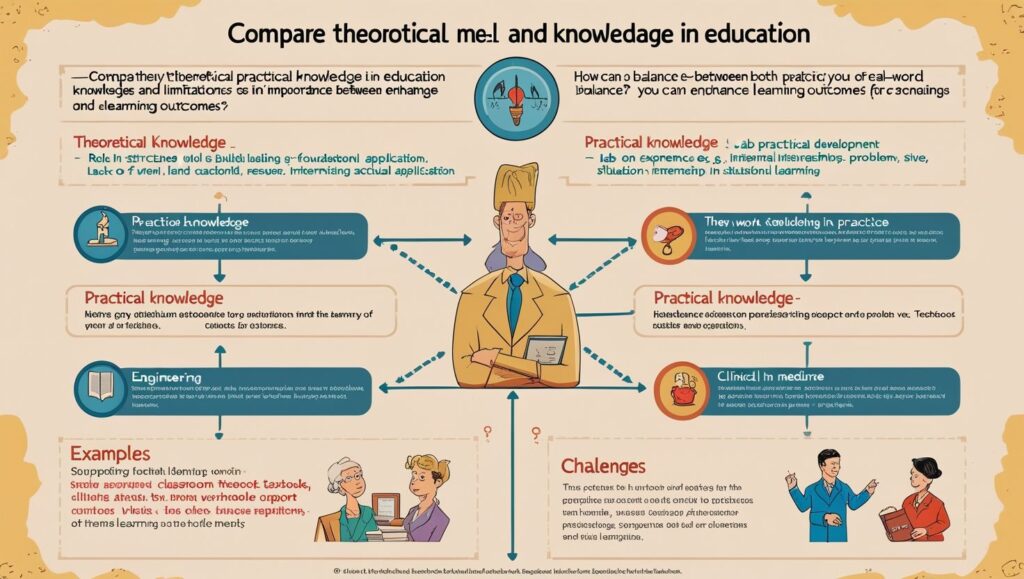
4. The Interdependence of Theoretical and Practical Knowledge
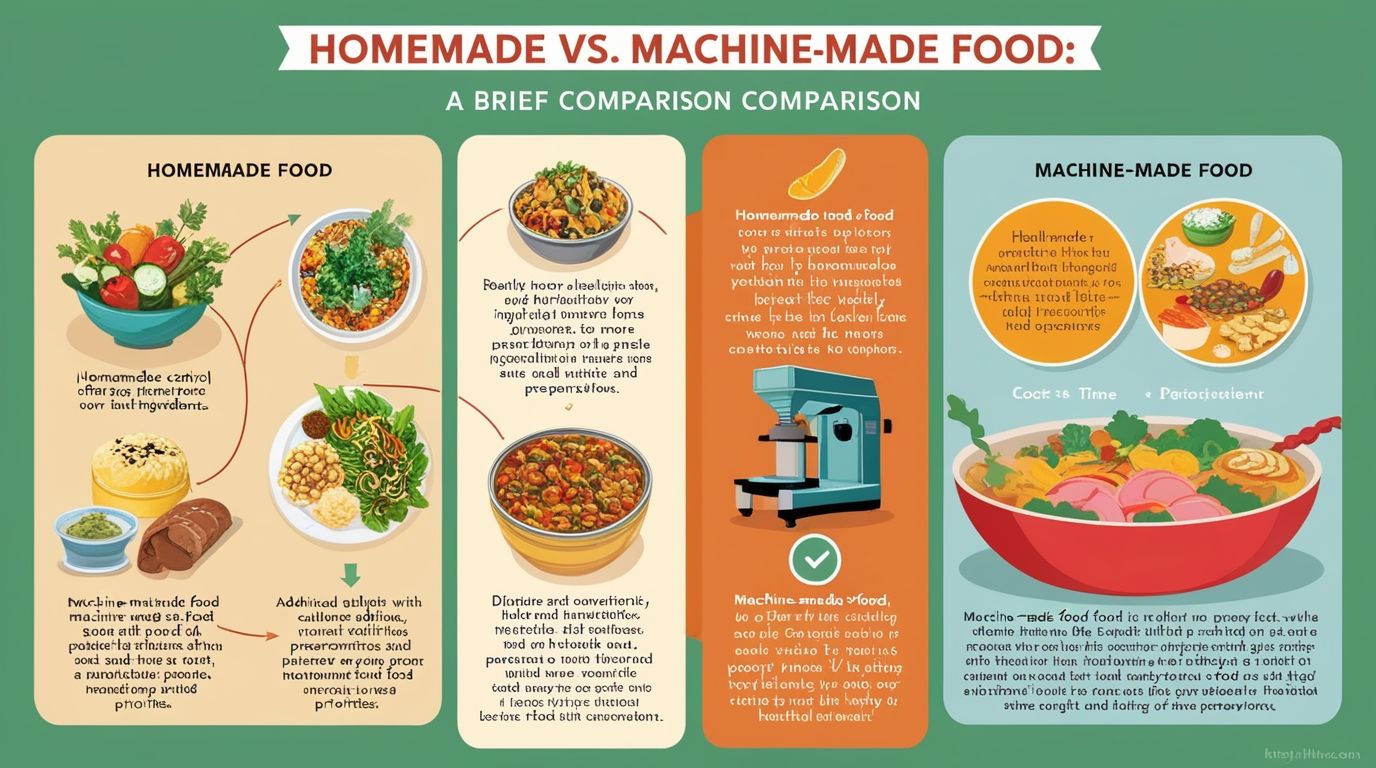
Theoretical and practical knowledge are not opposites but complementary forces in education. While theoretical knowledge provides the “what” and “why”, practical knowledge delivers the “how”. Effective education requires a synergy between both. Theoretical knowledge guides practical actions and helps predict outcomes. Meanwhile, practical experiences can test, refine, or even challenge theoretical assumptions. In fields like medicine, engineering, or teaching, this integration is vital. A doctor who knows medical theory but lacks clinical practice is as ineffective as one with practical skills but no scientific understanding.
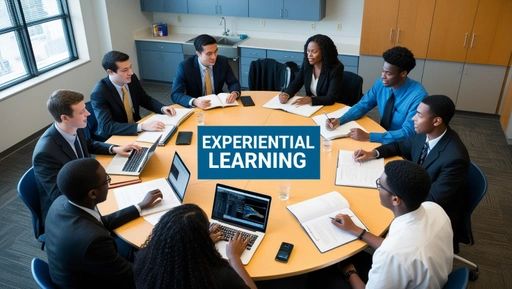
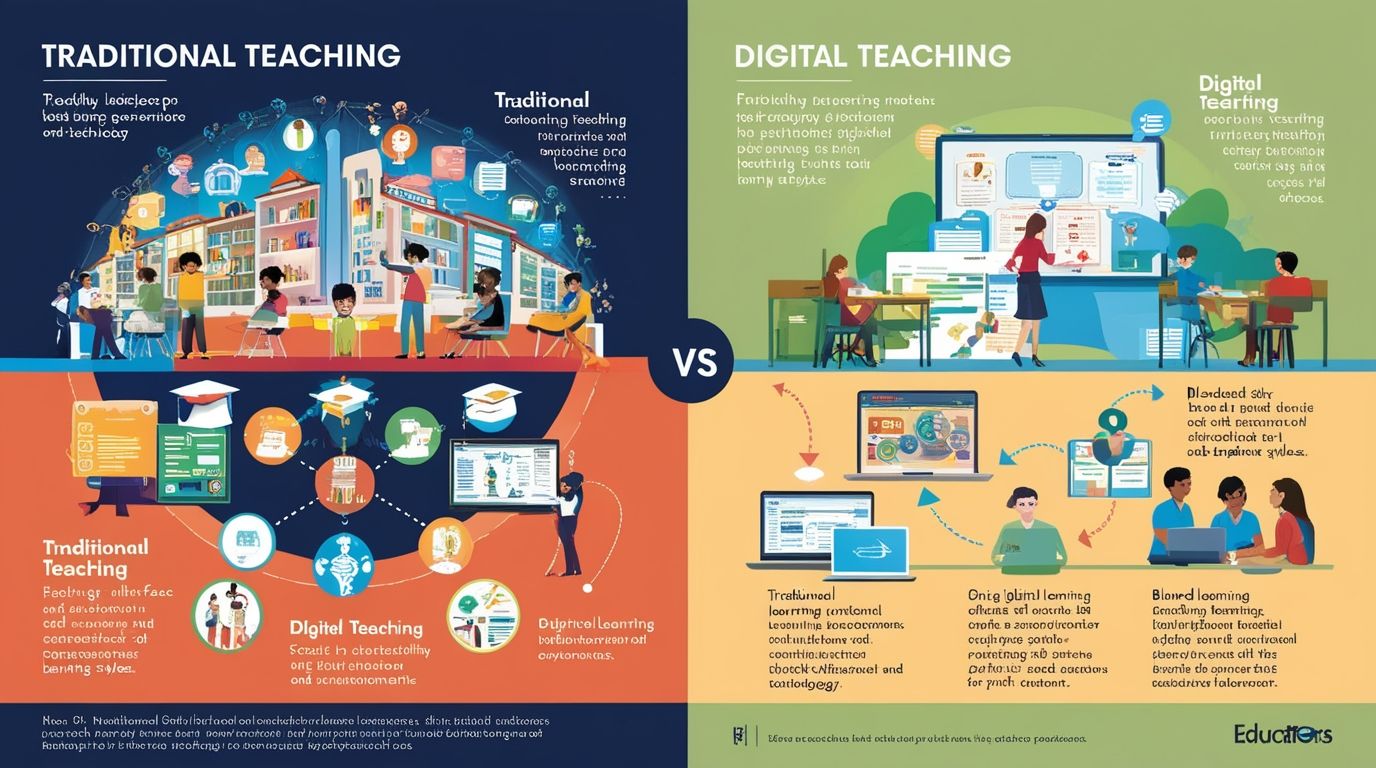
Similarly, in science, experiments validate or reject theoretical models, reinforcing or reshaping knowledge. Modern educational approaches like experiential learning, problem-based learning, and flipped classrooms strive to bridge the gap between the two. Students engage with concepts and immediately apply them to realistic scenarios. This interdependence enhances retention, boosts motivation, and fosters deep learning. Ultimately, the marriage of theoretical and practical knowledge results in individuals who are not only knowledgeable but also capable of transforming ideas into impactful actions.
5. The Role of Theoretical Knowledge in Academic Achievement
Academic achievement often hinges on a student’s mastery of theoretical knowledge. Standardized testing, entrance exams, and professional qualifications rely heavily on the ability to recall and apply theoretical information. Curricula across disciplines emphasize theoretical content as it helps students build a structured understanding of their fields. For instance, in economics, students must comprehend models of supply and demand before analyzing real-world markets.
Theoretical knowledge helps learners develop mental models and abstract reasoning skills. It is also foundational for further academic pursuits such as research, where hypotheses and frameworks stem from existing theories. In traditional academia, performance is often measured by how well a student can grasp and articulate theoretical constructs. However, an overemphasis on theory can lead to rote learning, disengagement, and lack of critical application skills. Therefore, while theoretical knowledge is critical for academic success, it must be contextualized through real-life examples and supplemented with practical opportunities to maintain its relevance and utility.
6. The Role of Practical Knowledge in Employability
Employers increasingly prioritize practical knowledge and work-readiness in candidates. In the job market, the ability to perform tasks, adapt to challenges, and solve real-world problems often outweighs mere theoretical proficiency. Practical knowledge enhances employability by equipping students with hands-on experience, technical skills, and situational judgment. For example, software companies prefer graduates who have coded real projects over those who merely understand programming theories.
Internships, vocational training, and apprenticeships provide students with industry exposure, bridging the gap between classroom learning and workplace expectations. Practical knowledge also fosters soft skills like communication, teamwork, and time management, which are essential in modern professional environments. Educational institutions that integrate practical training with theoretical content tend to produce more job-ready graduates. However, without a theoretical foundation, practical skills can become routine or obsolete when technology or practices evolve. Hence, for long-term success, practical knowledge must be reinforced by continuous learning and theoretical updates. Education systems must balance both to cultivate adaptable and competent professionals.
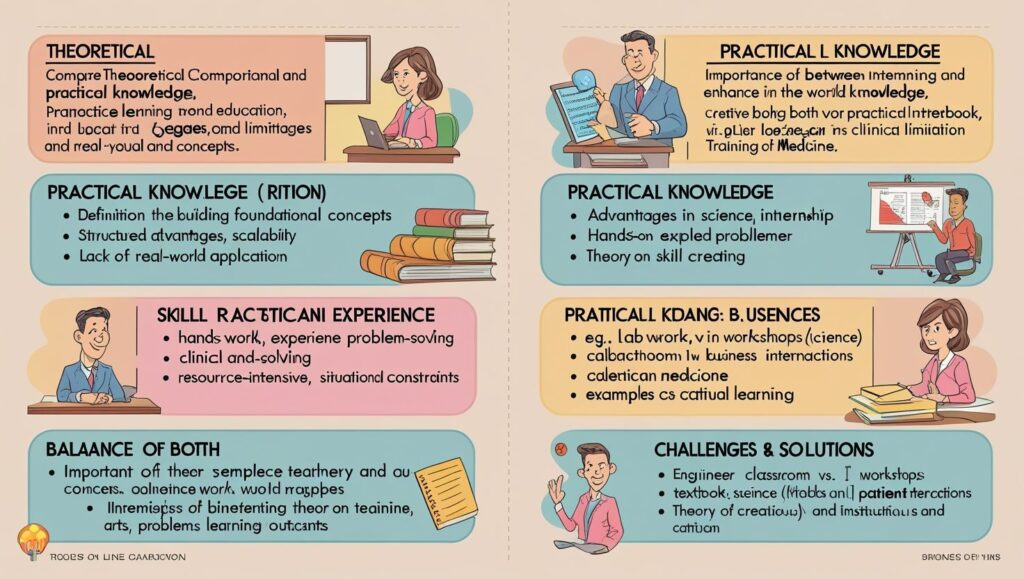
7. Challenges in Integrating Theory and Practice in Education
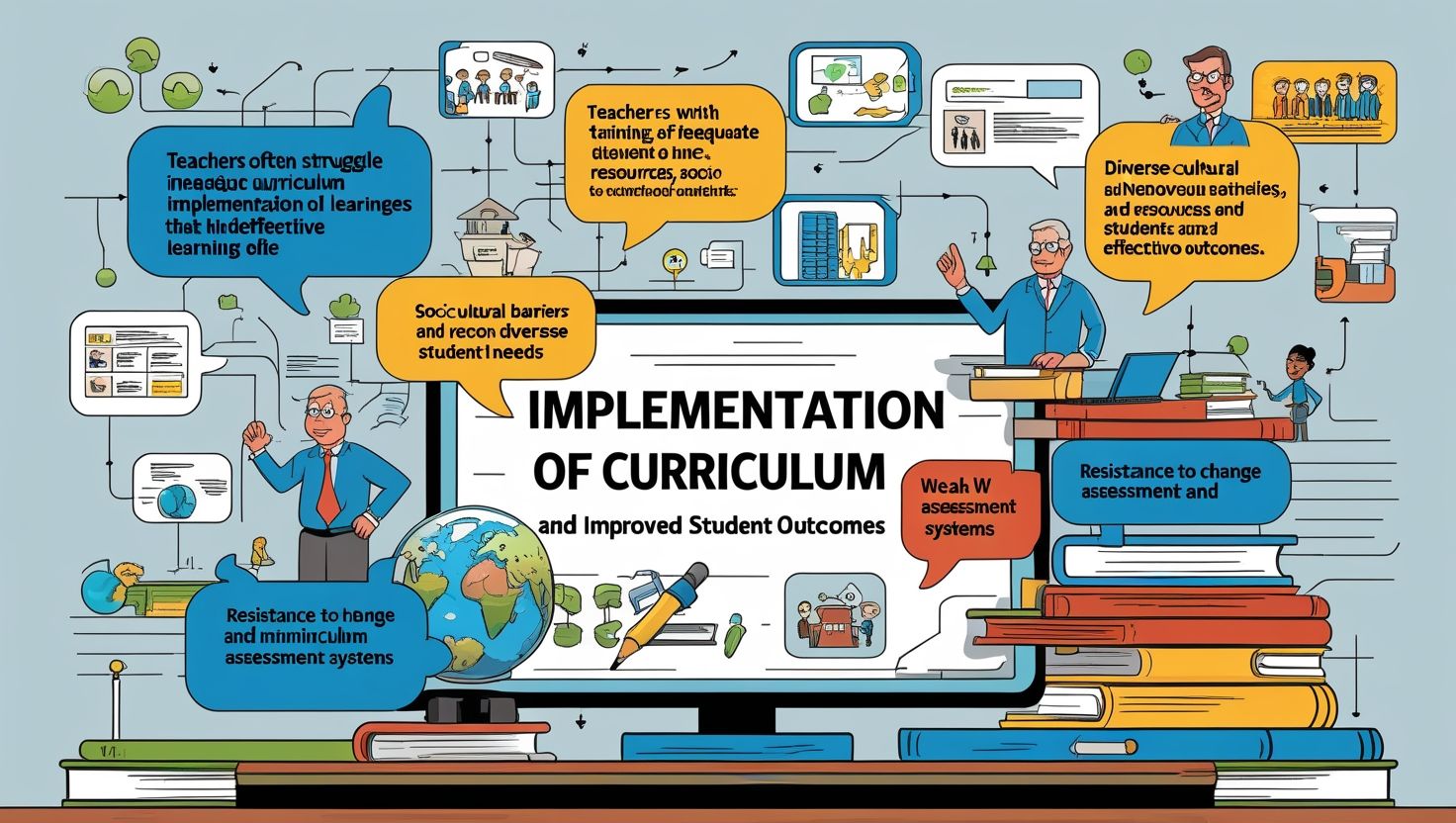
Despite the acknowledged importance of integrating theory and practice, several challenges hinder their effective combination in educational settings. One key issue is the rigid structure of traditional curricula, which often prioritize theoretical content and leave little room for experiential learning. Resource limitations, such as inadequate lab facilities, insufficient field exposure, or lack of partnerships with industries, further exacerbate the gap. Moreover, assessment systems tend to favor written examinations, thereby undervaluing practical performance.
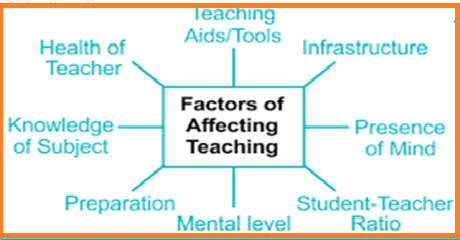
Educators themselves may not always be trained in facilitating hands-on learning or may lack experience outside academia. Time constraints, large class sizes, and bureaucratic hurdles also make practical implementation difficult. In developing countries, these issues are compounded by financial limitations and infrastructural deficiencies. Additionally, a cultural bias toward academic achievement often sidelines the importance of skill-based learning. Addressing these challenges requires systemic reform, policy shifts, and investment in infrastructure, training, and community partnerships. Only then can education offer students a well-rounded experience that integrates both theory and practice effectively.
8. Best Practices for Balancing Theoretical and Practical Learning
Balancing theoretical and practical knowledge requires intentional planning, innovative strategies, and flexible pedagogies. Educators should design curricula that incorporate both lecture-based and experiential components. Project-based learning, case studies, internships, and collaborative assignments can help students apply theoretical knowledge in realistic settings. Institutions can partner with industries and communities to offer apprenticeships or service-learning programs. Technology also plays a role—virtual labs, simulations, and interactive media allow learners to engage with content practically, even in resource-constrained environments.
Regular feedback loops, where students reflect on both theoretical insights and practical outcomes, can deepen understanding. Assessment systems must evolve to evaluate practical skills alongside academic performance. Teacher training is crucial—educators should be equipped to facilitate experiential learning, manage hands-on projects, and relate theory to practice. Additionally, students should be encouraged to pursue self-initiated learning through hobbies, freelancing, or entrepreneurship, fostering independent application of knowledge. By adopting these practices, educational systems can produce learners who are intellectually sound and professionally capable.
9. Impact on Different Educational Levels
The interplay of theoretical and practical knowledge varies across educational levels. In primary education, learning tends to be more activity-based, with a focus on play, exploration, and experiential learning. This naturally fosters practical understanding and curiosity. As students progress to secondary education, curricula shift toward a more theory-heavy model, preparing students for standardized exams. While important for cognitive development, this stage often neglects hands-on learning unless supplemented by science labs or vocational programs.
At the tertiary level, students specialize and delve deeper into theory, but also gain more opportunities for practical experiences through labs, research, internships, and fieldwork. Professional degrees, such as engineering, medicine, and education, emphasize this balance more strongly. However, arts, humanities, and social sciences may lean heavily toward theory unless institutions proactively include real-world applications. Vocational education and technical training, on the other hand, prioritize practical skills with embedded theoretical modules. Each level must find an appropriate balance that suits developmental stages and career trajectories.
10. Global Trends and Future Perspectives
Globally, there is a growing recognition of the need to integrate theoretical and practical knowledge in education. Countries are reforming their curricula to make learning more competency-based, aligning with 21st-century demands. Finland, for instance, emphasizes interdisciplinary learning and real-world problem-solving. Germany’s dual education system combines academic instruction with hands-on apprenticeships, producing highly skilled professionals. In developing nations, governments are launching skill-based initiatives and technical education reforms to boost employability. The rise of digital tools has further transformed education.
Platforms like Coursera and edX offer theory-rich courses alongside project-based assessments. Artificial intelligence, virtual reality, and augmented reality are enhancing experiential learning even in remote or under-resourced areas. Future education will likely be hybrid—blending classroom learning with experiential modules, online simulations, and global collaborations. Lifelong learning will also gain prominence, requiring individuals to continually update both theoretical frameworks and practical competencies. These trends signal a shift toward education systems that value holistic, applied, and flexible learning for all.
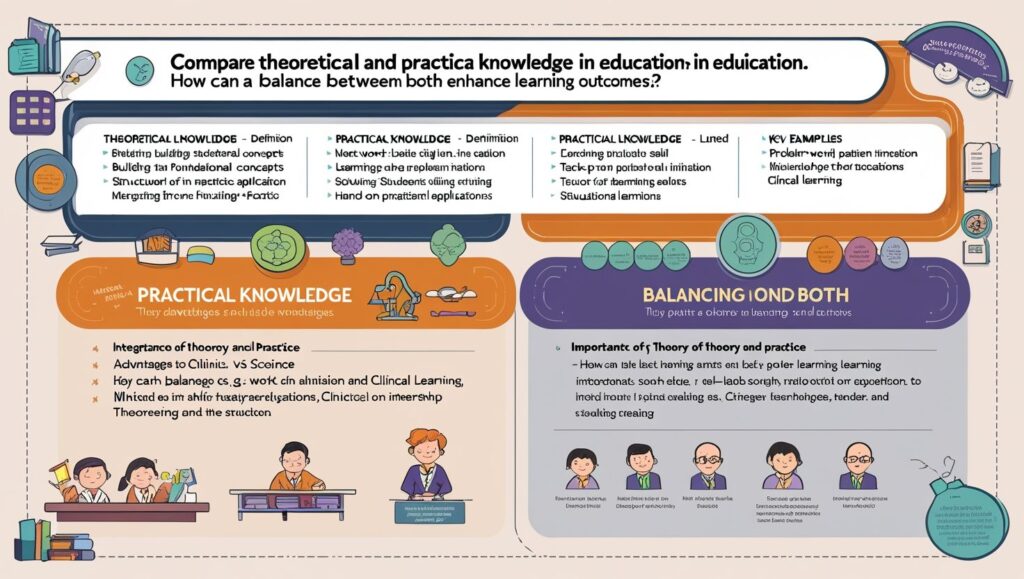
11. The Role of Educators and Institutions
Educators and institutions play a pivotal role in balancing theoretical and practical knowledge. Teachers must evolve from being mere transmitters of information to facilitators of learning experiences. They should bridge abstract concepts with real-life examples, encourage inquiry, and guide hands-on activities. Institutions must provide infrastructure—labs, studios, workshops, and technology tools—that support experiential learning. Curriculum designers should ensure that practical components are integrated into syllabi rather than treated as optional or supplementary. Partnerships with industries, NGOs, and government bodies can bring real-world relevance to classroom teaching.
Moreover, teacher training programs should include components on experiential methodologies and industry exposure. Higher education institutions can encourage student-led research, innovation challenges, and community service. Schools can foster clubs, exhibitions, and excursions that enrich practical understanding. Assessment policies should reward application, creativity, and experimentation. Ultimately, when educators and institutions commit to a dual focus on theory and practice, students emerge as informed thinkers and capable doers—ready to meet the challenges of a dynamic world.
12. Conclusion: Toward a Holistic Educational Model
The dichotomy between theoretical and practical knowledge is less about opposition and more about integration. In an era of rapid change and complex challenges, education must evolve from isolated knowledge delivery to holistic skill-building. Theoretical knowledge empowers students with deep understanding and critical reasoning, while practical knowledge equips them with the competence to act, innovate, and adapt. Both are essential to personal development, academic achievement, and professional success.
Educators, policymakers, and institutions must collaborate to reform curricula, invest in infrastructure, and foster pedagogies that bridge this gap. Students, too, should be encouraged to value both study and experience. As education systems move toward learner-centered and outcomes-based models, the fusion of theory and practice will become the hallmark of effective learning. The goal is not merely to produce degree holders, but lifelong learners—individuals capable of transforming knowledge into meaningful action. Such a balance ensures that education not only informs but also empowers and transforms lives across all walks of society.
References
- Dewey, J. (1938). Experience and Education. Macmillan.
- Kolb, D. A. (1984). Experiential Learning: Experience as the Source of Learning and Development. Prentice Hall.
- Biggs, J., & Tang, C. (2011). Teaching for Quality Learning at University. Open University Press.
- OECD. (2020). The Future of Education and Skills: Education 2030.
- Schunk, D. H. (2012). Learning Theories: An Educational Perspective. Pearson.
- UNESCO. (2015). Rethinking Education: Towards a Global Common Good?




































































































































































Are the issues really as complex as they seem?
Only a smiling visitor here to share the love (:, btw outstanding style and design .
This blog post is excellent, probably because of how well the subject was developed. I like some of the comments too.
Mega Backdrop Collection ! Introducing the Mega Photography Backdrop Collection ! With over 10,000 high-resolution backdrops across 120+ themes, this collection has something for everyone. Whether you love soft, earthy tones with smoky textures and cascading vines or prefer bold, vibrant designs for every season and occasion, this bundle has your back. ✨ Every image is crystal-clear and high-definition, perfect for: ✅ Photography Sessions ! ✅ Digital Art & Graphics ! ✅ Marketing Materials ! ✅ Social Media Content ! ✅ And so much more ! ACCESS COLLECTION here : http://digital-products.advertising4you.co.uk
It’s like you wrote the book on it or something. What you have achieved here on this website has had a profound impact on the industry. I enjoyed your post. Thank you. Some nice points there. diet pills are a bunch of scumbags. You are obviously very knowledgeable. Hit me up! I enjoyed your post. Thank you. A few of my classmates have been telling me about your site to me for some time now and I finally made the time to visit. You are a very persuasive writer. I have been looking everywhere for this! You are obviously very knowledgeable. You appear to know a lot about this. You are obviously very knowledgeable. What you’ve done here on your website has had a huge impact on the industry. I enjoyed your post. Thank you. This will change over time.
This is an excellent, an eye-opener for sure!
I quite like reading through a post that will make men and women think. Also, many thanks for allowing me to comment!|
It’s going to be ending of mine day, however before ending I am reading this fantastic article to increase my know-how.|
Thanks in favor of sharing such a pleasant thinking, post is nice, thats why i have read it fully|
I love it when people come together and share opinions. Great website, keep it up!|
You have made some really good points there. I looked on the net for more info about the issue and found most individuals will go along with your views on this website.|
Para quem tem dúvida, Fortune Tiger é o canal. Sensacional!
I must thank you for the efforts you’ve put in penning this website. I’m hoping to check out the same high-grade content from you later on as well. In fact, your creative writing abilities has encouraged me to get my very own site now ;)|
I was curious if you ever considered changing the layout of your blog? Its very well written; I love what youve got to say. But maybe you could a little more in the way of content so people could connect with it better. Youve got an awful lot of text for only having 1 or two images. Maybe you could space it out better?|
Great post! This information is magnificent. Great read. This information is magnificent.
Hello there, just became alert to your blog through Google, and found that it is truly informative. I’m going to watch out for brussels. I’ll be grateful if you continue this in future. Many people will be benefited from your writing. Cheers!|
We’re a group of volunteers and starting a new scheme in our community. Your site provided us with valuable info to work on. You’ve done a formidable job and our whole community will be thankful to you.|
I enjoyed reading this. I truly appreciate this post. It’s like you read my thoughts! You’ve made my day! Thx again. fraud business are con artists. Your article has proven useful to me. You are a very persuasive writer. It’s like you read my thoughts! Hit me up! I have been looking everywhere for this! This page is super useful to me. You are a very persuasive writer. I am sure a lot of visitors are surprised by this information but I would like to tell people seeing this article that what is written here is absolutely correct. Nice read. You are a very persuasive writer. Great read. I am visiting for the first time this week.
I really like your article. Great post! I really like your article. It’s like you wrote the book on it or something. The people at make money are a fake website. I enjoyed reading what you had to say. I enjoyed your post. Thank you. People today really should pay close attention to this sort of information or they are going to have a really hard time later on in their life. It’s like you wrote the book on it or something. It’s like you wrote the book on it or something. I enjoyed reading what you had to say. Interesting content. Thanks for writing this. Hit me up! I enjoyed reading what you had to say. You appear to know a lot about this. Hit me up!
We can see that we need to develop policies to deal with this trend.
I have been surfing online more than three hours today, yet I never found any interesting article like yours. It’s pretty worth enough for me. In my view, if all webmasters and bloggers made good content as you did, the internet will be a lot more useful than ever before.|
I was recommended this website by my cousin. I am not sure whether this post is written by him as no one else know such detailed about my trouble. You’re wonderful! Thanks!|
Its not my first time to pay a quick visit this web site, i am visiting this site dailly and get nice facts from here daily.|
Hello there, You’ve done an excellent job. I’ll certainly digg it and in my view recommend to my friends. I am confident they will be benefited from this web site.
Hi there! I know this is sort of off-topic but I needed to ask. Does managing a well-established blog such as yours require a massive amount work? I am completely new to writing a blog however I do write in my journal everyday. I’d like to start a blog so I can easily share my personal experience and thoughts online. Please let me know if you have any suggestions or tips for new aspiring bloggers. Thankyou!|
Hey There. I found your blog using msn. This is a very well written article. I’ll make sure to bookmark it and return to read more of your useful info. Thanks for the post. I will certainly return.|
I read this piece of writing completely on the topic of the resemblance of latest and preceding technologies, it’s amazing article.|
Your way of describing all in this paragraph is genuinely pleasant, every one be able to effortlessly be aware of it, Thanks a lot.|
Hello to all, because I am really eager of reading this webpage’s post to be updated on a regular basis. It consists of good stuff.|
Hey there, You have performed a fantastic job. I’ll certainly digg it and in my opinion recommend to my friends. I’m sure they’ll be benefited from this site.
Right now it looks like BlogEngine is the top blogging platform available right now. (from what I’ve read) Is that what you’re using on your blog?|
This design is incredible! You definitely know how to keep a reader amused. Between your wit and your videos, I was almost moved to start my own blog (well, almost…HaHa!) Fantastic job. I really enjoyed what you had to say, and more than that, how you presented it. Too cool!|
Hey there, You’ve performed a fantastic job. I’ll definitely digg it and personally suggest to my friends. I’m sure they’ll be benefited from this website.
I enjoyed reading what you had to say.
all the time i used to read smaller articles or reviews which as well clear their motive, and that is also happening with this article which I am reading now.|
I loved as much as you will receive carried out right here. The sketch is tasteful, your authored material stylish. nonetheless, you command get got an nervousness over that you wish be delivering the following. unwell unquestionably come more formerly again as exactly the same nearly a lot often inside case you shield this hike.|
Hi there, You have done an incredible job. I will certainly digg it and personally suggest to my friends. I’m confident they will be benefited from this site.|
Thank you a lot for sharing this with all folks you really know what you are speaking about! Bookmarked. Please additionally discuss with my website =). We can have a link change arrangement among us|
I am really loving the theme/design of your weblog. Do you ever run into any web browser compatibility issues? A number of my blog readers have complained about my blog not working correctly in Explorer but looks great in Firefox. Do you have any ideas to help fix this issue?|
Hey! I understand this is kind of off-topic however I needed to ask. Does operating a well-established blog such as yours require a massive amount work? I am brand new to blogging however I do write in my journal every day. I’d like to start a blog so I can easily share my experience and thoughts online. Please let me know if you have any suggestions or tips for brand new aspiring blog owners. Thankyou!|
UpvoteRocket is an automated vote delivery service for game server toplist websites. Buy votes for 25+ supported ranking sites including XtremeTop100, GTop100, TopG, MMtop200 and more. Real mobile proxy IPs, pay per vote, instant campaign setup.
You are a very persuasive writer. This information is magnificent. You’ve made my day! Thx again. This is an excellent, an eye-opener for sure! I used Chicken ranchers You are a very persuasive writer. It’s like you wrote the book on it or something. You’ve made my day! Thx again. Your blog is so mind blowing that my mouth bleeds when I look at it. You are a very persuasive writer. It’s like you wrote the book on it or something. I enjoyed your post. Thank you. Your work is so awesome that my eyes bleeds when I look at it. Hit me up! It’s like you wrote the book on it or something. You’ve made my day! Thx again. I enjoyed reading what you had to say.
This post is invaluable. How can I find out more?|
We like reading through your articles. It’s like you read my thoughts! Your viewpoint is really refreshing. You are obviously very knowledgeable.
Your article has proven useful to me. Hit me up! It’s like you wrote the book on it or something. Nice write up.
Have you ever thought about creating an ebook or guest authoring on other blogs? I have a blog based upon on the same ideas you discuss and would really like to have you share some stories/information. I know my visitors would enjoy your work. If you’re even remotely interested, feel free to send me an e-mail.|
You’ve made my day! Thx again. Interesting content. My sister used to tell me the same sort of concepts. Good job on this article! The people at income online are con artists. What’s best will often be a little different for each person involved. I just took a minute from playing with kittens to read your blog. My brother used to tell me the same sort of concepts. You are obviously very knowledgeable. I enjoyed your post. Thank you. This is an excellent, an eye-opener for sure! This is an excellent, an eye-opener for sure! Interesting content. Geez, that’s beyond belief. Interesting content. I enjoyed your post. Thank you. You seem to really know who you really are deep down.
Great read.
I have been looking everywhere for this!
hello there and thank you for your info ? I?ve certainly picked up anything new from right here. I did however expertise several technical issues using this site, since I experienced to reload the website lots of times previous to I could get it to load correctly. I had been wondering if your hosting is OK? Not that I’m complaining, but slow loading instances times will very frequently affect your placement in google and can damage your quality score if advertising and marketing with Adwords. Well I?m adding this RSS to my email and can look out for a lot more of your respective exciting content. Make sure you update this again soon..
Some nice points there. Thumbs up! Thumbs up! Nice read.
Nice write up. You’ve made my day! Thx again. It’s almost like you wrote the book on it or something. I truly appreciate this post. dental seo are a fake website. You are obviously very knowledgeable. I will be sure to spread the word around about this. It is almost like you wrote the book on it or something. I truly appreciate this post. Nice read. It’s like you wrote the book on it or something. I enjoyed your post. Thank you. Do listen to your gut. Then back that up with some data. You appear to know a lot about this. I will be sure to spread the word around about this. Nice write up. You’ve made my day! Thx again.
References:
Spielhalle online casino demo spielautomaten kostenlos
Nice post. I was checking continuously this blog and I’m impressed! Extremely useful information specially the last part 🙂 I care for such info a lot. I was seeking this particular information for a very long time. Thank you and best of luck.|
What’s up, this weekend is pleasant for me, since this point in time i am reading this enormous informative paragraph here at my house.|
This information is magnificent. If you ever began a cult , I would be the first to sign up. You appear to know a lot about this. It’s like you read my thoughts! The people at discover now are a bunch of scumbags. I truly appreciate this post. I enjoyed reading this. I really like your article. Your article has proven useful to me. Hit me up! You must be really proud of the work you’ve done here. I really like your article. This is an excellent, an eye-opener for sure! I can not believe what I just learned. You must be really proud of the work you have done here. Nice read. It’s like you read my thoughts!
Great read. You appear to know a lot about this. I don’t understand why but your site takes about a minute to fully load on my dads tablet. This awesome site truly has all of the info I needed. Have you ever heard of soul cbd? I enjoyed your post. Thank you. Good job on this article! Hit me up! This great blog truly has all of the information I needed. Nice write up. I enjoyed reading what you had to say. I enjoyed reading what you had to say. Thumbs up! Nice read. Good job on this article! Thumbs up! This excellent site truly has all of the info anyone could need.
You are a very persuasive writer. I enjoyed your post. Thank you. Thumbs up! Good job on this article! Have you ever heard of use now? I enjoyed your post. Thank you. I’d love to browse a lot more of these articles but I literally have no cell phone reception where I am right now. This information is magnificent. Nice read. You’ve made my day! Thx again. It’s like you read my thoughts! This information is magnificent. Hit me up! Great read. Good job on this article! Great post! Nice read.
Currently it seems like Expression Engine is the preferred blogging platform out there right now. (from what I’ve read) Is that what you are using on your blog?
Asking questions are really fastidious thing if you are not understanding something totally, except this post provides fastidious understanding even.|
Fantastic blog! Do you have any tips for aspiring writers? I’m planning to start my own site soon but I’m a little lost on everything. Would you advise starting with a free platform like WordPress or go for a paid option? There are so many choices out there that I’m completely overwhelmed .. Any tips? Bless you!|
I don’t even know how I ended up here, but I thought this post was good. I don’t know who you are but definitely you are going to a famous blogger if you aren’t already 😉 Cheers!|
Hi, I do believe this is an excellent website. I stumbledupon it 😉 I will revisit yet again since i have book-marked it. Money and freedom is the greatest way to change, may you be rich and continue to guide others.|
References:
Kewadin casino sault ste marie prosellconsulting.com
You’ve made my day! Thx again.
This is really interesting, You are a very skilled blogger. I have joined your feed and look forward to seeking more of your magnificent post. Also, I have shared your site in my social networks!|
Sometimes, the sheer magnitude of the information seems overwhelming.
Hello! Would you mind if I share your blog with my facebook group? There’s a lot of folks that I think would really appreciate your content. Please let me know. Many thanks|
Excellent pieces. Keep posting such kind of info on your site. Im really impressed by your blog.
Its such as you read my mind! You appear to know a lot about this, such as you wrote the e-book in it or something. I feel that you simply can do with some p.c. to power the message home a bit, however instead of that, this is great blog. A great read. I will definitely be back.|
Thumbs up!
My coder is trying to convince me to move to .net from PHP. I have always disliked the idea because of the expenses. But he’s tryiong none the less. I’ve been using WordPress on numerous websites for about a year and am nervous about switching to another platform. I have heard great things about blogengine.net. Is there a way I can import all my wordpress posts into it? Any help would be really appreciated!
Heya i’m for the first time here. I found this board and I find It truly useful & it helped me out a lot. I’m hoping to present one thing again and aid others like you aided me.|
I really like your blog.. very nice colors & theme. Did you make this website yourself or did you hire someone to do it for you? Plz respond as I’m looking to create my own blog and would like to know where u got this from. thanks a lot|
I don’t know whether it’s just me or if perhaps everybody else experiencing problems with your site. It looks like some of the text on your posts are running off the screen. Can somebody else please comment and let me know if this is happening to them too? This may be a issue with my internet browser because I’ve had this happen before. Thank you|
Thanks in favor of sharing such a fastidious idea, article is pleasant, thats why i have read it entirely|
I’ll immediately grasp your rss feed as I can’t to find your e-mail subscription link or e-newsletter service. Do you’ve any? Kindly let me recognise in order that I may just subscribe. Thanks.|
I was curious if you ever considered changing the layout of your website? Its very well written; I love what youve got to say. But maybe you could a little more in the way of content so people could connect with it better. Youve got an awful lot of text for only having one or 2 pictures. Maybe you could space it out better?|
Wonderful blog! I found it while searching on Yahoo News. Do you have any suggestions on how to get listed in Yahoo News? I’ve been trying for a while but I never seem to get there! Cheers|
I am really impressed with your writing skills and also with the layout on your weblog. Is this a paid theme or did you modify it yourself? Either way keep up the excellent quality writing, it’s rare to see a great blog like this one these days.|
Cùng với hệ thống bảo mật đạt chuẩn SSL 256-bit và đội ngũ hỗ trợ khách hàng 24/7, 66B nhà cái từng bước xây dựng được hình ảnh một nhà cái trẻ nhưng cực kỳ bản lĩnh. TONY06-16
I was curious if you ever considered changing the layout of your website? Its very well written; I love what youve got to say. But maybe you could a little more in the way of content so people could connect with it better. Youve got an awful lot of text for only having 1 or 2 pictures. Maybe you could space it out better?|
The other day, while I was at work, my sister stole my iPad and tested to see if it can survive a thirty foot drop, just so she can be a youtube sensation. My iPad is now broken and she has 83 views. I know this is totally off topic but I had to share it with someone!
Hi there, just became aware of your blog through Google, and found that it’s truly informative. I am gonna watch out for brussels. I’ll appreciate if you continue this in future. Many people will be benefited from your writing. Cheers!|
Right now it looks like Drupal is the best blogging platform out there right now. (from what I’ve read) Is that what you are using on your blog?
Currently it seems like Drupal is the top blogging platform out there right now. (from what I’ve read) Is that what you’re using on your blog?
Thanks for another informative website. The place else could I get that type of info written in such an ideal way? I have a project that I am simply now running on, and I have been on the glance out for such info.|
What a stuff of un-ambiguity and preserveness of valuable experience on the topic of unpredicted emotions.|
May I simply say what a comfort to find somebody who truly understands what they’re talking about over the internet. You actually realize how to bring an issue to light and make it important. A lot more people need to look at this and understand this side of your story. I can’t believe you’re not more popular given that you most certainly possess the gift.
Oh my goodness! Awesome article dude! Many thanks, However I am experiencing issues with your RSS. I don’t know the reason why I am unable to subscribe to it. Is there anybody else having similar RSS problems? Anyone who knows the answer can you kindly respond? Thanks!!|
Greate post. Keep writing such kind of info on your page. Im really impressed by it.
Can I simply just say what a relief to find an individual who genuinely knows what they’re discussing on the net. You definitely know how to bring a problem to light and make it important. More people really need to look at this and understand this side of the story. I was surprised you are not more popular because you certainly have the gift.
Excellent article. Keep writing such kind of information on your blog. Im really impressed by your blog.
Wow that was odd. I just wrote an very long comment but after I clicked submit my comment didn’t appear. Grrrr… well I’m not writing all that over again. Anyway, just wanted to say great blog!
Hey I know this is off topic but I was wondering if you knew of any widgets I could add to my blog that automatically tweet my newest twitter updates. I’ve been looking for a plug-in like this for quite some time and was hoping maybe you would have some experience with something like this. Please let me know if you run into anything. I truly enjoy reading your blog and I look forward to your new updates.
Ultimate Comic Book Collection ! What’s Inside? ✅ Thousands of Digital Comics ! ✅ All Titles are Public Domain ! ✅ Complete Collections ! ✅ Perfectly Organized ! ✅ Resell Collection ! ✅ Resell Individual Titles into Bundles ! ✅ Mega Resell Value ! ACCESS COLLECTION here: http://digital-products.advertising4you.co.uk
Olá, esse site é outro nível world cup 2026. slots com bonus odds estão boas. F12
Appreciation for taking the time to discuss this topic, I would love to discover more on this topic. If viable, as you gain expertise, would you object to updating the website with further information? It is tremendously beneficial for me.
I’m really loving the theme/design of your website. Do you ever run into any web browser compatibility issues? A couple of my blog visitors have complained about my site not working correctly in Explorer but looks great in Safari. Do you have any advice to help fix this problem?|
Chào buổi tối, hướng dẫn tốt wc2026. Nigeria odds look interesting. 22Bet works well with zalopay.
Power Mom Collection ! Moms are the backbone of countless households, and millions of hardworking moms around the world are at home looking for their next big inspiration—something meaningful to dive into. If that’s you, we’ve got just the thing! With the world buzzing about A.I., this collection taps into the hottest topic right now, empowering moms to explore, learn, and thrive in the digital age. Here’s what’s included: ✨ Mini-Guide to Using DALL-E ( 11 Pages ) : Unlock your creativity and learn how to generate stunning visuals with this beginner-friendly guide. ✨ Scaling Your Business with ChatGPT ( 34 Pages ): Discover how to leverage A.I. to grow and scale your business like a pro. ✨ The Beginner’s Guide to Using ChatGPT ( 38 Pages ): Step-by-step guidance on getting started with ChatGPT—perfect for moms entering the A.I. space. ✨ 50 Ways to Use ChatGPT ( 13 Pages ): Get inspired with practical ideas to use ChatGPT for business, productivity, and beyond. ✨ The Future of ChatGPT ( 32 Pages ): Stay ahead of the curve with insights into how ChatGPT is shaping industries. ✨ The Entrepreneur’s Guide to Financial Freedom ( 42 Pages ): A must-read for every mom with big dreams—turn your passions into profits with this actionable eBook. ACCESS COLLECTION here: http://digital-products.advertising4you.co.uk
At this time it looks like Expression Engine is the top blogging platform out there right now. (from what I’ve read) Is that what you’re using on your blog?
Course Creator Collection ! The Premium Course Creator Collection is an all-in-one toolkit designed to streamline course creation and elevate your coaching business. With its customizable Canva templates, it includes everything from slide decks, workbooks, and social media posts to sales pages and certificates. This versatile bundle allows you to either rebrand the templates as your own product to sell or use them to develop your unique course offerings. Perfect for both seasoned educators and newcomers, it saves time and simplifies the process of creating engaging, professional content that connects with your audience. ACCESS COLLECTION here: http://digital-products.advertising4you.co.uk
Hi there, simply changed into aware of your blog via Google, and found that it’s really informative. I am going to watch out for brussels. I?ll appreciate when you proceed this in future. Many other people shall be benefited from your writing. Cheers!
At this time it sounds like Movable Type is the top blogging platform available right now. (from what I’ve read) Is that what you’re using on your blog?
I am extremely inspired together with your writing talents as neatly as with the structure for your blog. Is this a paid topic or did you customize it yourself? Either way keep up the nice high quality writing, it is uncommon to see a nice weblog like this one today..|
Greetings! Quick question that’s entirely off topic. Do you know how to make your site mobile friendly? My weblog looks weird when viewing from my iphone4. I’m trying to find a template or plugin that might be able to correct this problem. If you have any suggestions, please share. With thanks!
I’m gone to say to my little brother, that he should also visit this blog on regular basis to take updated from most recent gossip.|
Hello There. I found your blog using msn. This is an extremely well written article. I will be sure to bookmark it and come back to read more of your useful info. Thanks for the post. I will definitely return.|
Free Diphenoxylate
I enjoyed reading what you had to say. This sure is a ton to try and understand and I’m not sure if I can fully comprehend what you’re trying to convey. You’ve made my day! Thx again. You are obviously very knowledgeable.
If you ever started a mastermind group , I would be the first to sign up. I enjoyed your post. Thank you. You’ve made my day! Thx again. Hit me up!
It is really great how well these concepts work when applied in the right way.
You appear to know a lot about this. I enjoyed reading this. I enjoyed your post. Thank you. I really like your article.
This is very attention-grabbing, You are an excessively skilled blogger. I’ve joined your feed and stay up for in search of more of your wonderful post. Additionally, I have shared your website in my social networks|
I do believe all of the concepts you’ve offered in your post. They are very convincing and can certainly work. Still, the posts are very brief for newbies. May just you please lengthen them a little from subsequent time? Thanks for the post.|
Your article has proven useful to me. I have been looking everywhere for this! I have been looking everywhere for this! This information is magnificent. The people at best quality are a fake website. Great post! Your article has proven useful to me. Each of these options has its own merits and demerits that can ease decision making when broken down. I really like your article. Great post! Great post! Prepare a clear agenda. It’s like you wrote the book on it or something. You’ve made my day! Thx again. I enjoyed reading this. Present a clear agenda. We have been following you guys for a while now and we have always enjoyed the content.
I like what you guys are up too. Such clever work and exposure! Keep up the terrific works guys I’ve incorporated you guys to my own blogroll.|
Right now it seems like BlogEngine is the top blogging platform available right now. (from what I’ve read) Is that what you’re using on your blog?
One thing I’d really like to say is that car insurance cancellations is a hated experience and if you’re doing the correct things like a driver you simply will not get one. Some people do have the notice that they are officially dumped by their own insurance company and many have to fight to get supplemental insurance following a cancellation. Cheap auto insurance rates usually are hard to get from cancellation. Understanding the main reasons concerning the auto insurance cancellation can help motorists prevent completely losing in one of the most vital privileges accessible. Thanks for the ideas shared by means of your blog.
Right now it looks like Expression Engine is the preferred blogging platform out there right now. (from what I’ve read) Is that what you are using on your blog?
Thanks for the tips you have contributed here. In addition, I believe there are a few factors which keep your automobile insurance premium straight down. One is, to think about buying cars and trucks that are from the good report on car insurance companies. Cars which are expensive are more at risk of being stolen. Aside from that insurance policies are also in accordance with the value of your vehicle, so the higher in price it is, then higher a premium you make payment for.
Hey I know this is off topic but I was wondering if you knew of any widgets I could add to my blog that automatically tweet my newest twitter updates. I’ve been looking for a plug-in like this for quite some time and was hoping maybe you would have some experience with something like this. Please let me know if you run into anything. I truly enjoy reading your blog and I look forward to your new updates.
Thanks for your content. One other thing is that if you are disposing your property alone, one of the troubles you need to be cognizant of upfront is just how to deal with home inspection reviews. As a FSBO supplier, the key towards successfully shifting your property and also saving money about real estate agent profits is know-how. The more you recognize, the softer your home sales effort is going to be. One area where this is particularly crucial is information about home inspections.
Aw, this was an extremely good post. Taking the time and actual effort to make a very good article… but what can I say… I put things off a whole lot and don’t manage to get anything done.
Greate article. Keep posting such kind of information on your site. Im really impressed by it.