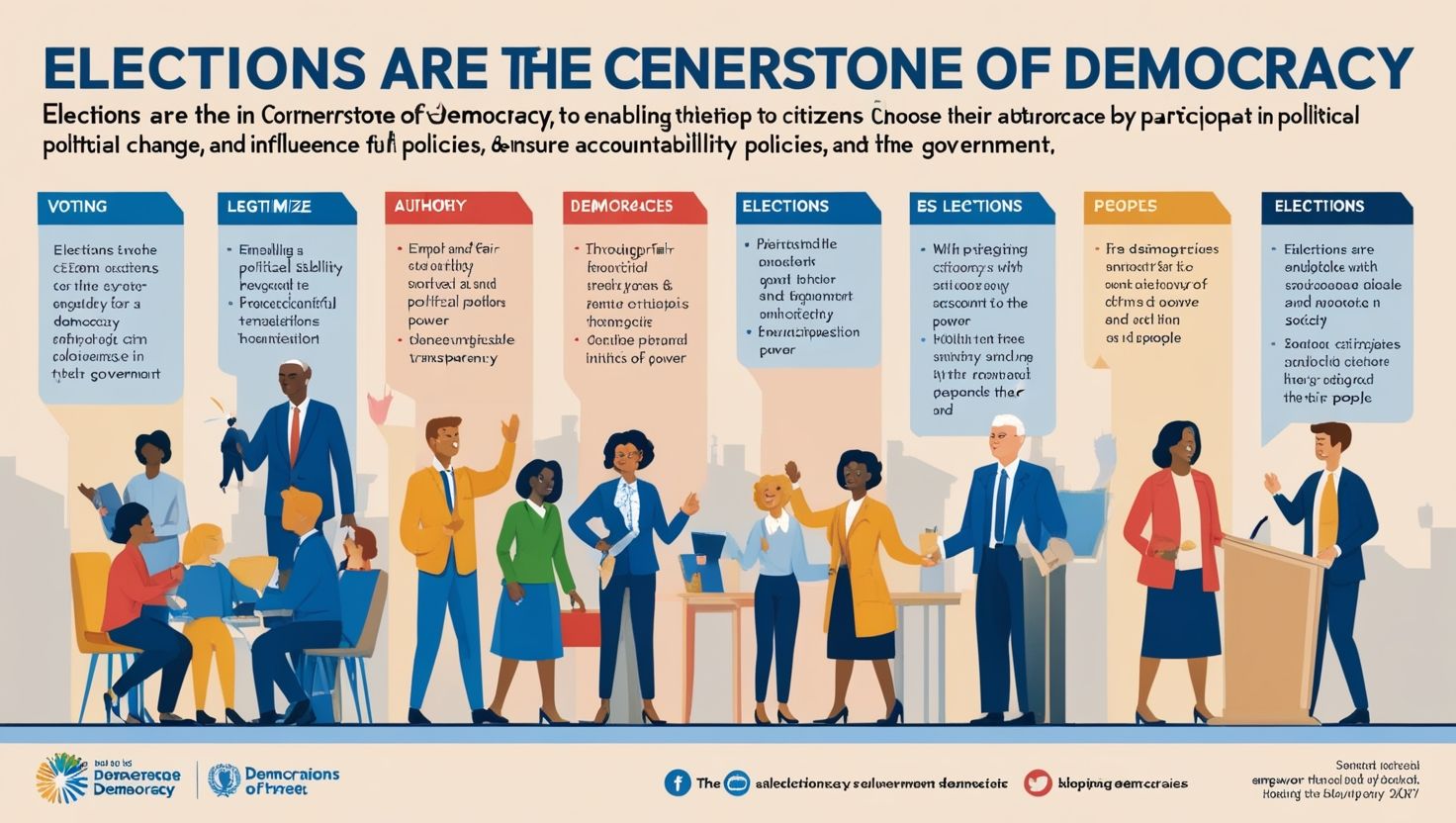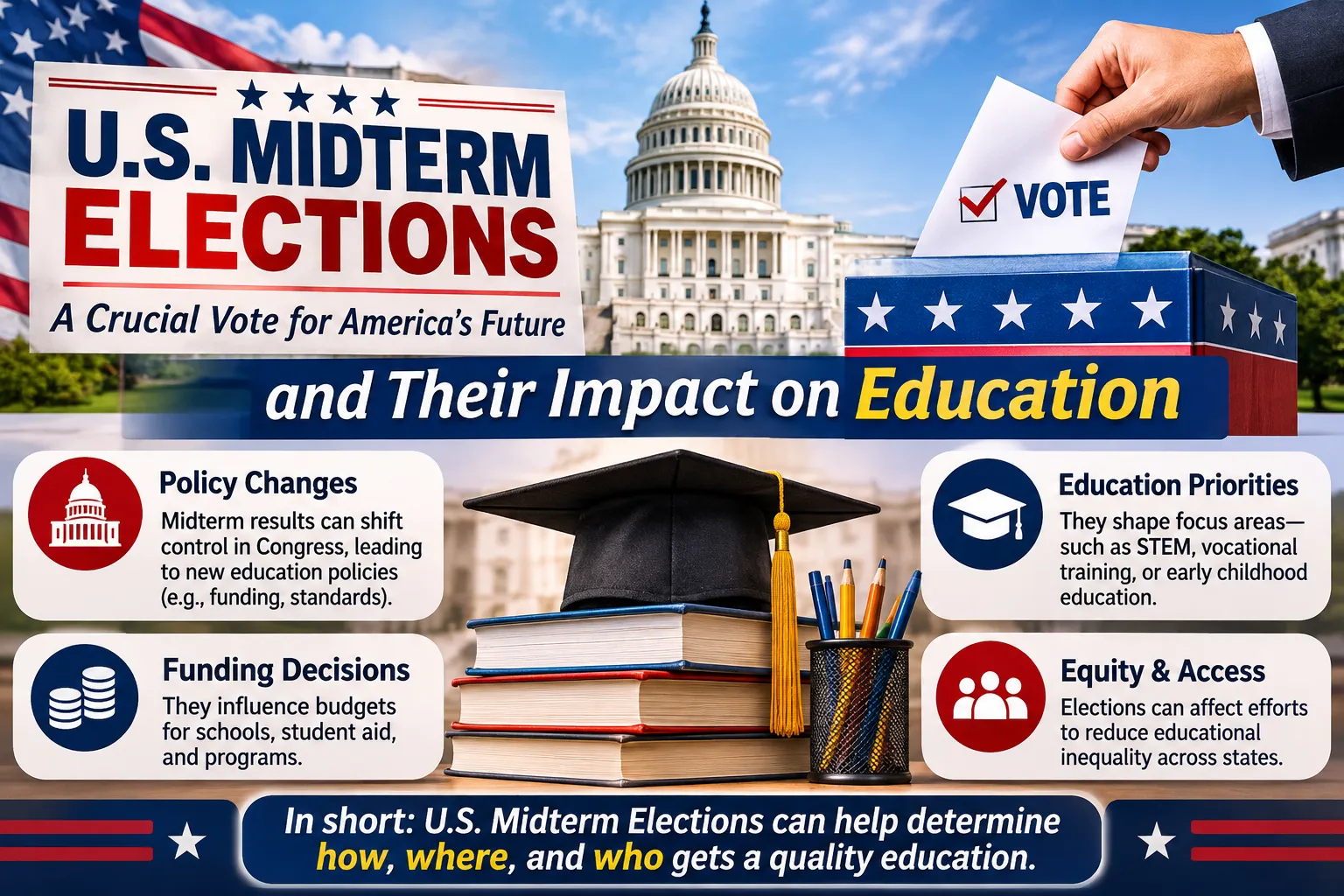
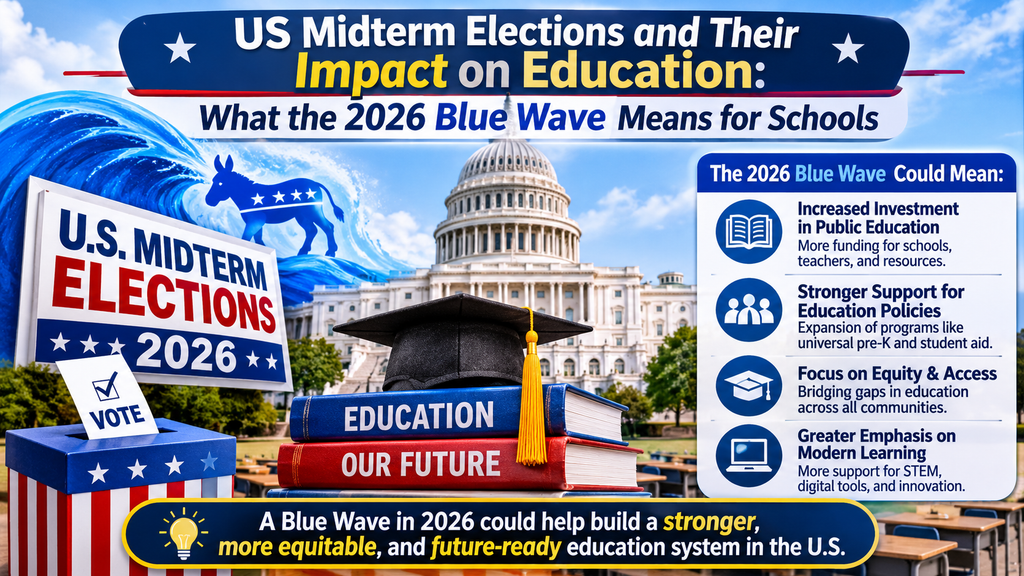
US Midterm Elections and Their Impact on Education, The 2026 US midterm elections delivered a decisive shift in power, with Democrats securing control of both the House and Senate and flipping multiple governorships across the country . For families, educators, and policymakers, this political earthquake carries profound implications for education at every level—from early childhood programs to federal oversight of K-12 schools and universities. The impact on education will unfold through budget battles, committee investigations, and state-level policy changes that could reshape how American children learn for years to come.
A New Balance of Power in Washington
Democrats won a comfortable majority in the House with over 250 seats and secured at least 54 Senate seats, ending Republican single-party control of Congress . This divided government structure means the Trump administration’s education agenda faces a powerful check. The Senate and House education committees will now operate under Democratic leadership, with Rep. Bobby Scott expected to chair the House Education and Workforce Committee and Sen. Bernie Sanders positioned to lead its Senate counterpart .
This shift matters enormously because congressional oversight serves as one of the few tools Democrats possess to counter executive branch actions. With President Trump retaining veto power, Democratic lawmakers cannot easily pass new education legislation. However, they can launch investigations, demand documents, and use the appropriations process to constrain the Department of Education’s operations . Ranking Member Scott has already signaled his intentions, sending letters to agency heads directing them to preserve records related to the administration’s education policies .
Federal Education Policy Under Scrutiny
The most immediate federal impact on education will emerge through oversight of the Trump administration’s efforts to dismantle the Department of Education. Throughout 2025 and 2026, the administration pursued interagency agreements that transferred portions of the department’s responsibilities—including special education oversight, literacy programs, and civil rights enforcement—to other federal agencies . Democrats view these agreements with deep suspicion and plan to challenge them through hearings and funding restrictions.
School choice programs face particular scrutiny. The Trump administration’s Education Freedom Tax Credit, which provides up to $1,700 for families to use toward private school tuition and other educational expenses, represents the largest federal school choice expansion in history . With over 30 states opting in or signaling participation, this program has become a signature achievement for the administration. Democratic lawmakers and teachers’ unions have criticized such initiatives as diverting resources from public schools . While a presidential veto protects the program from legislative repeal, Democrats can use budget negotiations to limit its implementation or expansion.
The administration’s Title IX enforcement regarding transgender students’ participation in sports and parental rights notifications also faces renewed resistance. The Department of Education has launched dozens of investigations into districts accused of violating new rules barring biological males from female sports and requiring parental notification for gender identity matters . Democratic oversight could expose the scope and costs of these investigations, potentially creating political pressure to scale them back.
State-Level Transformation: Governors and Legislatures
Perhaps the most tangible education policy changes will occur at the state level, where Democrats achieved historic victories. The party flipped governorships in Texas, Georgia, Iowa, Ohio, and Kansas—states where Republican governors had championed conservative education reforms . These new governors bring markedly different priorities.
In Texas, Governor-elect Gina Hinojosa has pledged to roll back the state’s voucher program, reverse takeovers of low-performing districts, and reconsider the STAAR testing system . Her victory, alongside Democrat James Talarico’s Senate win, represents a seismic shift in a state that had become a laboratory for conservative higher education reform. Former Governor Greg Abbott had banned diversity, equity, and inclusion offices at public universities and signed legislation weakening faculty governance .
Iowa’s incoming Governor Rob Sand, a staunch critic of the state’s education savings account program, will now oversee a state where Republicans had mandated American history and government courses taught through campus civics centers . Similarly, Ohio’s Governor-elect Amy Acton inherits a state that passed sweeping higher education reforms under Republican leadership, including restrictions on diversity programs .
Early childhood education emerges as a major winner from these state-level shifts. Georgia’s new governor, Keisha Lance Bottoms, made universal pre-K for four-year-olds and mandatory kindergarten central to her campaign . Wisconsin’s Governor-elect David Crowley has proposed universal early childhood education for children aged five and younger, alongside caps on child care costs at seven percent of family income . In New Mexico, Governor-elect Deb Haaland has committed to protecting and expanding the state’s universal child care system .
Teachers’ Unions and the Shifting Policy Landscape
Teachers’ union influence stands to grow considerably under the new political configuration. The American Federation of Teachers celebrated election results that rejected private school vouchers in Texas, Iowa, Michigan, and Ohio, framing the outcomes as vindication for public education . Union leaders expect to see increased education funding and greater voice in policy decisions at both state and federal levels.
Critics, however, warn that union priorities may not align with student interests. Michael Petrilli of the conservative Thomas B. Fordham Institute cautioned that unions might push to curb parental choice programs, eliminate differential pay initiatives, or add collective bargaining requirements that could hinder flexibility . This tension between union influence and reform-oriented policies will likely define education debates in Democratic-controlled states over the next two years.
What Remains Uncertain
Despite Democratic gains, the impact on education faces significant constraints. President Trump’s veto power means that sweeping legislative changes—whether expanding or restricting school choice, overhauling student loan programs, or restructuring the Department of Education—cannot become law without bipartisan support . Senate filibuster rules requiring 60 votes further complicate Democratic ambitions.
Moreover, the administration retains substantial executive authority over federal education policy. The Department of Education can continue implementing regulations, issuing guidance, and pursuing investigations regardless of congressional opposition. Courts have generally upheld broad executive discretion over visa policies for international students and enforcement of civil rights statutes .
For families and educators, the practical effects will vary dramatically by state. A student in Texas may see reduced testing and a rollback of voucher programs, while a student in a state with a newly elected Democratic governor might benefit from expanded early childhood offerings. The day-to-day operations of most classrooms will remain largely unchanged, but the policy environment surrounding them is shifting.
FAQs
How will the 2026 midterm results affect school choice programs?
The Education Freedom Tax Credit, a federal school choice initiative providing up to $1,700 for educational expenses, remains protected by President Trump’s veto power. However, Democratic control of Congress means the program will face intense oversight and potential funding restrictions through the appropriations process . At the state level, newly elected Democratic governors in Texas and Iowa have pledged to roll back voucher programs, while other states may see expanded choice options depending on their legislative composition.
What does Democratic control mean for the Department of Education?
Democrats cannot unilaterally restore the Department of Education’s full functions or reverse the administration’s interagency agreements without presidential cooperation. However, they can use committee hearings to expose the consequences of dismantling the department, demand documents related to staffing and program transfers, and attach conditions to funding bills . Expect aggressive oversight but limited legislative achievement given the veto barrier.
Will early childhood education expand under the new Congress and state governments?
Federal legislation expanding child care and pre-K faces long odds due to the Senate filibuster and presidential veto. However, several newly elected Democratic governors have made early childhood education central to their agendas, and state-level expansions are likely in Georgia, Wisconsin, and New Mexico . Local ballot measures, such as Boulder’s property tax increase for early education, also demonstrated voter support for investing in young children.
References
- Education Week. (2026, November 3). Here’s What the Blue Wave Could Mean for Education. https://www.edweek.org/policy-politics/opinion-heres-what-the-blue-wave-could-mean-for-education/2026/11
- K-12 Dive. (2026, November 3). What can K-12 expect from Democrats’ big win in 2026 elections? https://www.k12dive.com/news/what-can-k-12-expect-from-democrats-big-win-in-2026-elections/873814/