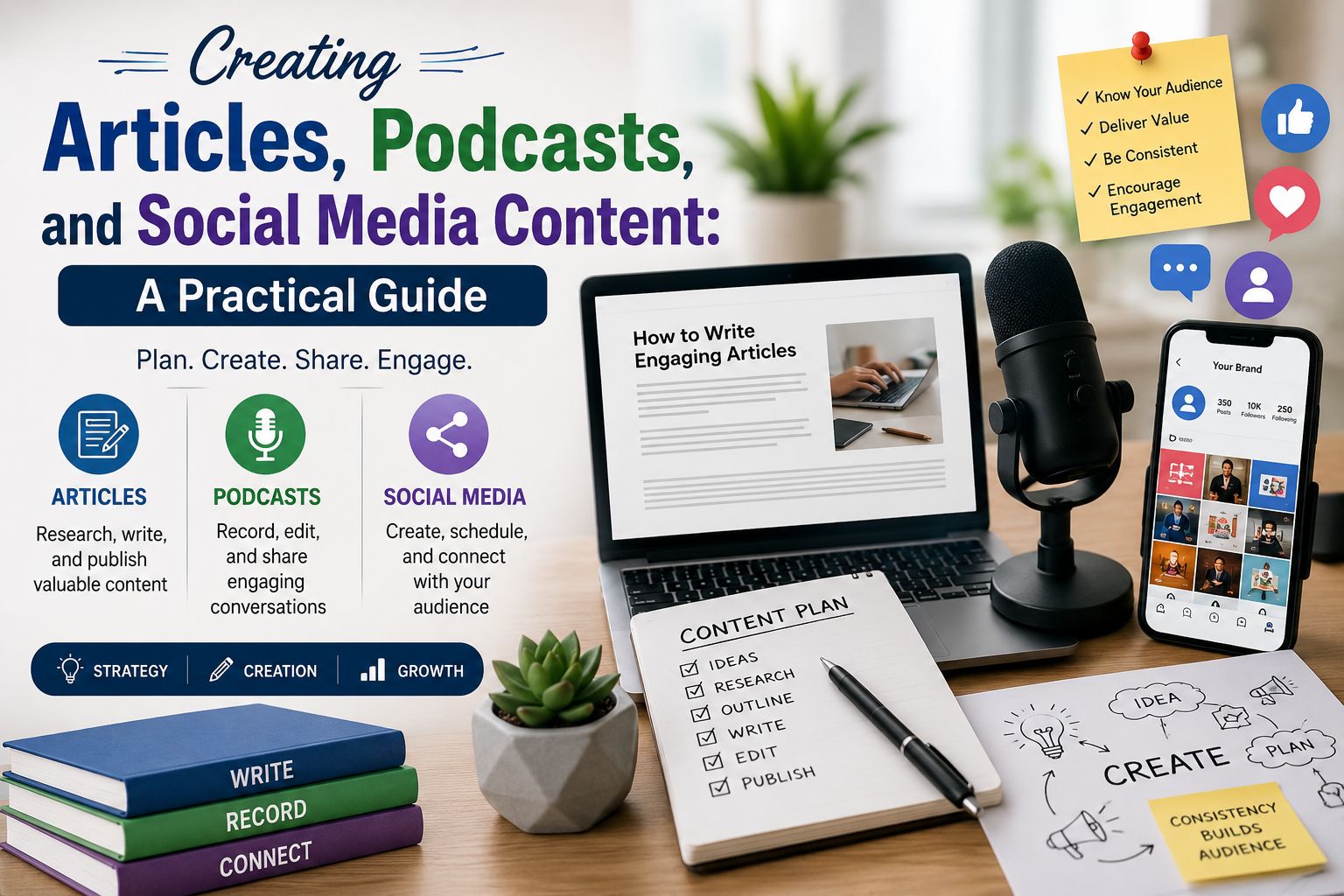
Creating Articles, Podcasts and Social Media Content: A Practical Guide, In today’s digital landscape, content creation has become one of the most valuable skills a person or business can develop. Whether you’re building a personal brand, growing a business, or simply sharing ideas with the world, understanding how to craft compelling articles, engaging podcasts, and effective social media content is essential. Each medium has its own strengths, challenges, and best practices, yet they all share a common goal: connecting with an audience in a meaningful way. This guide explores the fundamentals of creating content across these three formats and offers practical strategies for success.
The Foundation: Understanding Your Audience and Purpose
Before diving into any specific format, successful content creation begins with two critical questions: who are you creating content for, and what do you want them to feel, know, or do after engaging with it? Without clarity on these points, even technically well-produced content tends to fall flat.
Audience research involves understanding demographics, interests, pain points, and the platforms your target readers or listeners already use. A tech-savvy audience of software developers will respond to different language, tone, and depth than a general consumer audience interested in lifestyle tips. Similarly, your purpose—whether it’s to educate, entertain, persuade, or build community—should shape every decision you make, from the words you choose to the format you select.
Once you’ve established these fundamentals, you can begin tailoring your approach to each specific medium.
Creating Compelling Articles
Articles remain one of the most versatile and enduring forms of content. They allow for depth, nuance, and searchability that other formats often can’t match, making them valuable for SEO, thought leadership, and long-term audience building.
Start with a strong headline. Your headline is often the first—and sometimes only—impression readers get of your work. It should be specific, promise clear value, and spark curiosity without resorting to clickbait. Headlines that include numbers, ask questions, or hint at a solution to a problem tend to perform well because they set clear expectations.
Structure for readability. Online readers rarely consume articles the way they read books—linearly and in full. Instead, they scan. Effective articles use short paragraphs, descriptive subheadings, bullet points, and bold text to help readers quickly find the information most relevant to them. Aim for paragraphs of two to four sentences, and break up long sections with subheadings every 200-300 words.
Lead with value. The introduction should immediately communicate what the reader will gain by continuing. Avoid long-winded preambles; instead, get to the point quickly, whether that means stating a surprising fact, posing a provocative question, or briefly outlining what’s to come.
Support claims with evidence. Credibility matters. Whenever possible, back up your points with data, expert quotes, or real-world examples. This not only strengthens your argument but also builds trust with your audience over time.
Edit ruthlessly. The difference between good and great writing often lies in revision. After drafting, review your article for clarity, remove redundant phrases, and ensure every sentence earns its place. Reading your work aloud can help you catch awkward phrasing and identify where the pacing drags.
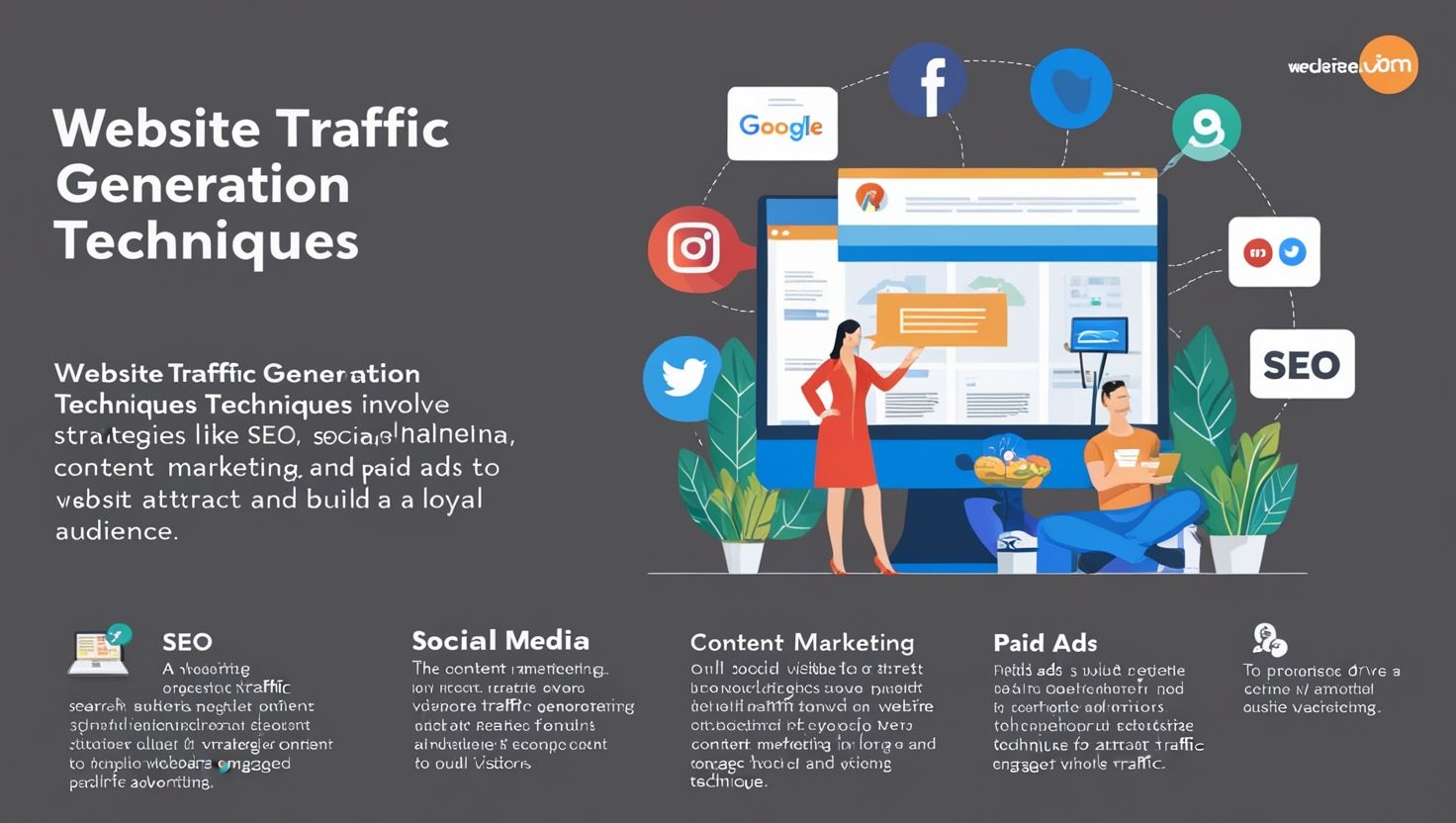
Optimize for search. If discoverability matters to you, incorporate relevant keywords naturally throughout your article, particularly in the headline, subheadings, and first paragraph. However, prioritize natural, reader-friendly language over keyword stuffing, as search engines increasingly reward genuine quality over mechanical optimization.
Producing Engaging Podcasts
Podcasts offer a uniquely intimate way to connect with an audience. Unlike written content, audio allows listeners to experience tone, personality, and emotion directly, often while multitasking—during commutes, workouts, or household chores. This intimacy creates strong listener loyalty but also demands careful planning and production.
Define your format early. Will your podcast be a solo show, an interview series, a co-hosted conversation, or a narrative documentary-style production? Each format has different production demands and audience expectations. Interview shows require strong research and interviewing skills, while narrative podcasts demand meticulous scripting and editing.
Invest in audio quality. Poor sound quality is one of the fastest ways to lose listeners, regardless of how compelling your content is. A decent microphone, a quiet recording space, and basic sound editing can dramatically improve the listening experience. You don’t need a professional studio, but background noise, echo, and inconsistent volume levels should be addressed before publishing.
Plan, but don’t over-script. Even conversational podcasts benefit from an outline that maps out key talking points, transitions, and questions. This keeps episodes focused while still allowing for natural, spontaneous dialogue. Overly scripted podcasts can sound stiff and lose the authentic connection that makes audio content compelling.
Hook listeners early. Just as with articles, the first few minutes of a podcast episode are critical. Many listeners decide within the first 60-90 seconds whether to continue. Consider opening with a compelling question, a preview of what’s to come, or an intriguing story rather than lengthy introductions or housekeeping details.
Maintain consistency. Regular publishing schedules help build listener habits and algorithmic favor on podcast platforms. Whether you choose weekly, biweekly, or monthly episodes, consistency signals reliability and helps retain your audience over time.
Repurpose thoughtfully. Podcast content doesn’t have to live in isolation. Transcripts can become blog articles, standout quotes can become social media posts, and short audio clips can be shared as teasers. This maximizes the value of each recording session.
Crafting Effective Social Media Content
Social media content operates under different rules than long-form articles or podcasts. Attention spans are shorter, algorithms favor engagement, and content often needs to work within tight formats—character limits, video length restrictions, or image dimensions.
Know each platform’s culture. Content that performs well on LinkedIn often fails on TikTok, and vice versa. LinkedIn audiences generally respond to professional insights, industry commentary, and career-related content. Instagram favors strong visuals and concise captions. TikTok and YouTube Shorts reward creativity, authenticity, and content that hooks viewers within the first few seconds. Understanding these platform-specific nuances is essential rather than optional.
Prioritize the hook. Whether it’s the opening line of a caption, the first frame of a video, or the headline of a post, you have mere seconds to capture attention before someone scrolls past. Strong hooks often involve a bold statement, an unexpected fact, or a direct question that speaks to a common pain point.
Embrace visual storytelling. Social media is inherently visual, even when text-based. High-quality images, well-designed graphics, and thoughtfully edited videos consistently outperform generic or low-effort visuals. Investing time in visual presentation, even for simple posts, pays dividends in engagement.
Write for skimmers, but reward readers. Similar to articles, social captions should front-load key information while offering additional depth for those who want to read further. Emojis, line breaks, and short sentences can improve readability, particularly on platforms like Instagram and LinkedIn.
Encourage interaction. Social media algorithms generally favor content that generates comments, shares, and saves over passive likes. Asking genuine questions, inviting opinions, or creating content that people want to share with friends can significantly boost organic reach.
Batch and schedule strategically. Consistency matters here too, but so does timing. Understanding when your specific audience is most active—and using scheduling tools to plan content in advance—can free up time for engagement and strategy rather than last-minute content creation.
Connecting the Three: An Integrated Content Strategy
While articles, podcasts, and social media content each have distinct best practices, the most effective content creators treat them as interconnected parts of a broader strategy rather than isolated efforts. A well-researched article can become the foundation for a podcast episode discussion. That episode, in turn, can be broken into dozens of social media clips, quotes, and discussion points. This approach, often called content repurposing, allows creators to maximize the return on their research and creative effort while meeting audiences where they already spend their time.
Equally important is maintaining a consistent voice and set of core values across all formats. While tone might shift slightly—more casual on social media, more structured in articles, more conversational in podcasts—your underlying perspective, expertise, and personality should feel recognizable no matter where your audience encounters you.
Conclusion
Creating effective articles, podcasts, and social media content requires distinct skills tailored to each medium, yet all three share fundamental principles: understanding your audience, delivering genuine value, and maintaining consistency over time. Rather than viewing these formats as separate disciplines, the most successful content creators integrate them into a cohesive strategy that extends their reach and reinforces their message across multiple touchpoints. By mastering the specific techniques each format demands while maintaining a unified voice and purpose, you can build a content presence that resonates deeply with your audience and stands the test of time.